
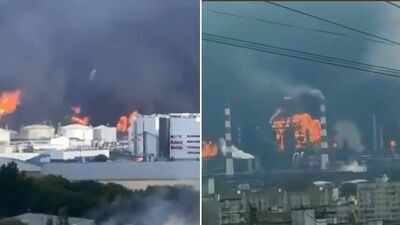
Ukraine’s largest drone assault on Moscow since the start of Russia’s full-scale invasion has brought the war closer than ever to the Russian capital’s residents. Thick black smoke billowed across the skyline, flights were disrupted at major airports, and reports emerged of black oily specks falling from the sky after a strike on one of Moscow’s most important oil refineries.The attack targeted the Kapotnya oil refinery in south-east Moscow for the second time in days, triggering a massive fire that sent towering plumes of smoke over the city. Videos shared online showed explosions at the facility, damaged residential buildings and drones flying over Moscow in broad daylight. Residents described waking up to shaking buildings, the smell of burning fuel and what some called “black rain” settling on cars and clothing.Kyiv framed the operation as retaliation for recent Russian strikes on Ukraine. President Volodymyr Zelensky warned that if Ukraine continued to suffer attacks, Russia would increasingly feel the consequences on its own territory. The raid also exposed the growing reach of Ukraine’s domestically produced long-range drones, several of which appear to have penetrated layers of Russian air defences around the capital.
The three drones behind the attack
Footage and military analysts cited by Ukrainian media suggested that Kyiv deployed a mix of long-range strike drones designed for different roles: the FP-1, the An-196 Liutyi and the jet-powered Bars UAV.The FP-1 has emerged as one of Ukraine’s principal deep-strike weapons. With an estimated range of between 700 and 1,500 kilometres and a payload capable of carrying significant explosive charges, it is designed to hit fuel depots, refineries and military facilities far behind Russian lines.Alongside it was the An-196 Liutyi, a fixed-wing kamikaze drone that has become a key part of Ukraine’s long-range arsenal. With a reported range exceeding 1,000 kilometres, the Liutyi has previously been linked to attacks on Russian airbases, logistics hubs and energy infrastructure.The most notable weapon may have been the Bars. Unlike conventional propeller-driven drones, the Bars uses a turbojet engine and can reportedly travel at speeds of up to 700 km/h. Its speed makes interception significantly more difficult and allows it to penetrate heavily defended airspace. Analysts believe footage from Moscow showed Bars drones being used against strategic targets around the city.
Why the refinery mattered
The Kapotnya refinery is among the most strategically important energy facilities in Russia. It supplies a substantial share of fuel consumed in Moscow and the surrounding region, producing large quantities of petrol and diesel.Striking the facility fits a broader Ukrainian strategy aimed at damaging Russia’s energy sector, which remains a crucial source of revenue for the Kremlin’s war effort. Ukrainian forces have repeatedly targeted refineries, fuel depots and oil terminals across Russia in recent months, seeking both economic and psychological effects.The latest strike appeared particularly dramatic because of the scale of the fire. Videos showed huge columns of black smoke rising above refinery towers, while nearby residents reported seeing soot-covered vehicles and oily residue falling from the sky.
A warning for Moscow
Russian authorities said hundreds of Ukrainian drones were intercepted overnight, though several appear to have reached their targets. The attack temporarily shut down operations at multiple Moscow airports and caused widespread disruption across the region.For many residents, the strike was notable not only for the damage it caused but for how visible it was. Moscow rarely experiences the kind of air raid conditions familiar to Ukrainians after years of war. Many residents reported receiving no warnings before drones appeared overhead.The assault underlined how rapidly Ukraine’s long-range strike capabilities have evolved. What began as occasional drone incursions into Russian territory has developed into increasingly sophisticated attacks involving multiple drone types, decoys and coordinated strikes on strategic infrastructure.