
The US-Iran war has not just hit portfolios of Indian investors, it has also led to record outflows, and fewer inflows in equities. One big sign of the impact of the ongoing uncertainty has been a jarring figure from May 2026 when the net equity inflows fell to a twelve month low of Rs 22,908 crore. This is a fall of 40% from the level of Rs 38,440 crore in April, also making it the steepest month-on-month decline since May 2023.Experts have linked the decline in inflows to heightened geopolitical tensions and increased market volatility.According to Association of Mutual Funds in India (AMFI) data, lumpsum investments were particularly affected as rising crude prices, weakness in the rupee and periodic market corrections clouded short-term visibility. Unlike Systematic Investment Plans (SIPs), one-time investments tend to be more sentiment-driven, with investors often preferring to wait for better entry points during volatile periods. Among equity-oriented categories, flexi-cap funds attracted the highest inflows at Rs 5,176 crore, although this was nearly 49% lower last month. Small-cap funds got Rs 4,946 crore, while mid-cap funds saw Rs 4,385 crore inflows, both seeing declines of 33% and 28%, respectively, compared with April.Gold exchange-traded funds (ETFs), meanwhile, recorded net outflows of Rs 725 crore in May, marking their first monthly outflow in 13 months. Debt mutual funds saw a sharp reversal, registering net outflows of Rs 96,949 crore during the month compared with inflows of Rs 2.47 lakh crore in April.
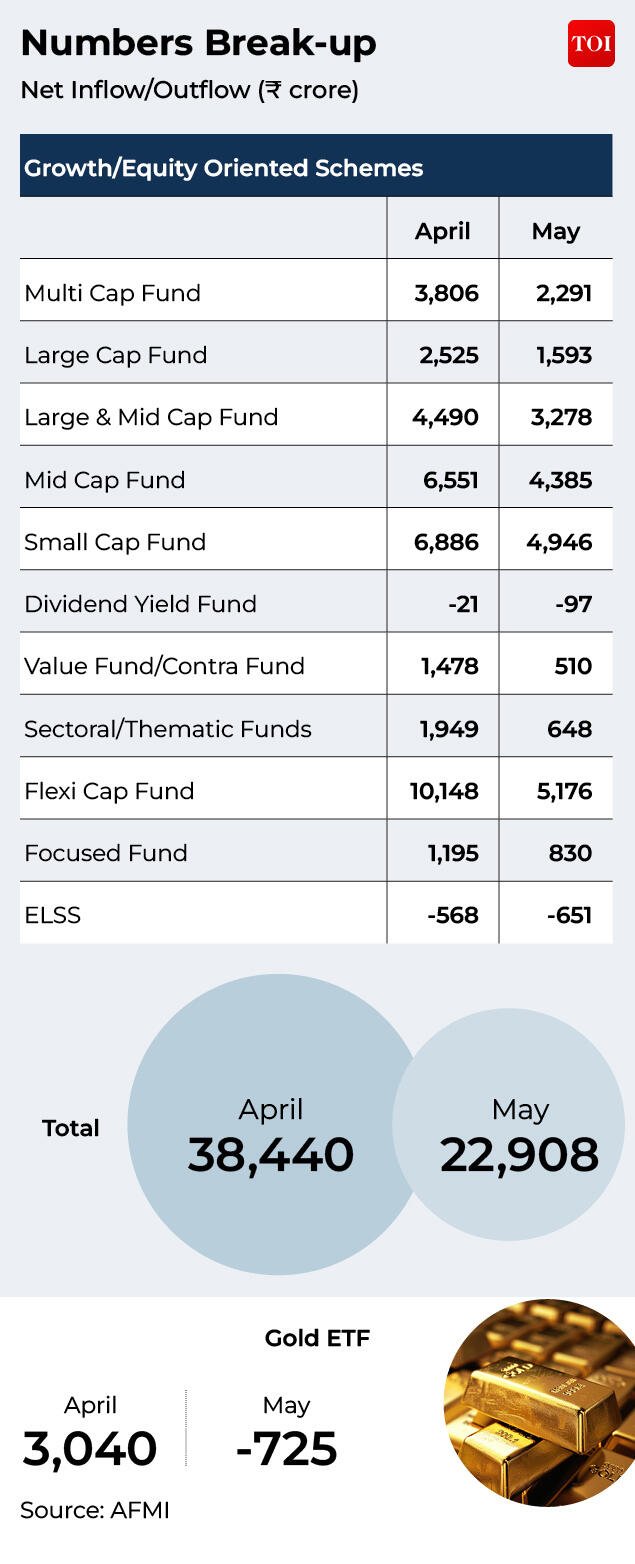
Category wise inflow and outflow details
“The real risk this month isn’t equity at all. Equity inflows didn’t crash; they normalised after a freak-high April and have now stayed positive for 63 straight months. The quieter danger is in debt: since debt funds lost their tax edge, many investors have abandoned the category, some reaching for high-yield bonds in search of lost returns. Debt is the stabiliser. Walking away from it, or buying risky credit dressed up as safe income, raises risk while feeling like caution,” says Dhirendra Kumar, CEO of Value Research.What stands out though is that SIPs, which remain the backbone of the mutual fund industry, continued to show resilience. Monthly SIP contributions were Rs 30,954 crore, just marginally lower than the Rs 31,115 crore in April.However, the moderation in flows also marks the second consecutive month of declining SIP contributions. The industry had seen record-high SIP inflows of Rs 32,087 crore in March. So what is the biggest lesson that SIP investors need to take from the ongoing uncertainty?
What should SIP investors do when geopolitical events trigger market swings?
Experts warn against panic selling, emphasizing the need to maintain investment discipline. In fact, the simplest advice comes from Dhirendra Kumar of Value Research: do nothing. That is the whole answer, and it is harder to follow than it sounds, he says.“An SIP is a standing instruction, and that is its advantage: it keeps buying when prices are low, and the mood is dark, which is exactly when nerves fail. Pause it in a worrying month, and you skip the cheap units, resuming only after prices recover. A headline about US-Iran talks is news about the market’s mood, not an instruction about your plan,” Dhirendra Kumar tells TOI.May proved the point: 9.64 crore accounts kept paying in through a falling rupee and a volatile market, holding SIP contributions above Rs 30,000 crore for the third month running. In hindsight, the right response to almost every recent crisis was to do nothing, Dhirendra Kumar says.Experts urge investors to treat the ongoing correction in stock markets as ‘normal’ behaviour.
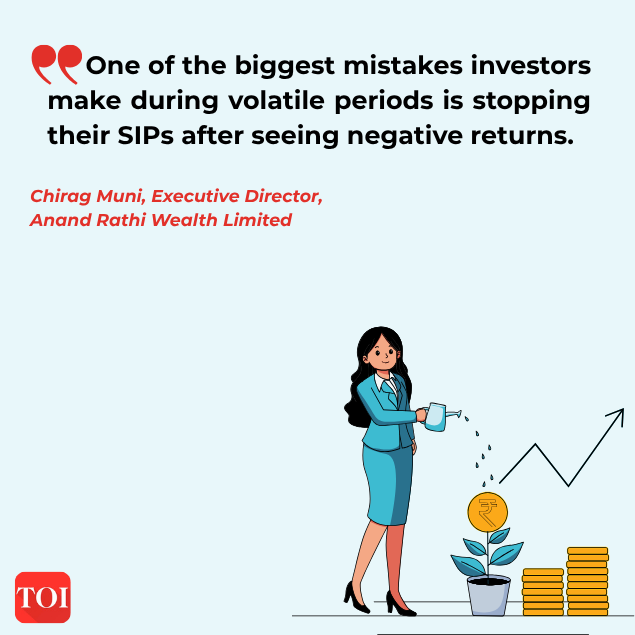
Mistakes investors make
“Our study shows that if an investor had invested through an SIP in the Nifty 50 Index for 1 year and experienced negative returns, those returns would have turned positive in the range of 17% to 21% if the investment had been continued and held for another 5 years. The key is to avoid panic, stay invested through market cycles and maintain an appropriate allocation across large, mid and small caps within the overall portfolio,” says Chirag Muni, Executive Director, Anand Rathi Wealth Limited.
Are current market conditions creating an opportunity?
Finding opportunity in adversity should be the mindset, say market experts.According to Prateek Nigudkar, Senior Fund Manager at Shriram AMC, valuations in the large-cap segment appear relatively more comfortable compared with certain other market segments. “At the same time, while parts of the mid- and small-cap universe continue to trade at elevated valuation levels, selective opportunities may exist for investors with an appropriate risk appetite and investment horizon,” he tells TOI.

What investors should know
With the Nifty 50 down around 8% from its peak, current market conditions appear to be more of an opportunity than a risk for long term investors, feels Chirag Muni of Anand Rathi Wealth Limited.The approach should be clear: Rather than trying to time the market, investors should focus on building long term wealth through diversified equity mutual funds that invest across sectors and market caps.“An ideal allocation of around 50 to 55% in large caps, 20 to 25% in mid caps and rest in small caps can help create a well diversified equity portfolio,” Chirag Muni tells TOI.
Will equity inflows recover soon?
Some experts note that foreign outflows were a trend even before the war. Additionally, the traction for global AI stocks may make foreign investors reluctant to invest aggressively in Indian stocks.“India was witnessing FII outflows even before the war. The conflict accelerated these outflows, as higher energy prices threatened to erode India’s relatively strong macroeconomic fundamentals. A peace deal could lead to India seeing some of these flows return, particularly if government and RBI measures, such as FCNR deposits and tax exemptions for investors in sovereign bonds, help stem the rupee’s decline,” says Prateek Nigudkar.
Challenges remain
“Additionally, cooling energy prices could ease some of the overhang on equities. That said, the challenges of limited AI-related investment opportunities and relatively elevated valuations are likely to persist and may continue to constrain the scale of any large inflows,” he says.For Dhirendra Kumar, to a large extent, the inflows never really left. “The SIP, which reflects ordinary investors, barely moved, down just half a per cent. What fell was lumpy lump-sum money, which always swings with the mood. I’d be cautious about tying the market too closely to one event. Investors who wait for the “all clear” of a signed deal may simply buy at higher prices, once the cheaper units are gone. I don’t think it’s wise to forecast monthly flows off geopolitical news, or to build a plan around it. The encouraging part is that the SIP held steady through the uncertainty. That’s the number that matters, and it didn’t need a peace deal to stay firm,” he tells TOI.Chirag Muni also points to the resilience of SIP contributions. “While net equity inflows in May moderated by around 40% to Rs 22,908 crore, SIP contributions continued to remain close to the Rs 31,000 crore mark, a trend that has been sustained over the last 6 months,” he says.According to Muni, this indicates that retail investors continue to stay committed to their long term investment plans and hence the recent moderation in inflows appears more temporary in nature. “Indian investors have also become far more mature in their approach to equities and a part of the buying during market lows has already happened. This is visible from the strong net equity inflows of Rs 40,450 crore and Rs 38,440 crore recorded in March and April 2026 respectively, which were well above the one year average monthly equity net inflow of around Rs 30,000 crore. Going forward, equity net inflows are likely to gradually recover towards Rs 30,000 crore level as market sentiment continues to improve,” he says.What needs to be understood is that the core strength of SIPs lies in rupee-cost averaging. When markets decline, the same monthly investment buys more units, lowering the average purchase cost. As markets eventually recover, these additional units can enhance long-term returns. From an investor standpoint the message from experts is clear: SIP investors should remain invested and continue their contributions without interruption, allowing them to benefit from the power of compounding and stay on track toward achieving their long-term financial goals.(Disclaimer: Recommendations and views on the stock market, other asset classes or personal finance management tips given by experts are their own. These opinions do not represent the views of The Times of India.)