
RAIPUR: A blue plastic drum stuffed with ganja inside a Bastar village house. A Swift car allegedly piloting a pickup carrying nearly half a tonne of cannabis through Dhamtari’s forest corridor. A woman supplier from Odisha arrested in a 52-kg ganja case. And now, the alleged mastermind of a Rs 4.5-crore interstate trafficking racket arrested in Uttar Pradesh after a 912-kg seizure in Mahasamund.Together, the cases reveal how narcotics traffickers are constantly reinventing their methods as Chhattisgarh emerges as a critical transit corridor linking Odisha’s cannabis belt with markets across northern and western India.Over the past few months, police across the state have reported a series of major seizures, exposing an increasingly sophisticated interstate trafficking network that sources contraband from Odisha and moves it through Chhattisgarh to destinations in Uttar Pradesh, Gujarat, Maharashtra and other parts of the country.Officials said, “State’s geography has made it a crucial transit corridor. Districts such as Mahasamund, Dhamtari, Gariyaband, Bastar and Balrampur lie along routes frequently used by smugglers moving cannabis from Odisha’s cultivation belt to markets across northern and western India. The changing modus operandi of traffickers has become a key concern for investigators.”
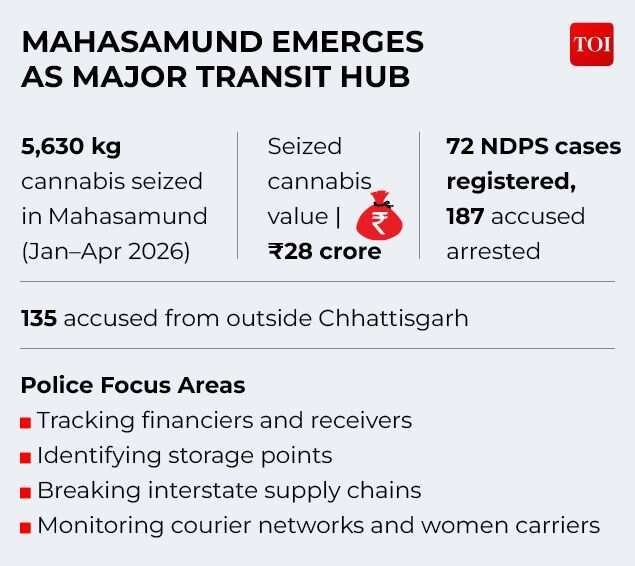
Major transit hub
Going by the latest breakthrough against interstate narcotics syndicates, Raipur range IG Amresh Mishra said, “Mahasamund police have busted a Rs 4.5 crore ganja trafficking network spanning Odisha to Uttar Pradesh and arrested its alleged mastermind from Shamli in Uttar Pradesh, exposing a “white-collar drug mafia” operating under the cover of liquor businesses.”The arrest of Vinay Sharma, a liquor contractor with multiple alleged businesses across states, came in a 912-kg ganja seizure case where contraband was hidden under green bananas inside a truck and moved using fake number plates to evade detection.Police said the consignment originated in Kandhamal district of Odisha and was being routed to Uttar Pradesh, with earlier arrests already made in the supply chain before the final receiver was traced through technical surveillance, WhatsApp and call data analysis.IG said Sharma allegedly operated a wider network involving liquor, bhang and cannabis trade, using legitimate business fronts to finance and facilitate interstate narcotics movement.Police added that the operation marks one of the most extensive “end-to-end” crackdowns in recent months, with 65 of 110 NDPS cases this year in Mahasamund already linked to complete source-to-destination mapping of drug networks.Raigarh police also arrested a key woman supplier from Odisha in a 52-kg ganja case, tightening the net further around the Odisha-linked supply chain.The accused, Subhadra alias Mami Malik (41), a resident of Kandhamal, was arrested after interrogation of three earlier accused revealed her role in supplying ganja near Sambalpur railway station for transportation towards Madhya Pradesh.
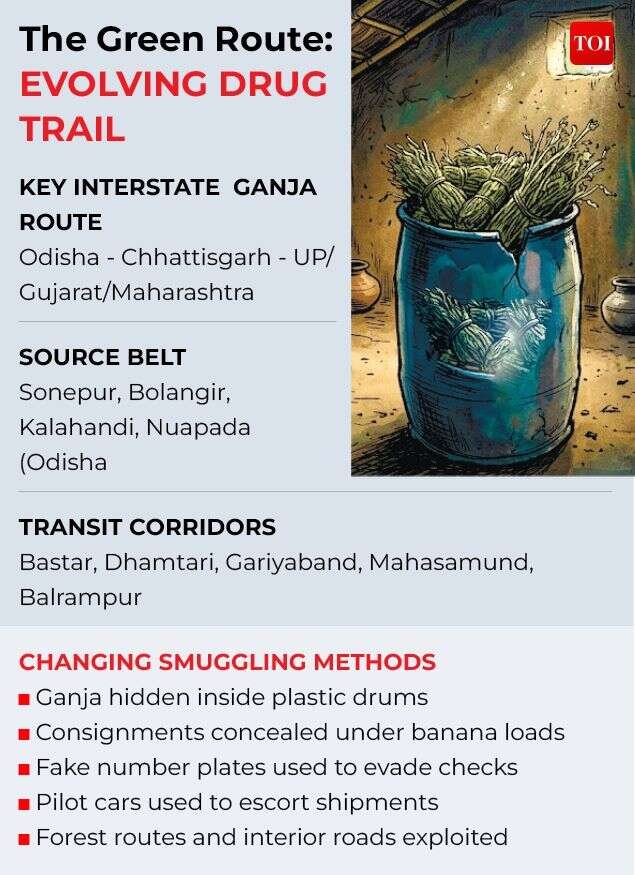
Evolving drug trail
Raigarh SP Shashimohan Singh said both cases underline the evolving nature of narcotics trafficking in the state, where consignments are not only hidden in food cargo like bananas or transported using fake registration plates, but are also managed through decentralised supply chains involving financiers, interstate couriers and local facilitators.In Bastar’s Kesharpal village, police recently recovered more than 33 kg of ganja allegedly concealed inside a blue plastic drum kept in a room of a house.Officials said in stead of transporting large quantities in a single shipment, traffickers stockpile narcotics at safe locations and gradually move them through multiple carriers, reducing the risk of detection.The numbers underscore the scale of the challenge.In Dhamtari alone, police have carried out at least seven major seizures in six weeks, including a 490.818-kg haul valued at Rs 2.45 crore, 131 kg worth nearly Rs 65 lakh, 127 kg linked to property worth Rs 72.71 lakh, and a separate 44-kg consignment worth Rs 8.8 lakh allegedly headed from Odisha to Gujarat.Police believe the seizures represent only a fraction of the trade. Officials said the repeated appearance of Gujarat-bound consignments suggests traffickers are using Chhattisgarh as a key link in a larger interstate supply chain.Hard drugs, too, are surfacing alongside cannabis.Recent figures indicate the scale of the challenge. Mahasamund, one of the state’s key transit districts, has witnessed a sharp rise in NDPS cases and cannabis seizures, with a significant number of accused found to be from outside Chhattisgarh.
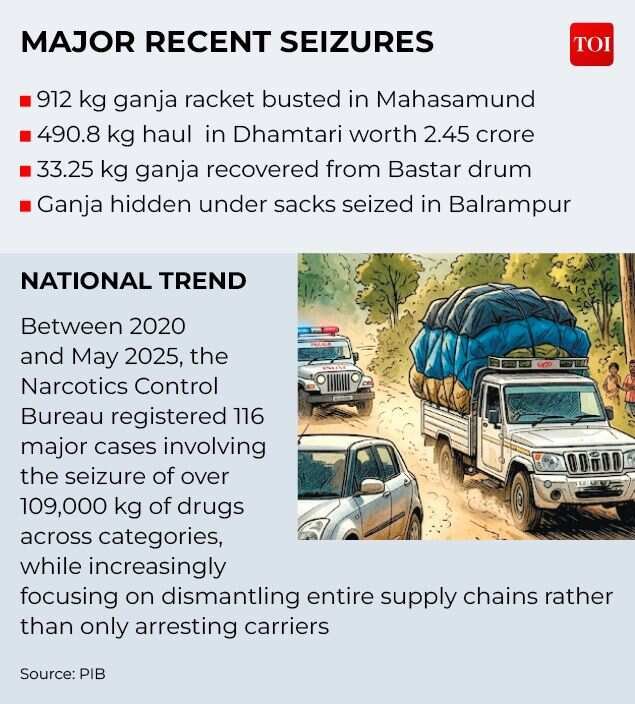
Major recent seizures.
“The seizure of contraband is only one part of the investigation. The larger objective is to dismantle the networks that organise and finance these operations,” a senior police officer told TOI.For enforcement agencies, the recent crackdowns represent significant successes. But for investigators, the bigger concern is the adaptability of the drug trade itself.The involvement of women in recent narcotics cases has also drawn the attention of enforcement agencies. Investigators say women couriers are often used because they attract less suspicion during travel and routine checking, particularly on public transport routes.The routes, however, remain strikingly similar: from Odisha’s cannabis belt through Chhattisgarh and onward to some of India’s largest consumption markets.