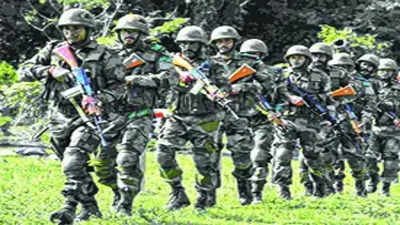
The INSAS (Indian Small Arms System) was the first domestically developed small‑arms family, consisting of a rifle and a light machine gun (LMG).Developed in the 1980s to fire the 5.56×45mm Nato round, the weapons were designed by the Armament Research and Development Establishment (ARDE) and produced by the Ordnance Factories Board.The rifle entered service in 1990 and was the Indian Armed Forces’ standard weapon for nearly three decades. INSAS was intended to replace older 7. 62mm L1A1 self‑loading rifles and a light machine gun in that caliber. Three variants were planned — rifle, carbine, and LMG — but only the rifle and LMG went into mass production.INSAS was first displayed at the 1998 Republic Day parade and saw combat in the 1999 Kargil War. It was also used in counter‑insurgency operations in Jammu and Kashmir and extensively by paramilitary forces against Maoist insurgents.Despite wide adoption, the rifle attracted persistent operational complaints.The Army’s dissatisfaction stemmed from reliability problems, performance limits, and operational shortcomings revealed over years of use.Soldiers reported frequent jamming, particularly in high‑altitude and extreme weather conditions. The polymer magazines were prone to cracking in cold climates, and the three‑round burst mode was inconsistent, sometimes firing more or fewer rounds than intended.
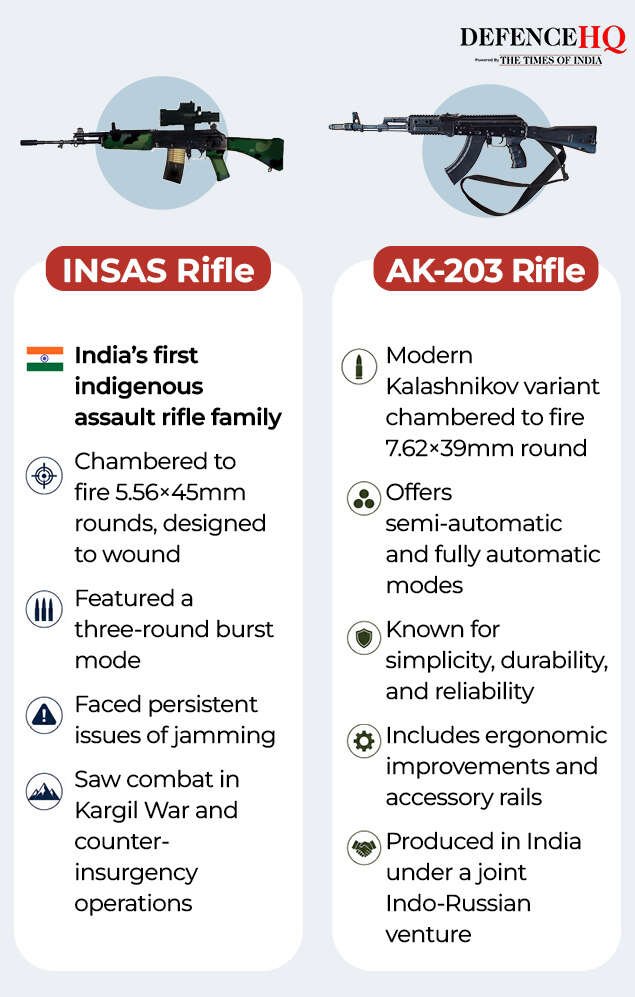
Another major concern was its calibre.Chambered in 5.56×45mm, the INSAS was criticized for causing wounds rather than immediate incapacitation, which can increase attrition as comrades attend the injured — a particular liability in anti‑terror operations where a wounded adversary may remain combative.In close combat and counter‑insurgency scenarios, Indian troops often found themselves at a disadvantage against foes armed with AK‑47s firing heavier 7. 62mm rounds. Soldiers in Kashmir and other conflict zones consistently complained that the INSAS lacked stopping power.“INSAS failed to inspire confidence in the soldiers due to repetitive faults. Hopefully AK‑203 will help achieve the soldiers’ motto — Ek Goli Ek Dushman,” said Lt Gen Sanjay Kulkarni (retired), former DG Infantry.These shortcomings pushed the Army to seek a more reliable, more lethal alternative, leading to the adoption of the AK‑203. Built on the Kalashnikov platform, the AK‑203 is valued for simplicity, durability, and ease of maintenance. It performs reliably across diverse environments, from deserts to high‑altitude battlefields, and is chambered in 7.62×39mm rounds for greater stopping power.Compared with older AK variants, the AK‑203 includes modern features such as ergonomic improvements, adjustable stocks, and accessory rails for optics, and offers both semi‑automatic and fully automatic modes.“The INSAS rifle served the Army for decades, but it is now outdated. Its three‑round burst and limited automatic capability no longer meet operational requirements. Troops need a weapon that is reliable, lethal, and chambered in 7. 62mm,” an Army official said.“The AK‑203, produced under a joint Indo‑Russian venture, offers that combination of firepower, durability, and modern features. Its improved ergonomics and Picatinny rails allow mounting of sights and attachments, giving soldiers flexibility across missions. It is a decisive step forward in equipping our soldiers for contemporary battlefield demands.”Equally important, the AK‑203 is being manufactured in India by Indo‑Russian Rifles Private Limited in Amethi, supporting the Make in India initiative and ensuring large‑scale supply. The shift to the AK‑203 reflects a broader doctrinal emphasis on lethality, reliability, and adaptability across varied combat environments.