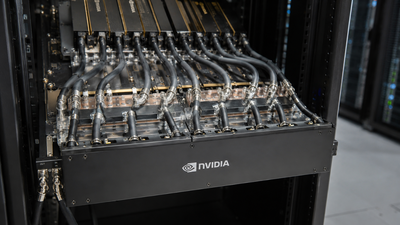
Artificial intelligence is transforming everything from scientific research to everyday computing, but its rapid growth comes with an increasingly visible environmental cost. Behind every AI model lies a vast network of data centres that consume enormous amounts of electricity and water to keep powerful processors operating safely. As demand for AI infrastructure accelerates, technology companies are searching for ways to reduce that impact. Nvidia has unveiled a new liquid cooling architecture designed to make next-generation AI factories significantly more efficient by reducing both energy consumption and water use. While the technology represents an important engineering advance, researchers caution that improving cooling systems alone will not eliminate AI’s wider water footprint, which begins long before a model generates its first response.
How Nvidia plans to reduce water use in AI data centres with liquid cooling
As AI models become larger and more computationally demanding, the graphics processing units (GPUs) powering them generate enormous amounts of heat. Traditional air-cooling systems are increasingly reaching their practical limits, particularly in high-density AI facilities where thousands of processors operate simultaneously.To address this challenge, Nvidia has introduced a liquid cooling architecture for what it describes as the next generation of AI factories. Instead of relying primarily on chilled air circulating through server halls, the system delivers coolant directly to the chips, removing heat far more efficiently.According to a recent press release by Nvidia, direct-to-chip liquid cooling can improve cooling efficiency while reducing dependence on evaporative cooling systems that consume large volumes of freshwater. The company says the approach enables higher computing densities, lowers overall energy demand for cooling and supports the deployment of increasingly powerful AI infrastructure.In its official announcement, Nvidia states:“Liquid cooling enables significantly higher energy efficiency and can dramatically reduce water consumption compared with traditional cooling approaches.”The company also notes that warmer cooling water can often be reused or transferred to external heat recovery systems instead of being discarded after a single cooling cycle.
Why AI’s water footprint extends far beyond cooling systems
Although cooling receives much of the public attention, researchers emphasise that water consumption associated with artificial intelligence extends well beyond the operation of data centres.Studies show that water is used throughout the AI supply chain, including semiconductor manufacturing, electricity generation and the construction of computing infrastructure. Chip fabrication alone requires ultrapure water, with advanced semiconductor facilities consuming millions of litres each day to clean silicon wafers during production.Once AI systems become operational, indirect water use continues through electricity generation. Many power stations still rely on water-intensive cooling processes, meaning the environmental impact of an AI model depends not only on the efficiency of the data centre itself but also on the energy sources supplying it.Researchers from the University of California, Riverside and the University of Texas at Arlington, whose work ‘Making AI Less”Thirsty”: Uncovering and Addressing the Secret Water Footprint of AI Models’ brought global attention to AI’s hidden water footprint argue that water consumption should be considered across the entire lifecycle of artificial intelligence rather than focusing solely on cooling infrastructure.They write that:“The water footprint of AI includes both direct water withdrawal for cooling and indirect water embedded in electricity generation and hardware manufacturing.”This broader perspective highlights why reducing cooling water alone cannot fully address AI’s overall environmental demands.
Can liquid cooling make artificial intelligence more sustainable
Experts generally agree that liquid cooling represents an important step towards improving the efficiency of future AI infrastructure. By transferring heat more effectively than conventional air cooling, the technology can reduce electricity consumption, enable denser computing environments and lower operational water requirements in many facilities.However, the scale of AI’s expansion means overall resource demand is also rising rapidly. As companies build increasingly powerful data centres to support generative AI, cloud computing and scientific research, gains in efficiency may be offset by the growing number of processors deployed worldwide.Experts from the Faculty of Engineering, Ruppin Academic Center say, while technologies, including cold-climate siting, natural water body cooling, waterless designs, and waste heat recovery, can reduce on-site demand, their deployment remains limited.Nvidia itself presents liquid cooling as part of a broader transformation towards more sustainable AI infrastructure rather than a complete environmental solution. Improvements in cooling technology will likely need to be combined with renewable electricity, more efficient chips, water recycling systems and responsible data centre design if AI’s environmental footprint is to be meaningfully reduced.Ultimately, the challenge is not whether liquid cooling works; it does. The larger question is whether efficiency gains can keep pace with AI’s accelerating global expansion. As artificial intelligence becomes embedded in more industries, addressing its water footprint will require innovation across the entire technology ecosystem, from chip manufacturing to energy production and data centre operations.