
This is an AI generated image, used only for representational image
After more than 100 days of keeping global economies and energy markets on edge, crude prices have finally cooled to a sweeter spot. Tensions are easing in the Middle East and the Strait of Hormuz is back in business. Last week about 258 vessels transited the route, up from 138 previously, easing supply concerns worldwide.This transit movement has also pulled Brent from the above $120 per barrel to roughly $70–72, while West Texas Intermediate sits near $68 a barrel.For India, cheaper crude is like an unexpected discount on one of its largest bills. The country imports more than 85% of its crude, so any fall in global oil prices delivers multiple benefits: a smaller import bill that eases inflationary pressure, improved government finances, higher corporate profitability, and a narrower current account deficit.At the same time, fuel‑intensive sectors from airlines to logistics also stand to gain from lower energy costs.A nearly 40% drop in crude prices is good news for India, but the benefits won’t arrive all at once. While some sectors are likely to feel the impact sooner, others, including consumers, may have to wait a little longer.
How much will your commute cost?
Diesel and petrol pricesFor millions of Indian consumers, the first question that pops up after every drop in crude oil prices is whether petrol and diesel will become cheaper and if so, then how soon.While lower international oil prices generally create room for fuel price cuts, this time, the answer is not straightforward.Oil minister Hardeep Singh Puri has said that despite the global dip, fuel prices in the country are expected to remain unchanged for now. The reason is simple: there is a lag between buying crude oil and selling it as petrol and diesel.Unlike stock markets that react instantly, the oil business works on procurement cycles. Indian refiners are currently processing crude that was purchased around two to two-and-a-half months ago, when the conflict in the Middle East had pushed oil prices above $110 per barrel. At the time, insurance and freight costs had also surged because of concerns over disruptions in the Strait of Hormuz, making imports significantly more expensive.As a result, the fuel currently being sold at petrol pumps is made from costlier crude bought during the peak of the crisis and crude purchased at today’s lower prices will take time to reach Indian refineries and eventually retail outlets.State-owned oil marketing companies also have another reason to hold off on cutting prices.According to the minister, Indian Oil Corporation, Bharat Petroleum Corporation and Hindustan Petroleum Corporation together incurred losses of Rs 74,781 crore on the sale of petrol, diesel and subsidised domestic LPG after absorbing much of the rise in global oil prices instead of passing it on fully to consumers.Now, fuel price cuts are on the cards but provided that, “oil prices remains like this (at current rates), it (cutting retail prices),” Puri said.Air travelCheaper crude oil prices are also giving the aviation sector some much-needed breathing room. Since aviation turbine fuel (ATF) accounts for nearly a third of an airline’s operating costs, even a small reduction can make a meaningful difference to profitability.Reflecting the decline in global oil prices, the Centre reduced ATF prices for domestic airlines by around Rs 5 per litre, bringing the price in Delhi to nearly Rs 110 per litre. The cut, the first since the Middle East conflict sent jet fuel prices soaring, offers airlines some relief after weeks of elevated fuel costs.The impact is already beginning to show.Air India has reportedly reduced fuel surcharges on several long-haul international routes from July. According to travel industry sources, the surcharge on flights to North America and Australia has been reduced from $280 to $200, while the surcharge on UK and Europe routes has been cut from $205 to $125. The airline is yet to officially comment on the changes.Budget carrier Air India Express has also restored services across its Middle East network after operations were disrupted during the conflict. Flights to Salalah in Oman and Kuwait have resumed, reflecting the gradual normalisation of air travel as tensions in the region ease.
Kitchen bills
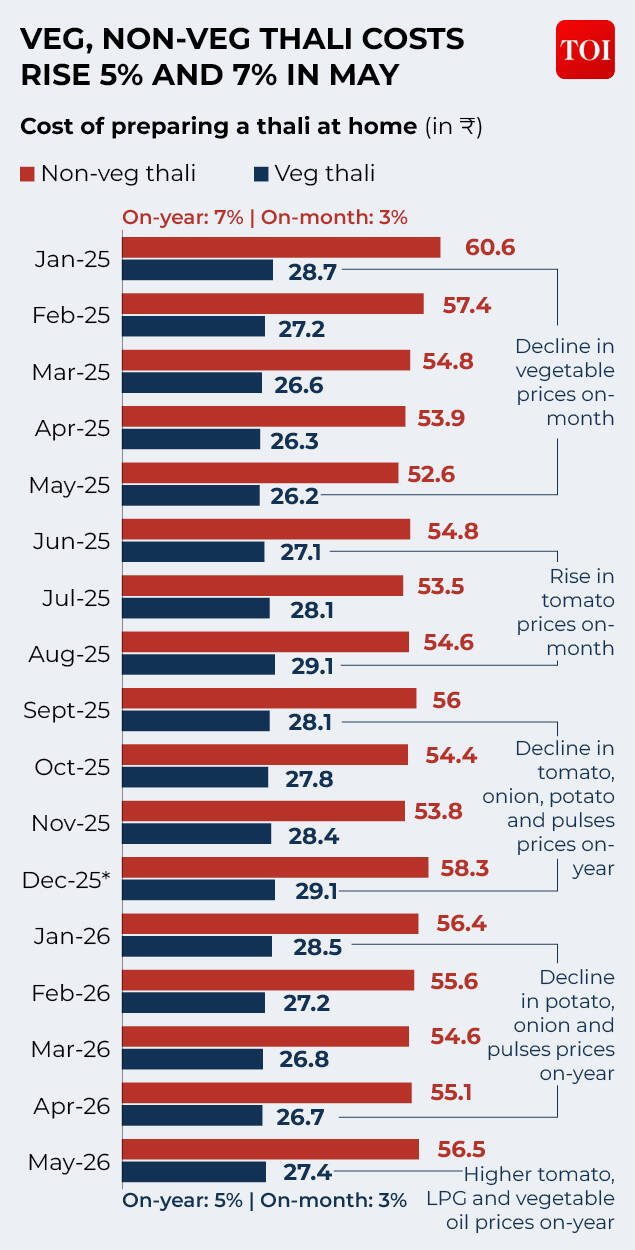
Your food bills could become cheaper, but whether that happens depends on where you eat.The first beneficiaries of cheaper crude are likely to be restaurants, hotels, dhabas, caterers and other businesses that rely heavily on commercial LPG. Effective July 1, oil marketing companies cut the price of a 19-kg commercial LPG cylinder by Rs 183.50, bringing its retail price in Delhi down to Rs 2,930. The price of the 5-kg Free Trade LPG (FTL) cylinder was also reduced by Rs 13 to Rs 808.50.The price cut is expected to ease operating costs for businesses, although whether those savings are passed on to customers will depend on competition and individual pricing decisions. Commercial LPG prices have been particularly volatile this year, rising by Rs 111 in January and another Rs 195.50 in April as global energy prices surged. The latest revision marks the first major rollback as crude prices cool.Households, however, are unlikely to see similar relief anytime soon. In June, the price of a 14.2-kg domestic LPG cylinder was increased by Rs 29, taking the Delhi retail price to Rs 942, after another Rs 60 hike in March during the peak of the Middle East conflict.The benefits could eventually extend beyond restaurants. In your kitchen, edible oil prices may also fall as imports are set to stablise and transportation costs slip towards the pre-war levels. Additionally, lower crude prices reduce the cost of key inputs such as packaging materials, freight, logistics and imported raw materials, easing cost pressures for food and FMCG companies.While consumers should not expect grocery prices to fall overnight, businesses may face less pressure to raise prices, shrink pack sizes or cut costs if lower energy prices are sustained. Since fuel is only one part of the overall cost structure, any savings are likely to be gradual, depending on how other input costs such as raw materials and labour move in the coming months.
Rupee’s haal chaal
Crude oil and the rupee often move in tandem. As oil prices soared during the Gulf crisis, the Indian currency weakened sharply, almost hitting a record low of 97 against the dollar.Since India imports more than 85% of its crude oil needs, higher oil prices mean a bigger import bill and greater demand for US dollars to pay for those imports, putting pressure on the rupee. On the other hand, as crude prices fall, India’s oil import bill shrinks, supporting the currency.That relationship has been visible in recent months. During the peak of the Middle East conflict, the rupee slipped to record lows of around 96.9 against the US dollar as soaring crude prices and supply concerns rattled markets. With tensions easing and oil shipments through the Strait of Hormuz returning to normal, the rupee has recovered to the 95-96 range, helped by a lower oil import bill.A stronger rupee does more than improve sentiment in the currency market. It helps reduce India’s current account deficit, strengthens the country’s external position and lowers the cost of imports. If the recovery continues, overseas spending, from studying abroad and foreign travel to importing goods and raw materials, could also become a little cheaper.However, crude oil is only one of the many factors influencing rupee. Demand for dollars from importers and companies hedging overseas liabilities, foreign investor flows and US Federal Reserve policy continue to play a major role. In fact, despite opening stronger on hopes of cheaper crude, the rupee recently gave up its gains as dollar demand outweighed the positive impact of lower oil prices.
Stock market: Cheaper crude brightens Dalal Street
The sharp spike in crude prices during the Middle East conflict had rattled Dalal Street, but as oil prices eased, so did investors’ nerves. BSE Sensex, which was hovering around 80,239 on March 2, slipped to an intraday low of 71,546 in early April as fears of supply disruptions, rising inflation and higher input costs weighed on sentiment. Since then, it has staged a solid comeback, climbing to 77,502, a recovery of nearly 6,000 points (8.3%) from its crisis low.The Nifty 50 followed a similar path. After falling from 24,866 on March 2 to an intraday low of 22,183 on April 2, it has bounced back to 24,176, gaining almost 2,000 points (9%) from its lowest level during the turmoil.The real turnaround came in mid-June, when the US and Iran struck an interim peace deal, easing worries over disruptions to global oil supplies. As crude prices retreated, so did fears of runaway inflation and rising business costs, giving markets a fresh reason to rally.Since mid-June, the Sensex has gained about 2,700 points (3.6%), while the Nifty has added over 500 points (2.3%).As Dalal Street traded in green, BSE’s total market capitalisation, which had shrunk by nearly Rs 49 lakh crore between February 27 and March 23, has since bounced back strongly. As of July 2, it stood at Rs 479 lakh crore,with investors gaining nearly Rs 16 lakh crore compared with the start of the conflict.The rally has come despite continued selling by foreign investors. Foreign Portfolio Investors (FPIs) have pulled out nearly Rs 2.7 lakh crore from Indian equities so far in 2026, already exceeding the Rs 1.66 lakh crore withdrawn during the whole of 2025. The resilience suggests domestic optimism over easing crude prices and improving macroeconomic conditions has, for now, outweighed persistent foreign outflows.
Economy: India’s biggest gain may not be at the fuel pump
The biggest winner from cheaper crude may not be your fuel bill, it could be the growth story. The Indian basket of crude, a blend of Brent Dated and the Oman-Dubai average, fell back to $70.71 a barrel earlier this week, almost back to its pre-conflict average of $69.01 in February.It had surged to $113.49 in March and $114.48 in April during the peak of the conflict. The decline is expected to reduce India’s import bill, ease pressure on government finances and help oil marketing companies recover from losses that were once estimated at around Rs 700 crore a day.A lower oil bill means fewer dollars flowing out of the country, easing pressure on rupee, narrowing the current account deficit and helping keep imported inflation in check.And the impact doesn’t stop there. Fuel is a key cost for almost every sector, from factories and farms to airlines, trucks and logistics companies. As energy becomes cheaper, businesses find it easier to absorb costs instead of passing them on to consumers, helping contain inflation. That also gives the Reserve Bank of India (RBI) more room to manage interest rates, while making Indian assets more attractive to global investors.The improving outlook has already prompted several global brokerages to upgrade their forecasts for India.Goldman Sachs has raised its 2026 GDP growth forecast to 6.8% while trimming its inflation and current account deficit estimates. It now expects India’s current account deficit to narrow to 1.1% of GDP, supported by softer crude prices and stronger remittance inflows, and sees the country posting a balance of payments surplus this year.The brokerage believes lower oil prices have reduced the need for further fuel price hikes, which should support household spending and consumption.Bank of America Securities is even more optimistic, forecasting India’s economy to grow by around 7% in both 2026 and 2027. It expects Brent crude to average about $72 a barrel during the second half of this year before easing further in 2027 if peace in West Asia holds.EY has also upgraded its outlook, projecting India’s economy to grow between 6.6% and 6.8% this financial year. It expects inflation to remain around 4.5%, while both the fiscal deficit and current account deficit improve as lower energy prices reduce cost pressures across industries.India has also emerged from the recent energy shock stronger than many expected. While the country imports most of its crude oil, it also has one of the world’s largest refining networks, allowing it to process imported crude domestically instead of relying heavily on imported petroleum products. According to EY, this has helped cushion the impact of volatile oil prices while strengthening the country’s energy security.The crisis has also changed the way India buys its oil. Instead of relying heavily on the Gulf, refiners diversified supplies by increasing purchases from Russia, the United States, Oman, West Africa and South America. That strategy is expected to continue even as the Strait of Hormuz returns to normal operations, reducing India’s dependence on any single region.Looking ahead, the government is expected to focus on expanding strategic petroleum reserves, encouraging domestic exploration, strengthening refining capacity and accelerating the shift towards cleaner energy, all aimed at making India less vulnerable to future geopolitical shocks.
Bottom line
The sharp fall in global crude oil prices has undoubtedly improved India’s economic outlook, but its full benefits will take time to filter through.While consumers may not see an immediate reduction in petrol, diesel or domestic LPG prices as oil marketing companies work through costlier inventories and recover past losses, the broader economy is already beginning to gain.A lower oil import bill, easing inflationary pressures, improved fiscal and current account positions, and stronger prospects for corporate earnings are creating a more favourable macroeconomic environment.If crude prices remain around current levels and the fragile peace in the region holds, India could emerge as one of the biggest beneficiaries of cheaper energy.