
There are few careers in football that will divide opinion quite like Neymar’s.He leaves the Brazil national team as its greatest goalscorer ever. He retires having broken a record many believed would never fall, surpassing Pelé’s tally of international goals after more than six decades. His international journey ends with 80 goals, 59 assists and 130 appearances, alongside an Olympic gold medal, a FIFA Confederations Cup title and countless moments of brilliance that inspired an entire generation of footballers.And yet, for many, the conversation surrounding Neymar will begin with a question rather than an answer. How does a player whose numbers rival the greatest in football history still leave behind a lingering sense of unfulfilled promise?
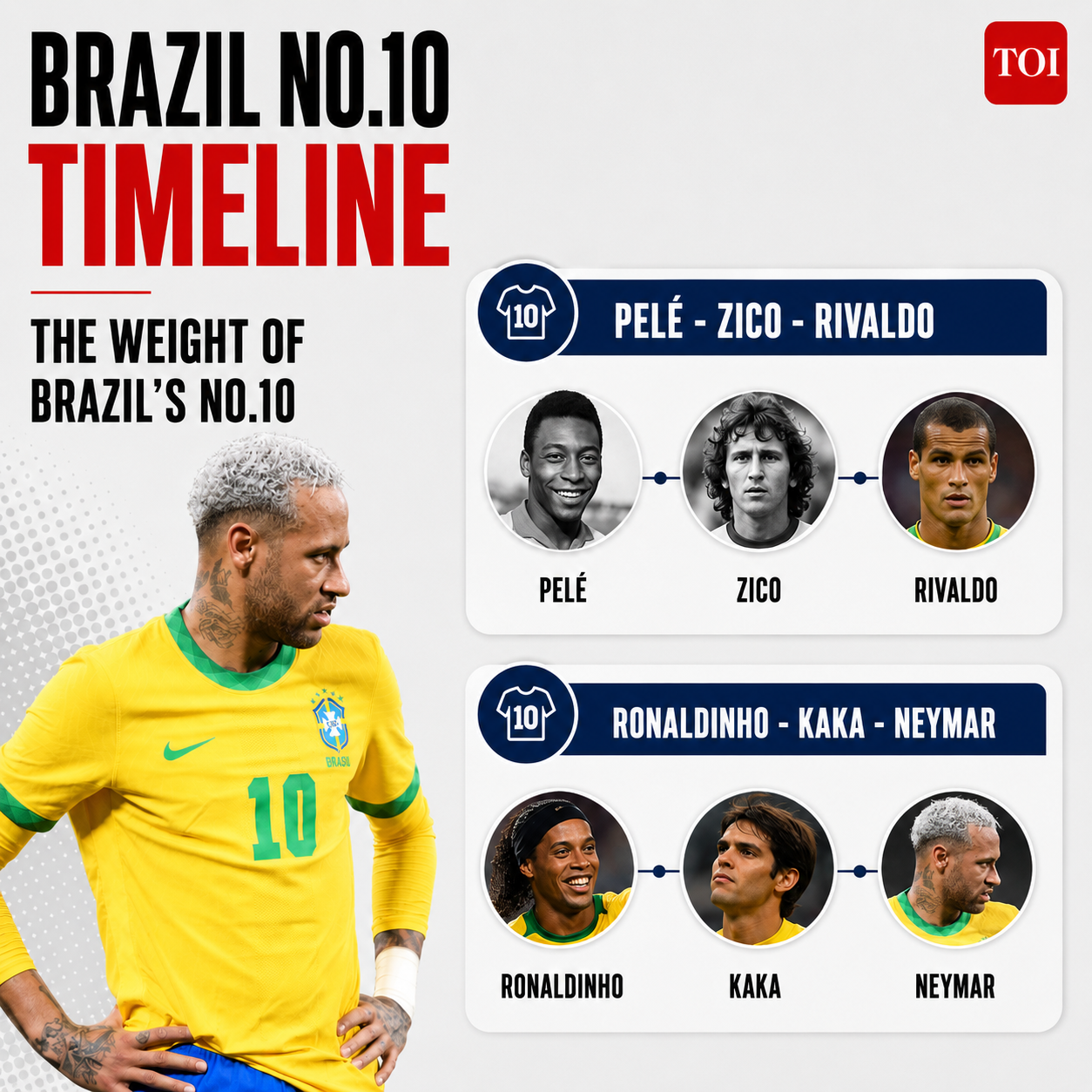
The weight of Brazil’s No.10
The answer lies somewhere between expectation and reality, between extraordinary individual achievement and the impossible standards that come with wearing Brazil’s No. 10 shirt.A career that started and ended in the same placeThere was a fitting symmetry to Neymar’s farewell.In August 2010, a fearless teenager walked onto the pitch at MetLife Stadium for his senior Brazil debut against the United States. He scored on debut and immediately reinforced the belief that Brazil had found its next global superstar. Sixteen years later, the same stadium became the setting for his final act.Brazil’s 2026 World Cup campaign ended with a 2-1 defeat to Norway in the Round of 16. Neymar came off the bench, converted a stoppage-time penalty that ultimately proved only a consolation and collapsed to the turf in tears after the final whistle.His final words captured both the pain of defeat and the acceptance of a remarkable journey brought to its conclusion.“I tried, I tried. Now it’s over.”The greatest scorer Brazil has ever producedHistory will remember one undeniable fact: no player has scored more goals for Brazil than Neymar.
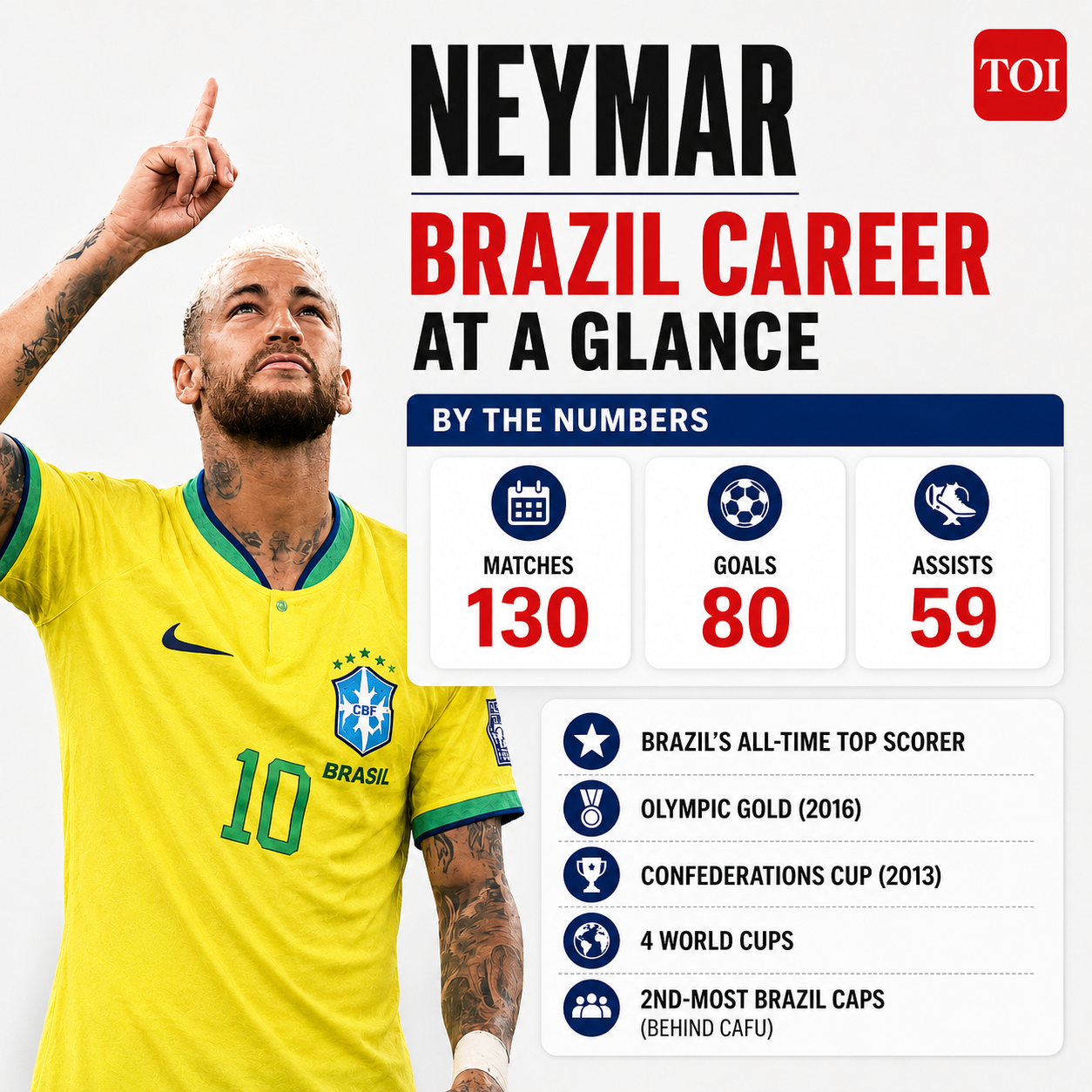
Neymar Brazil career at a glance
He retires with 80 international goals in 130 appearances, overtaking Pelé’s long-standing record in 2023 and finishing second only to Cafu’s 142 caps. His farewell strike against Norway also made him only the second Brazilian man, after Pelé, to score in four different FIFA World Cups.Yet those remarkable numbers have long been accompanied by debate. Critics have often highlighted that 46 of Neymar’s 80 international goals came in friendlies, including three scored in matches technically played for trophies but widely regarded as glorified friendlies. Viewed in isolation, those figures can create the impression that he accumulated goals away from football’s biggest occasions.The complete picture, however, is considerably more nuanced.
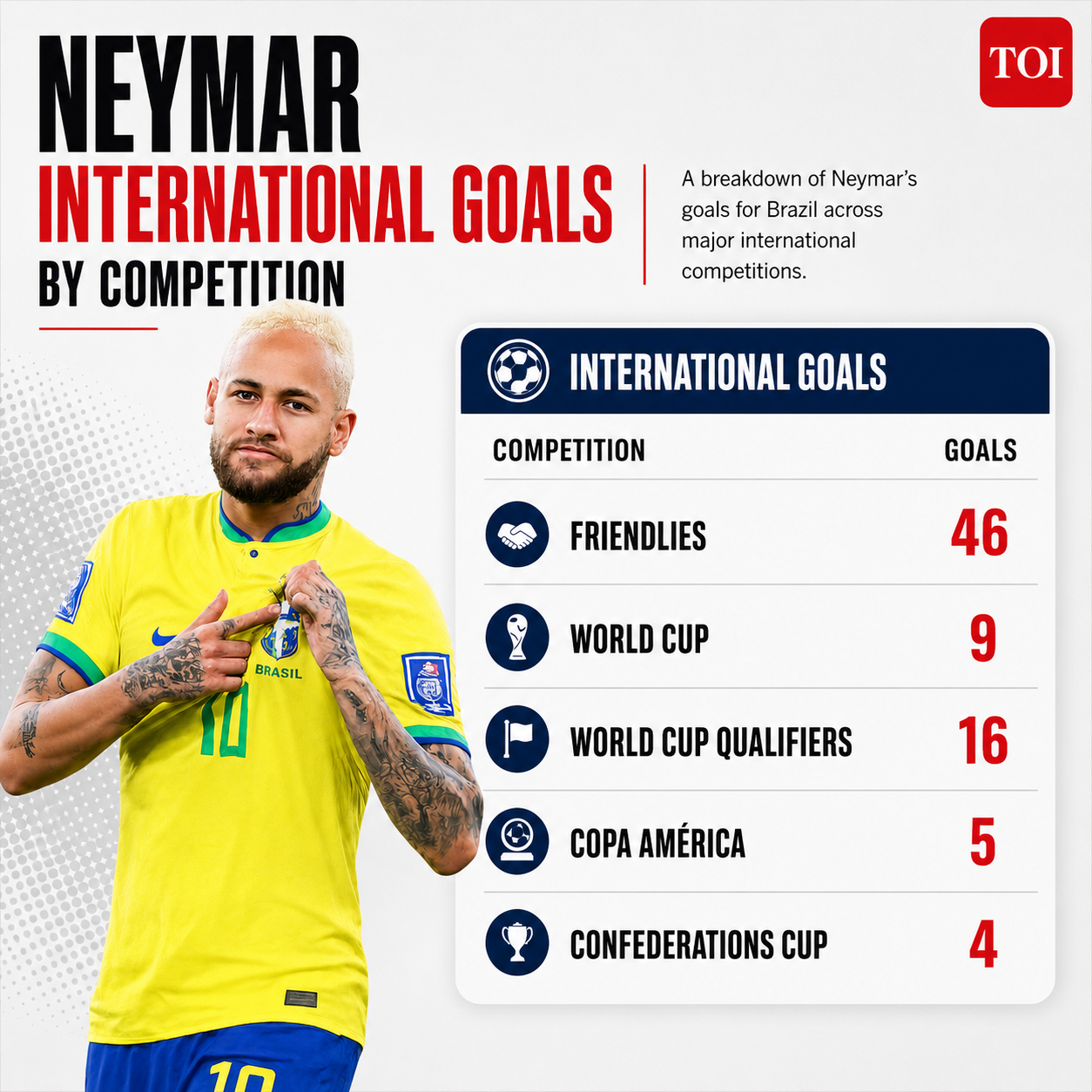
Neymar International goals by competition
Neymar’s record in competitive football comfortably stands up to scrutiny. He scored five goals in 12 Copa América matches, struck four times in five games during Brazil’s victorious 2013 FIFA Confederations Cup campaign, netted 16 goals in 28 World Cup qualifiers and, perhaps most impressively, scored nine goals in 15 FIFA World Cup appearances.Those figures underline a reality that is often overlooked. Neymar consistently delivered in elite competitions. The issue was never his ability to perform on the biggest stages. Instead, circumstances repeatedly denied him the defining moments that shape footballing immortality.That is because Brazil has never measured its greatest players by goals alone. It measures them by World Cups.

Brazil doesn’t judge its No.10 by goals. It judges him by World Cups.
Pelé remains the only player in history to win three World Cups, while Ronaldo Nazário’s 15 goals across four tournaments, including both strikes in the 2002 final, helped deliver Brazil’s fifth title. Neymar’s own World Cup numbers compare favourably with many of the game’s greats. He finished with nine goals and three assists in 15 appearances, averaging a direct goal involvement roughly every 102 minutes while combining creativity with clinical finishing.Yet unlike Pelé or Ronaldo, Neymar’s World Cup story became one of cruel interruptions rather than glorious conclusions.The World Cup that changed everything
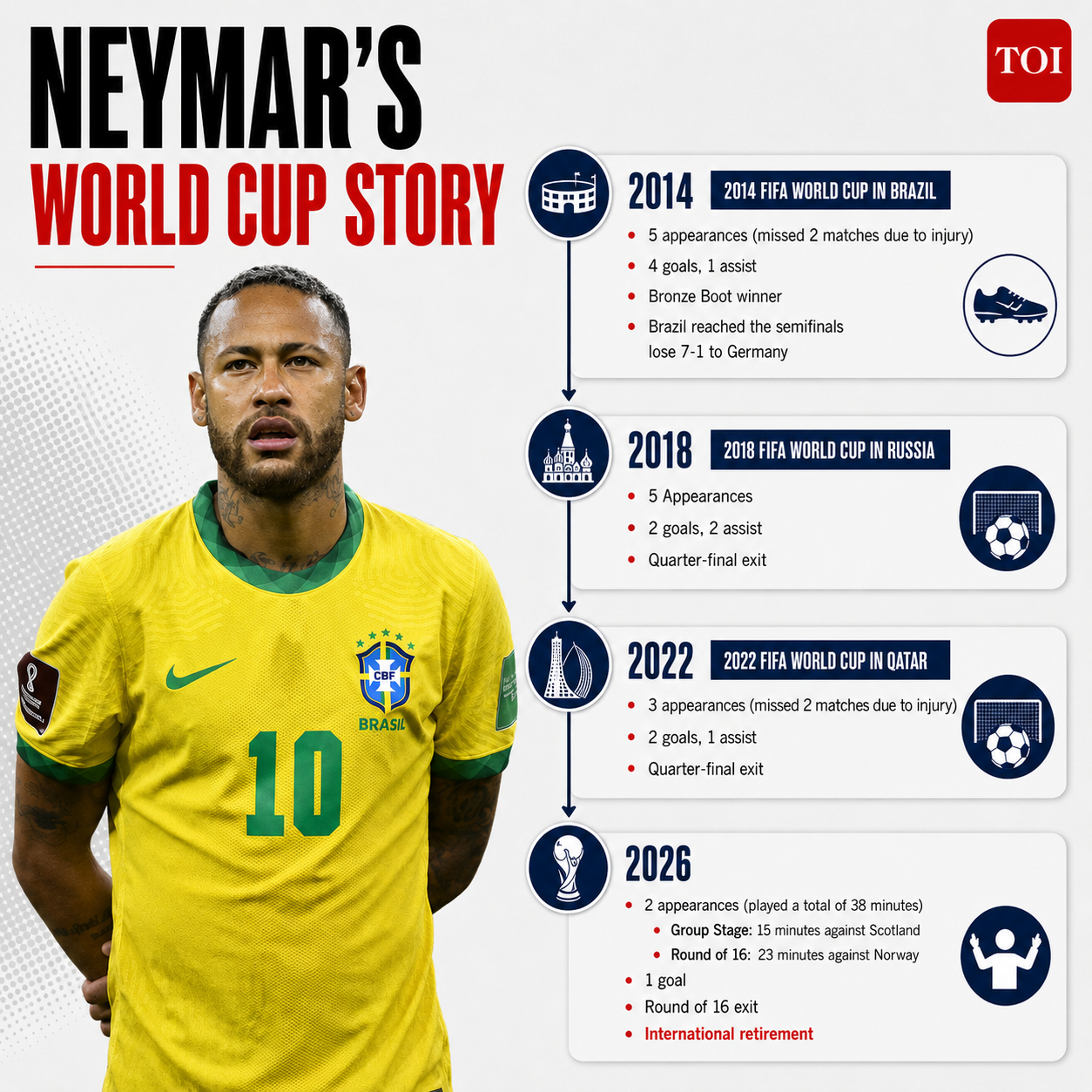
Neymar’s World Cup story
If one image defines Neymar’s international career, it is probably not one of his spectacular goals but the sight of him being carried off on a stretcher in Fortaleza during the 2014 World Cup.Brazil had built that tournament around one player. At just 22, Neymar was the country’s undisputed talisman and among the brightest stars in world football. Everything pointed towards a defining tournament on home soil before Juan Camilo Zúñiga’s knee into his back against Colombia changed everything.The fractured vertebra ruled Neymar out of the remainder of the tournament. Only days later came the darkest night in Brazilian football history as Germany dismantled the hosts 7-1 in the semi-finals. Whether Neymar could have changed that outcome will forever remain one of football’s great unanswered questions, but there is little doubt that his own career was never quite the same afterwards.Recurring ankle injuries, knee problems, muscle setbacks and, eventually, a torn ACL steadily interrupted what once looked destined to become one of football’s defining careers. Every comeback seemed shorter than the last, and every major tournament began with fresh questions about whether his body would allow his talent to flourish.A body that could no longer match the ambitionIn many ways, Neymar’s final World Cup mirrored the closing years of his career.His place in Brazil’s squad remained uncertain until the final stages because of persistent fitness concerns. Carlo Ancelotti reportedly had reservations after another calf injury, but Brazil’s senior players pushed for his inclusion, recognising not only his quality but also the respect he commanded inside the dressing room.The coach relented, but the tournament ultimately became a reminder of how much injuries had taken from him.
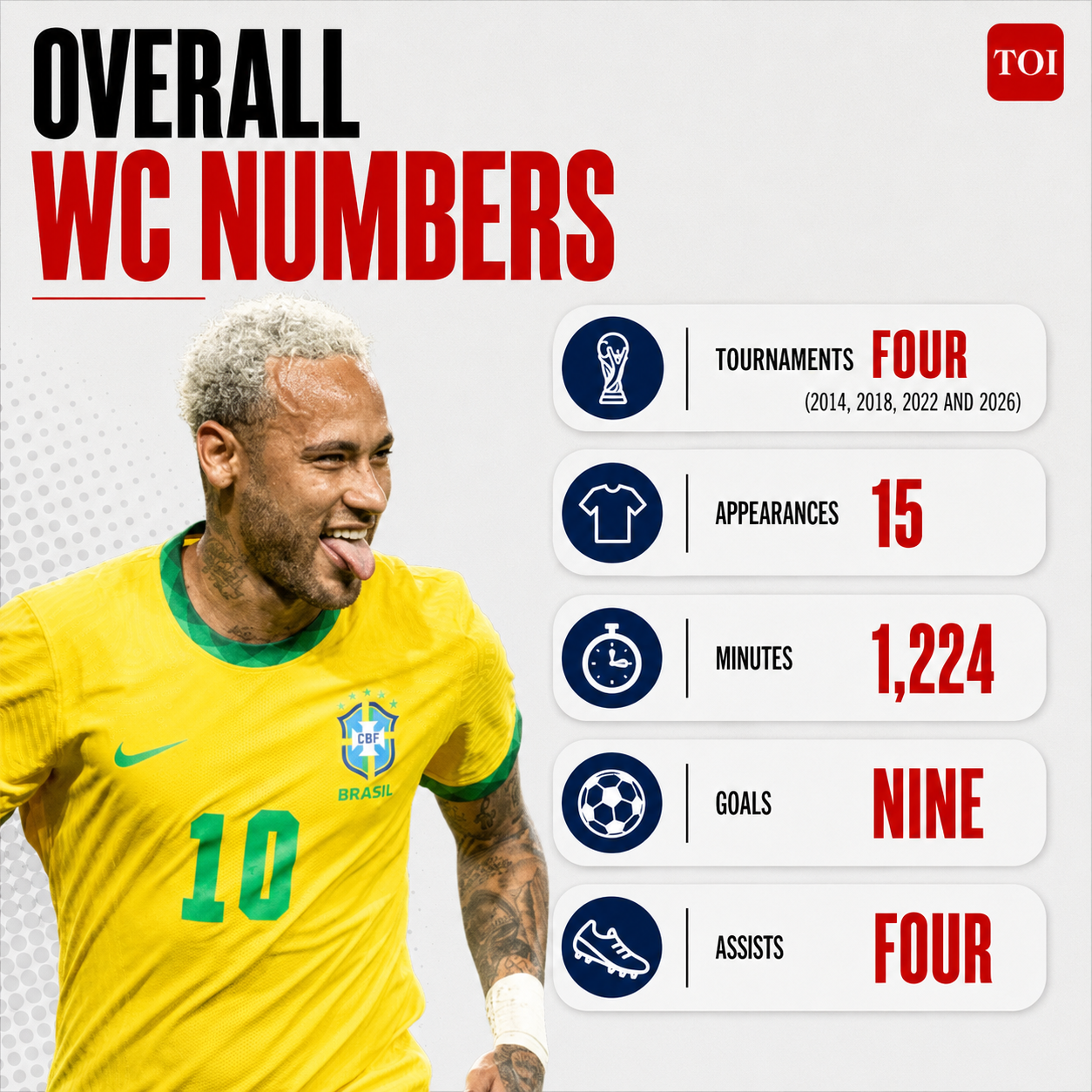
Neymar overall World Cup numbers
Neymar featured in only two matches throughout the competition, making a brief 15-minute appearance against Scotland before playing just over 20 minutes against Norway in the Round of 16. Less than 40 minutes of football summed up the reality of his final World Cup more powerfully than any emotional farewell could.The player who once carried Brazil’s attack was now limited to short bursts. His footballing mind still recognised spaces and opportunities before almost anyone else. His body simply could not execute them with the same consistency anymore.More than goals, more than trophiesJudging Neymar purely through the lens of silverware misses much of what made him special.He emerged at a time when football was becoming increasingly tactical, structured and physically demanding, yet refused to sacrifice imagination for efficiency. His football remained instinctive, expressive and fearless. Every touch carried risk, every dribble invited confrontation and every feint reminded supporters that football could still be an art form as much as a tactical exercise.His influence stretched well beyond the Brazil national team. Children across playgrounds copied his stepovers before they understood tactics. Coaches analysed his movement, defenders designed entire game plans specifically to stop him and countless young footballers attempted to imitate the fearless creativity that became synonymous with his game.Perhaps his greatest contribution came at a time when elite football was becoming increasingly dominated by systems, pressing structures and tactical discipline. Neymar proved there was still room for improvisation. He reminded supporters that football’s greatest moments often come not from rehearsed patterns but from imagination. An entire generation of attackers, from South America to Europe, grew up trying to replicate the feints, elasticos, flicks and body swerves that became his trademark.In many ways, Neymar became the last global superstar whose identity was built as much on artistry as efficiency. Long after his statistics fade from memory, his influence on how young footballers view attacking play may prove to be one of his most enduring legacies.A club career that deserved greater appreciationIf the World Cup ultimately defined the debate around Neymar, his club career tells a very different story.
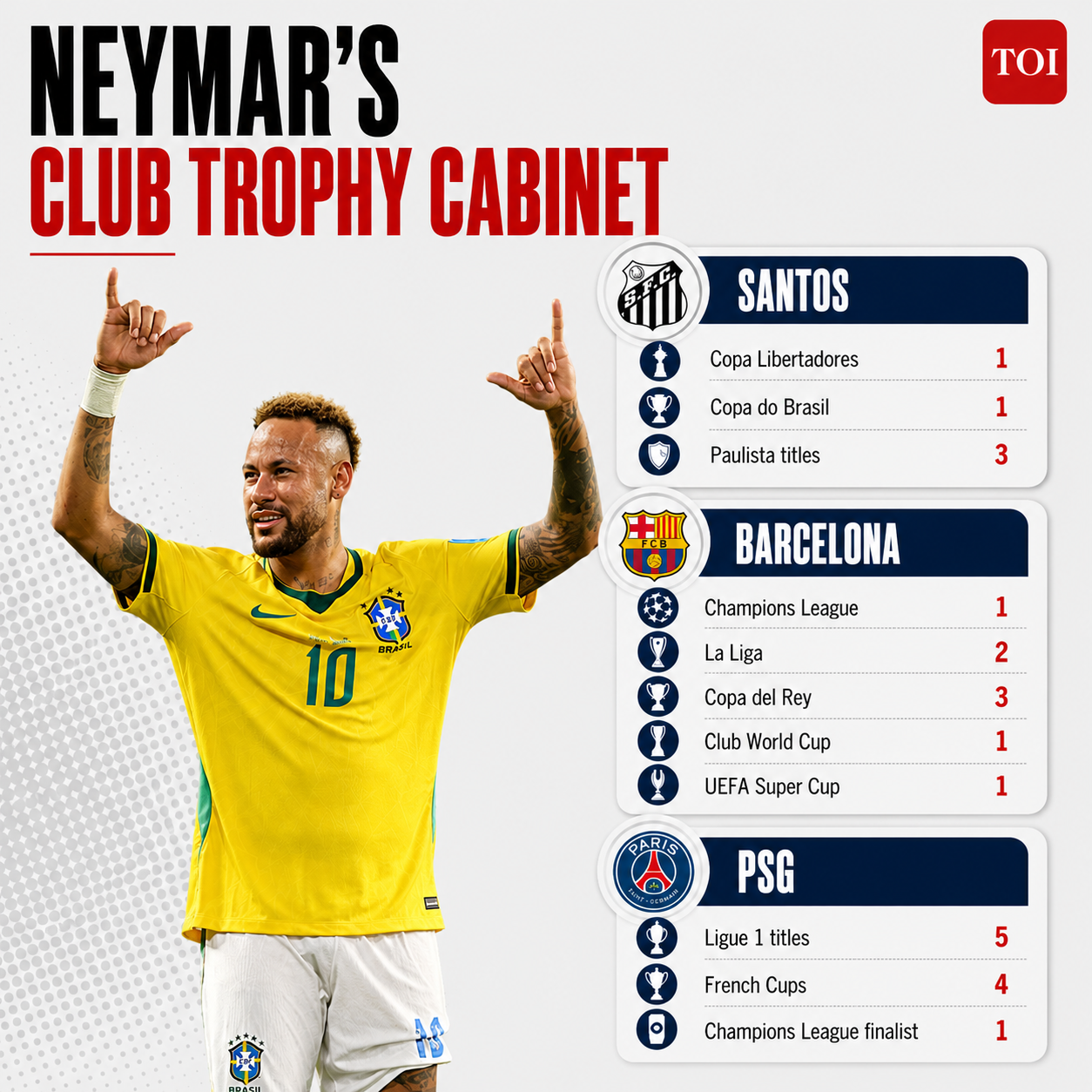
Neymar’s club trophy cabinet
Long before he became Brazil’s all-time leading scorer, Neymar had already established himself as one of the finest footballers of his generation. He burst onto the scene with Santos, helping the Brazilian giants win the Copa Libertadores in 2011, their first South American crown in nearly five decades, while collecting a string of individual honours that confirmed he was ready for Europe.His move to Barcelona transformed promise into global superstardom. Alongside Lionel Messi and Luis Suárez, he formed the iconic “MSN” attacking trio that terrorised defences across Europe. The trio inspired Barcelona to a historic treble in 2014-15, with Neymar scoring in both the semi-final and final of the UEFA Champions League. By the time he left Catalonia, he had won two La Liga titles, three Copa del Rey trophies, the Champions League, the FIFA Club World Cup and numerous domestic honours, firmly establishing himself among the world’s elite.His record-breaking transfer to Paris Saint-Germain in 2017, still the most expensive in football history, was intended to move him out of Messi’s shadow and towards individual greatness. While injuries repeatedly interrupted his time in France, Neymar still helped PSG dominate domestically, winning multiple Ligue 1 titles and guiding the club to its first-ever UEFA Champions League final in 2020. Individually, he continued to produce extraordinary numbers, regularly finishing seasons with elite goal and assist returns whenever he remained fit.Across club football, Neymar amassed well over 450 career goals, created hundreds more and collected more than 30 major trophies. He won league titles in Brazil, Spain and France, conquered Europe with Barcelona and earned countless individual accolades, including multiple places in the FIFA FIFPRO World XI, regular Ballon d’Or podium finishes and recognition as one of the defining footballers of his era.By almost any objective measure, it was a glittering club career.The difficulty for Neymar was that extraordinary success was never enough. Every trophy, every spectacular goal and every dazzling performance was viewed through one unavoidable lens: could it compensate for not delivering the World Cup to Brazil? For many, the answer was always going to be no, making his international legacy far harsher than the sum of his achievements elsewhere.The impossible comparisonPerhaps Neymar’s greatest misfortune was the era into which he was born. There was another layer to that burden. Every generation of Brazilian football eventually produces a gifted No. 10, but very few inherit the responsibility of ending a World Cup drought stretching back to 2002. Neymar did. Every tournament became less about enjoying one of football’s most gifted entertainers and more about whether he could restore Brazil to the summit of world football. That expectation followed him through every injury, every defeat and every comeback, making his career one of constant comparison rather than simple appreciation.

Neymar achievements and the debate
Brazil expected him to become the next Pelé, while world football expected him to break the duopoly established by Lionel Messi and Cristiano Ronaldo. Neither expectation was entirely fair.Pelé’s three World Cups remain unmatched. Messi and Ronaldo produced unprecedented consistency over nearly two decades. Neymar’s brilliance was therefore judged not on its own extraordinary merits but against standards that only a handful of players in football history have ever reached.He did not fall short because he lacked talent. He fell short of expectations that may have been impossible to fulfil.An ending filled with sadness, not regretWhen the final whistle blew against Norway, Brazil’s earliest World Cup exit since 1990 was confirmed. Neymar fell to the ground before being consoled by teammates, while Carlo Ancelotti admitted the defeat would become fuel for Brazil’s next cycle despite insisting his side had deserved better.
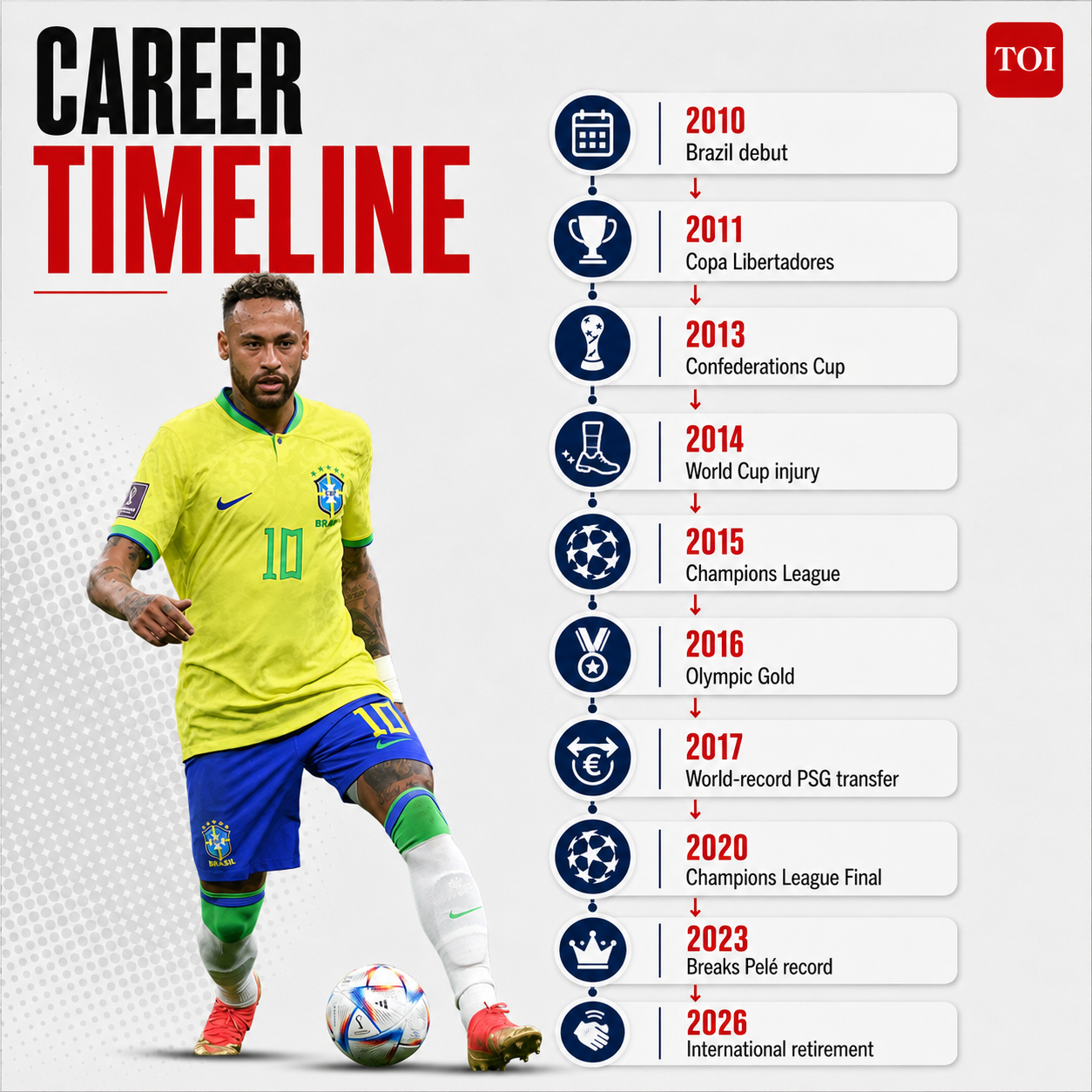
Neymar career timeline
Brazil now enters a new era. A new No. 10 will eventually emerge and another generation will chase the sixth World Cup star that has eluded the Seleção since 2002. But replacing Neymar will involve far more than replacing goals.It means replacing the player who carried Brazil’s creative burden for more than a decade, the footballer every defence feared and the artist who reminded millions that football could still surprise. His career will always invite debate. Some will remember the injuries, others the trophies he never won, and many will argue that he fell short because he never lifted the World Cup.History, however, should be kinder than that.Neymar leaves as Brazil’s greatest goalscorer, one of the finest footballers the country has produced and perhaps the last great Brazilian superstar whose game was built as much on joy as on efficiency. He never won the trophy that defines footballing immortality, but he gave Brazil moments that will endure for generations.