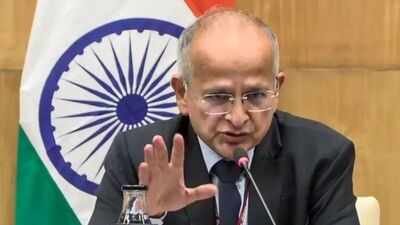
NEW DELHI: The ministry of external affairs (MEA) on Saturday said Prime Minister Narendra Modi is a “quintessential” Indian politician who prefers direct engagement with the electorate and don’t like being spoken to through intermediaries.While addressing a media briefing in New Zealand, when MEA Secretary (East) Rudrendra Tandon was asked why PM Modi had not held a press conference or interacted with journalists during his visit here.Tandon chuckled and said that the question gave him a sense of “déjà vu”, recalling a similar query raised during the Prime Minister’s visit to Norway earlier this year.“So you know, your question has that quality of deja vu, because see, it’s not appropriate for me as a civil servant to question Mr. Modi’s political method, he’s a very successful politician,” Tandon said.“But let me give you some context. Prime Minister Modi is a quintessential Indian politician. By and large, Indian politicians favour direct contact with their electorate,” he added.Explaining further, Tandon said India’s electorate largely prefers direct interaction with political leaders rather than communication through intermediaries.“And you must remember that the Indian electorate are predominantly rural folk. They want direct contact. They don’t like being spoken down to, they don’t like being spoken to through intermediaries,” he said.“And Mr. Modi has perfected the art of direct contact with his electorate, and he seems to be doing a rather good job of it, since you know, he’s been elected now, he’s in his third term, he’s one of the longest-serving Prime Ministers in our country,” Tandon added.Speaking about the purpose of the Prime Minister’s visit, Tandon said strengthening the rules-based Indo-Pacific order was a key objective.“The purpose of this visit is to strengthen the rule-based Indo-Pacific order. One of the reasons we look at New Zealand as a significant partner in this part of the world is because of our joint quest for strengthening the rule-based order in the Indo-Pacific, which is very important for India as an Indian Ocean nation,” he said.The remarks come months after a Norwegian journalist questioned why PM Modi did not take questions during a joint media interaction with Norwegian Prime Minister Jonas Gahr Støre in Oslo in May. The journalist had also referred to India and Norway’s rankings in the World Press Freedom Index.At the time, MEA Secretary (West) Sibi George defended India’s democratic institutions and media landscape. “We hear a lot of people asking why this, why that, but let me tell you this. We are one sixth of the total population of the world, but not one sixth of the problems of the world,” George had said.“We have a constitution which guarantees the fundamental rights of the people. We have equal rights for the women of our country, which is very important,” he added.George also criticised international commentary on India’s media environment saying, “You know how many stories are up here. We have how many breaking news coming every day in the evening. At least 200 TV channels in Delhi alone, in the English language, in Hindi language and multiple languages.”Prime Minister Modi is on a two-day visit to New Zealand from July 10-11 at the invitation of Prime Minister Christopher Luxon. The visit, the first by an Indian Prime Minister to New Zealand in 40 years, saw the two countries elevate bilateral ties to a Strategic Partnership and adopt a Roadmap to 2030 aimed at expanding cooperation in trade, defence, technology, security and regional affairs.