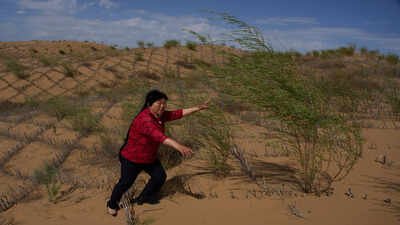
Across the deserts of northern China, a quiet, repetitive movement has played out for nearly 50 years: People bending down, pressing long straw bundles into shifting sand, then planting tiny saplings in the empty squares they’ve created. It looks simple, almost ordinary. But when you zoom out, you realise you’re looking at one of the largest human efforts to push back a desert in modern history.This is the story of China’s “Green Great Wall” – and the people whose lives have been shaped by its sand, its silence and its slow return to green, reported AP.
A grid of straw and stubborn hope
The technique that defines this project is called the “straw checkerboard.” Imagine forearm‑length sticks of straw pushed into the ground, first in straight rows, then in intersecting lines, until the land becomes a vast lattice pattern. In the centre of each square, workers plant a sapling.The logic is simple and clever:– The straw grid helps stabilise loose sand, stopping it from being blown away by strong desert winds.– It creates small protected pockets where young plants can take root.– With irrigation, those fragile saplings are given just enough support to try and survive.
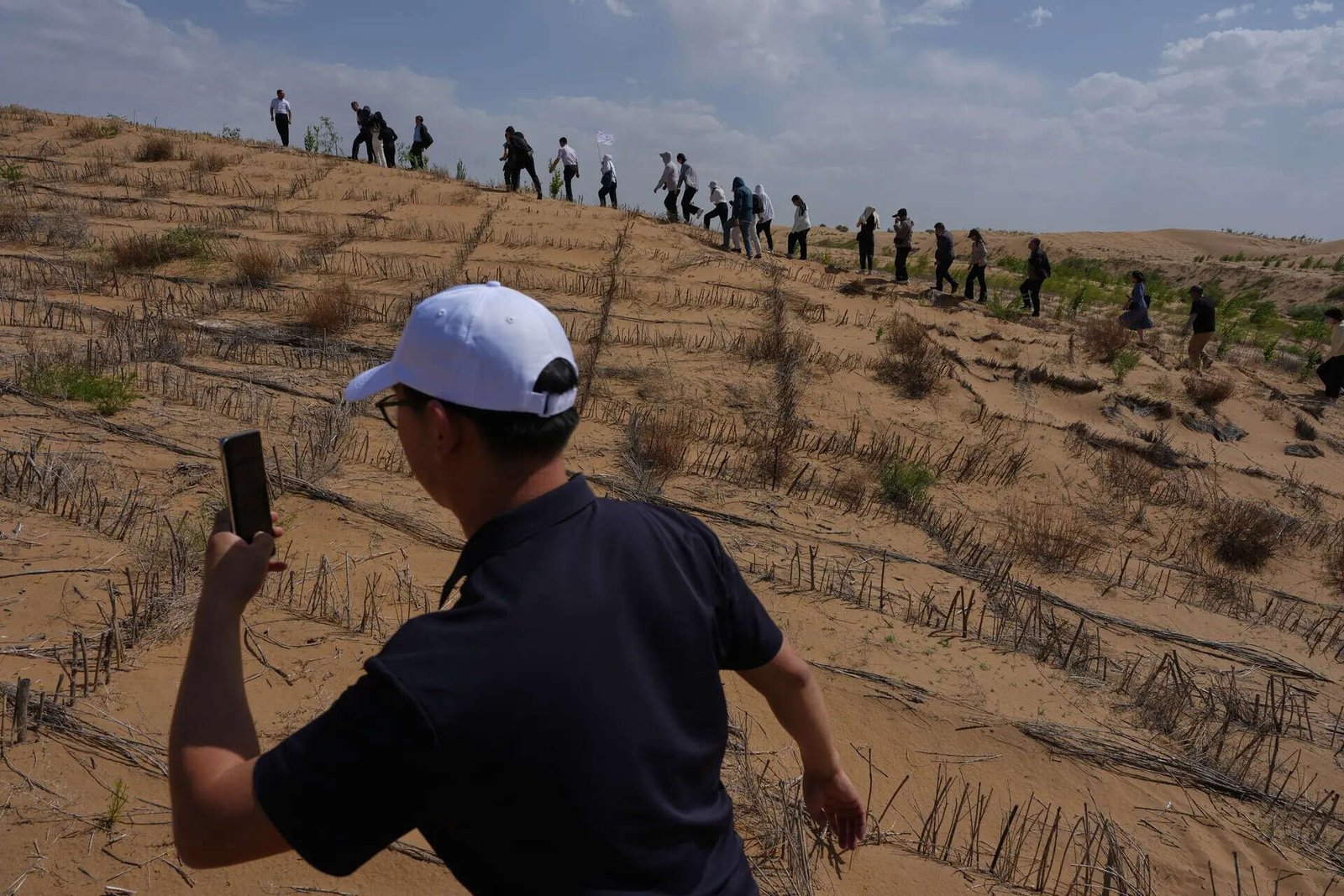
Visitors walk past a grass checkerboard on a sand dune that is part of desertification control efforts at the Engebei Ecological Area near Ordos in northern China’s Inner Mongolia province on Friday, June 12, 2026. (AP Photo/Ng Han Guan)
Over time, this pattern has spread across huge areas of northern China. Seen from above, it looks like someone has drawn a net over the land, one small square at a time. It has become the visual symbol of a much bigger effort: the Three‑North Protective Forest Program, often called the Green Great Wall.Launched in 1978, the programme set out to fight desertification—the slow process where land loses vegetation and becomes vulnerable to wind, sandstorms and drought. For years, overgrazing, unsustainable farming and water stress stripped these regions of cover. People retreated as the desert advanced. The checkerboards and trees were an attempt to reverse that direction.
Progress written in hectares – and in human memories
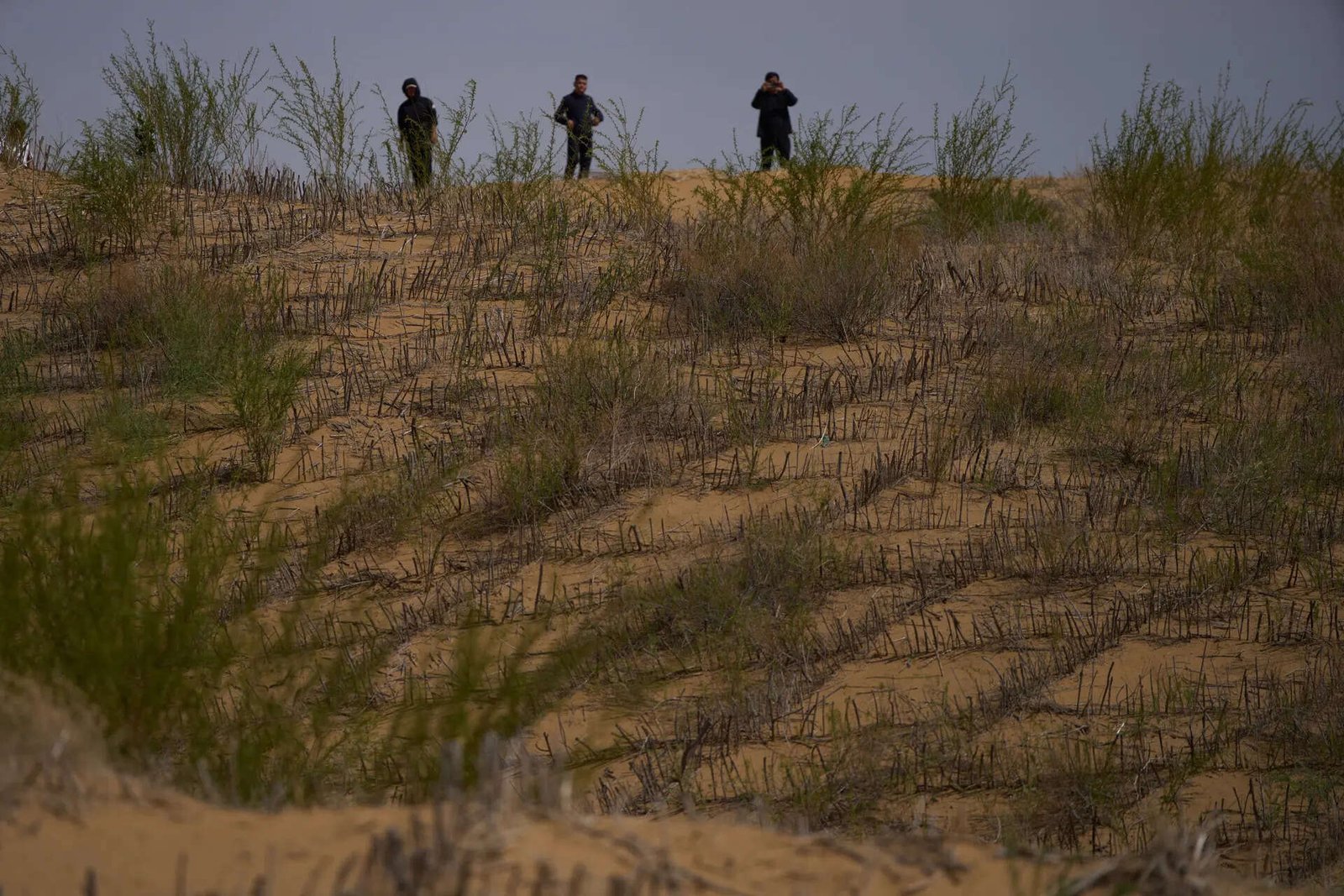
Men stand on top of a sand dune covered by a grass checkerboard that is part of desertification control efforts at the Engebei Ecological Area near Ordos in northern China’s Inner Mongolia province on Friday, June 12, 2026. (AP Photo/Ng Han Guan)
By the year 2000, the area of desertified land in northern China had reached its peak. Since then, official data suggests that the country has been reducing desertified land by more than a thousand square kilometres each year, with forests planted under the programme now spanning around half a million square kilometres.Scientists like Zhu Jiaojun, who has devoted much of his career to studying and guiding this effort, describe the change in numbers: desertified land shrinking by around 10% since 2000, severely degraded areas dropping by more than 40%, forest cover in the programme zone rising from roughly 5% in 1978 to about 14% by 2022.But those numbers only become real when you listen to the people who’ve lived with the sand and the wind.On a recent visit to the Kubuqi Desert, about 800 kilometres west of Beijing, a 60‑year‑old woman named Yin Yuzhen shared what it was like in the early days. She and her husband started as sand‑control workers near their hometown in the neighbouring Mu Us desert. Back then, she remembers, the landscape felt almost empty of life.“Even the passing of a bird across the sky made me happy,” she recalled, reported AP. The wind could blow so hard and thick with sand that it became difficult to see even a short distance. The horizon was not green; it was a blur of dust.Now, she says, it feels different. “We can see the sun. We can see the green in the distance. We can see the road.” Those three simple sights—sun, green, road—capture what this work has meant to her: visibility, vegetation, and connection.Her days are still shaped by the desert. From dawn to noon, she and her husband tend to trees, fix damaged checkerboards, or replace them where needed. Their children sometimes join them. Local volunteers arrive to help at times. When she speaks about the future, her greatest hope is that younger people continue what they started.“We need to teach young people to love this Earth,” she says. “If we love it with all our hearts, nature will love us in return.”
Millions of hands, one slow transformation
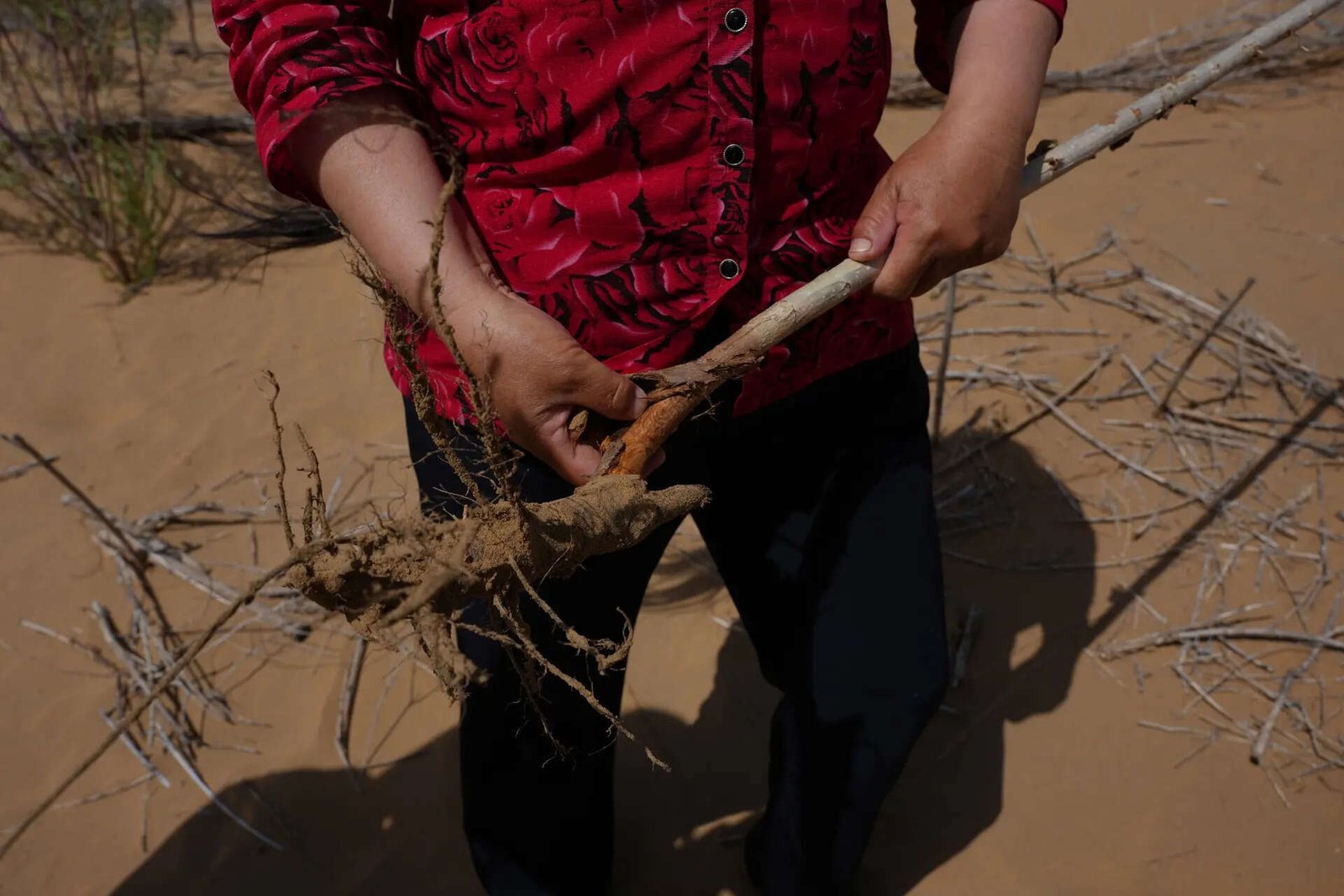
Yin Yuzhen, a sand-control worker, holds up a plant that did not survive because it was not planted deep enough while at a desertification control site at the Engebei Ecological Area near Ordos in northern China’s Inner Mongolia province on Friday, June 12, 2026. (AP Photo/Ng Han Guan)
Zhu estimates that more than 300 million rural labourers have been involved over the decades, mostly in paid, part‑time roles. For many, sand‑control work has been both a livelihood and a calling. Their physical labours—carrying straw, digging holes, planting saplings—have slowly altered the map, turning some of the harshest regions into landscapes where trees stand, winds are softer, and communities feel more secure.Experts like Barron Joseph Orr, chief scientist for the U.N. Convention to Combat Desertification, emphasise that the significance of the Three‑North Program isn’t just its scale. It’s the long‑term political commitment that has kept it going. Efforts to reverse desertification rarely succeed if they are short‑term projects. They need to be woven into national development strategies, budgets and policies over decades.China is not alone in this kind of ambition. In Africa, for example, a “Great Green Wall” initiative was launched in 2007 to plant trees and restore land across multiple countries bordering the Sahara. But in every region, the same lesson repeats: large‑scale restoration is possible, but it demands time, persistence and adaptation.
More than trees: Sustaining land and lives
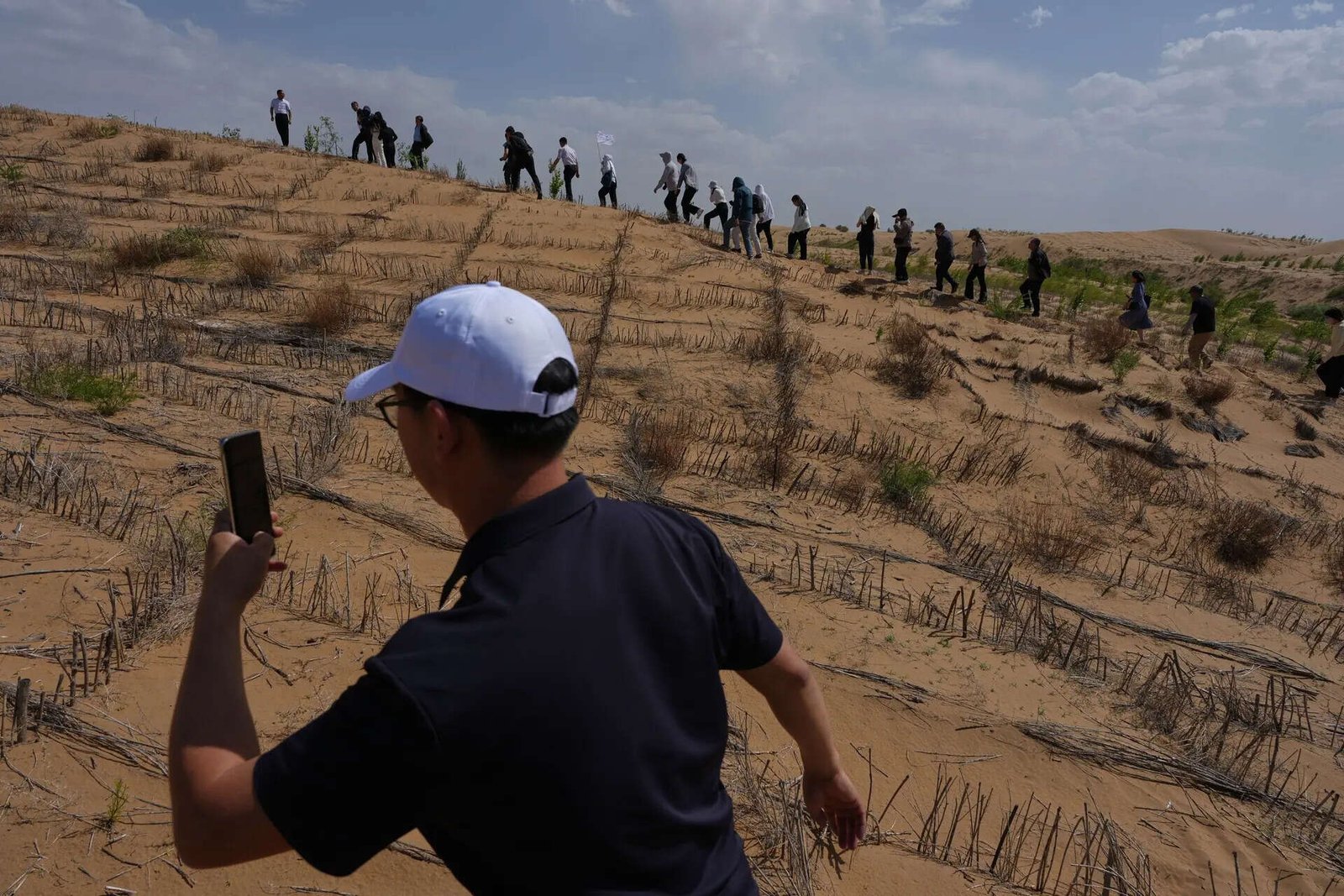
Visitors walk past a grass checkerboard on a sand dune that is part of desertification control efforts at the Engebei Ecological Area near Ordos in northern China’s Inner Mongolia province on Friday, June 12, 2026. (AP Photo/Ng Han Guan)
Planting trees is only part of the story. Keeping them alive—and ensuring that people thrive alongside them—is the deeper challenge.Orr points out that dryland ecosystems, once restored, can become more self‑sustaining over time. However, they still need careful management and long‑term monitoring. Water availability, soil health, species choice, and local climate shifts all influence whether the gains hold or fade.On the ground, groups like Green Camel Bell in Gansu province work at the intersection of ecology and daily life. They talk with farmers and herders about what desertification means for their land and livelihoods. They organise tree planting in dry areas, help communities restore vegetation, and emphasise that protecting the environment shouldn’t be seen as competing with economic development.“Efforts to combat desertification and restore forests should be linked to local livelihoods,” says founder Zhao Zhong, “so communities do not see economic development and ecological protection as an either‑or choice.” Orr agrees: restoration projects are more likely to succeed when local people can see and feel tangible benefits—whether through jobs, better grazing, improved water security or new forms of income.For scientists like Zhu, one of the biggest questions now is what happens next. As the landscape improves, will human intervention and investment be reduced? If so, can the progress be sustained? He calls this “the biggest challenge”: how to keep conservation alive when the visible crisis begins to ease and attention shifts elsewhere.
A human wall against a moving desert
When people hear “Great Wall,” they often think of stones and towers. The Green Great Wall is different. It’s made of straw grids, saplings, human hands and quiet hope.At its heart, this story isn’t only about climate and land. It’s about how ordinary people, like Yin and her husband, have spent much of their lives doing slow, repetitive work in harsh conditions because they believe the land can change—and because they want their children to grow up in a place where the sky is clearer, the horizon is greener, and the road is visible.It’s easy to think of desertification as an abstract environmental issue. But for the families who live there, it’s about dust in the air, sand on the doorstep, crops that won’t grow, animals that struggle, and kids who have fewer opportunities. And for those same families, restoration is about visibility, safety, pride and a sense that the future is not only retreat.Human interest lives in these gestures: in the straw checkerboard pressed into shifting sand, in the tiny tree watered in hope, in the old worker who still smiles when a bird crosses the sky.When you picture this Green Great Wall stretching across northern China, what stands out more to you—the scale of the environmental change, or the quiet persistence of the people behind it? Tell us in the comments section below.(With inputs from AP)