Whether Rohit Sharma plays his final ODI at Lord’s or scores a century to live another day is something only time will tell. But the reported development that the BCCI selectors have made up their minds and, in a way, left the player with little choice is nothing new in Indian cricket. The selectors’ job is brutal. Not everyone has what it takes to call a spade a spade. And when they are dealing with stars of Indian cricket, those conversations become even more uncomfortable, yet no less necessary.
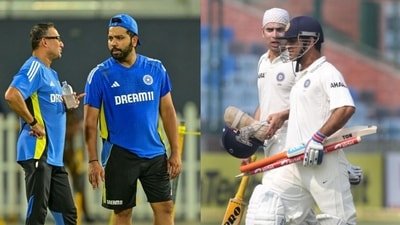
The chief selector’s judgement on Rohit is not the first and certainly won’t be the last. But it does bring back memories of something similar involving VVS Laxman, MS Dhoni and the BCCI selection committee, headed by Kris Srikkanth, in 2012. Just as 2025-26 has been a period of transition for this Indian team, 2012 marked the end of an era. Rahul Dravid, who had retired from ODIs and T20Is a year earlier, walked away from Tests after a disappointing tour of Australia. By the end of the year, Sachin Tendulkar had also announced his ODI retirement.
The day Laxman took control of his own exit
But the real shock was reserved for August 2012. With just a week to go before the start of a three-Test series against New Zealand, Laxman, despite being named in the squad, announced his retirement from international cricket. In the space of nine months, Indian cricket had moved on from three of its greatest batting legends of the previous 15 years. Yet it was Laxman’s press conference that laid bare the ruthless nature of selection.
Also Read: Rohit Sharma gave his all, but Agarkar’s vision, Gambhir’s plan and Jaiswal’s rise crushed his World Cup dream for good
Not a rude word was said, but Laxman’s decision was an act of defiance. He wasn’t going to let the selectors decide his future. Instead, he pulled off the classic “You can’t fire me because I quit” move. Before addressing the press conference, Laxman called Srikkanth to thank him for trusting him. On the surface, it was a gesture of gratitude. But the timing also ensured that he took the power away from the chairman of selectors. For one of cricket’s true gentlemen to make that choice spoke volumes.
Laxman’s decision was abrupt, not because it was entirely unexpected, but because he chose to dictate the ending rather than leave it to someone else. It triggered the biggest storm since the Greg Chappell-Sourav Ganguly saga. Then again, it reflected just how deep the divide had become. Laxman was hurt by the growing talk that he was occupying a youngster’s spot and had reportedly been told that the New Zealand series would be his last, with the consolation of playing his farewell on his home ground in Hyderabad. Rather than react with anger, Laxman once again showed his class – this time off the field – and chose to walk away.
Form, fairness and the selectors’ dilemma
The selection committee had every right to question Laxman’s form, for it had dipped considerably over his previous five series. He managed just 182 runs in England and, even against Australia, a team he relished batting against, scored only 155 runs, with both series ending in 0-4 whitewashes for India. But in all honesty, those were the only two series in which he truly struggled. He averaged 99 against the West Indies at home, with a highest score of 176 not out, and close to 50 in the Caribbean the year before. Fitness was never Laxman’s greatest strength, but after the Border-Gavaskar Trophy debacle, he went back to the grind, played plenty of domestic cricket and trained relentlessly. Yet, it still wasn’t enough for the board to give him a little more time.
The role of Dhoni, the then captain, added fuel to the fire. Laxman wanted to speak to Dhoni about his future, but MSD was reportedly “unreachable”. The controversy only intensified when Laxman hosted a retirement dinner for most of his teammates, including Tendulkar, Dravid, Virender Sehwag, Zaheer Khan and Gautam Gambhir. The one person who wasn’t invited, however, was Dhoni. When asked at the pre-match press conference whether Laxman had invited him, Dhoni replied with a blunt, “No.” Asked about Laxman’s sudden retirement, Dhoni’s response was equally curt: “You need to ask Laxman about it.”
14 years later, the echoes return
And now that the Rohit episode gathers momentum, the mind can’t help but hark back to that summer 14 years ago. Shubman Gill, unlike Dhoni, may not be out of reach, but Ajit Agarkar, like Srikkanth, couldn’t have been more firm in his stance. “We are moving on without you. The ball is in your court.
Whether history is repeating itself or merely rhyming is open to debate. Every generation forces Indian cricket to confront difficult farewells, and selectors rarely emerge unscathed from those decisions. Laxman chose to seize control of his own ending rather than wait for it to be written by others. Rohit’s story is still unfolding, but the circumstances feel strikingly familiar. If the reported conversations are accurate, the BCCI once again finds itself balancing respect for a modern great with the need to build for the future. As always, the decision may prove right, but the manner will remain open to scrutiny.