Christopher Nolan’s The Odyssey stays true to the filmmaker’s signature style of using real locations and practical effects instead of relying heavily on green screens or CGI. Rather than recreating ancient landscapes on soundstages, Nolan and his crew traveled across six countries to bring Homer’s epic to life, filming with large-format IMAX cameras in some of the world’s most striking natural and historic settings.
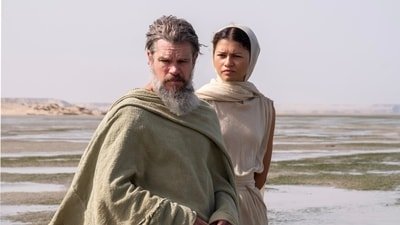
Speaking at CinemaCon in April, Nolan reflected on the scale of the production. “This has been an absolute nightmare to film… but in all the right ways.”
He added: “We went all over the world to make this film because this is The Odyssey. You’ll be pleased to hear how difficult it was for us because it’s meant to be difficult. That’s the nature of the story.”
Here’s a look at every major filming location used for The Odyssey.
Greece: Where the epic begins
As The Odyssey is rooted in Greek mythology, much of the production took place in Greece’s Messenia region, known for its rugged coastline and ancient landmarks.
Voidokilia Beach
The crescent-shaped beach served as one of the film’s coastal backdrops, offering pristine Mediterranean scenery.
Also Read: Why did Christopher Nolan choose Matt Damon as Odysseus in ‘The Odyssey’? Filmmaker explains
Nestor’s Cave
Located near Voidokilia Beach, the ancient cave was reportedly used for scenes involving the Cyclops, one of Odysseus’ most famous encounters.
Methoni Castle
The medieval fortress overlooking the sea also featured during filming, adding an authentic historical setting to the epic.
Morocco: Standing in for ancient Troy
To recreate the legendary city of Troy, the production filmed at Ait Benhaddou, the UNESCO World Heritage site known for its centuries-old earthen architecture. The fortified village has previously appeared in several historical epics and fantasy films.
Italy and Malta: Islands of myth
Odysseus’ long voyage takes him across mysterious islands, and Nolan filmed several of those sequences in Italy and Malta.
Favignana Island, Italy
Located off Sicily, Favignana’s turquoise waters and rocky coastline provided the backdrop for several sea-based sequences.
The Aeolian Islands, Italy
The volcanic archipelago was used for scenes connected to Aeolus, the god of the winds.
Also Read: Tom Cruise reviews Christopher Nolan’s The Odyssey, reveals what impressed him the most
Gozo, Malta
Filming also took place on the Maltese island of Gozo, home to the famed Calypso’s Cave, which is traditionally associated with the nymph Calypso in Greek mythology.
Iceland
For some of the film’s darker sequences, the production traveled to Iceland’s Snæfellsnes Peninsula. Its volcanic terrain, glaciers and geothermal landscapes created an atmospheric setting without extensive visual effects.
Scotland: Homecoming to Ithaca
The final leg of production took the crew to Moray Firth in Scotland. Locals spotted a custom-built wooden replica of an ancient Greek galley sailing through the region’s misty waters, with the area reportedly serving as a stand-in for Ithaca, Odysseus’ homeland.
By : Tusharika Tripathi