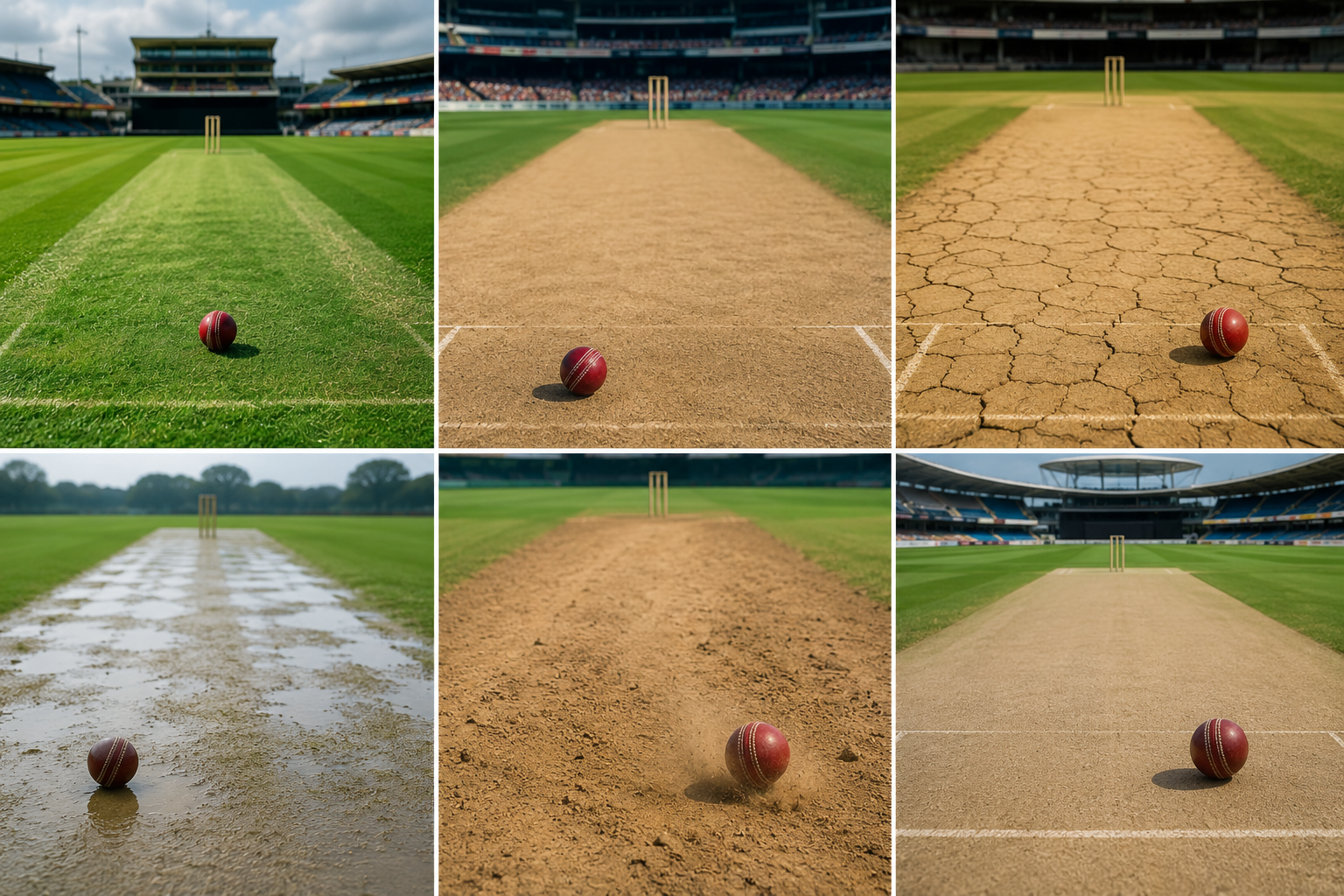
The pitch is one of the most important parts of a cricket match. It affects how the ball behaves and can give an advantage to batters, fast bowlers, or spinners. Every pitch is different, which is why teams study the surface before the match starts.
Types of Cricket Pitches
| Pitch Type | Main Features | Best For | Example |
|---|---|---|---|
| Green Pitch | Grass cover, moisture | Fast bowlers | Lord’s (England) |
| Flat Pitch | Hard, even bounce | Batters | Mohali (India) |
| Dry Pitch | Dry surface with cracks | Spinners (later in the match) | Nagpur (India) |
| Wet Pitch | Damp and soft | Swing bowlers | Colombo (Sri Lanka) |
| Dusty Pitch | Loose, dusty surface | Spin bowlers | Eden Gardens (India) |
| Dead Pitch | Flat with no help for bowlers | Batters | Dubai International Stadium |
How to Read a Cricket Pitch
Before every match, captains and players look at the pitch to plan their strategy.
-
Grass: More grass usually helps fast bowlers.
-
Moisture: Wet pitches help swing bowling.
-
Cracks: Cracks often help spin bowlers later in the game.
-
Weather: Rain and sunshine can change how the pitch plays.
Why Are Cricket Pitches Important?
The pitch can change the result of a match. A green pitch gives fast bowlers an advantage, while a dusty pitch helps spinners. On a flat pitch, batters usually score big runs. Understanding pitch conditions helps fans enjoy the game more and also makes fantasy cricket predictions better.
Every cricket pitch is different and brings its own challenge. Green pitches help pacers, dusty and dry pitches support spinners, while flat and dead pitches are ideal for batting. Knowing the different types of cricket pitches helps players make better decisions and gives fans a better understanding of the game.