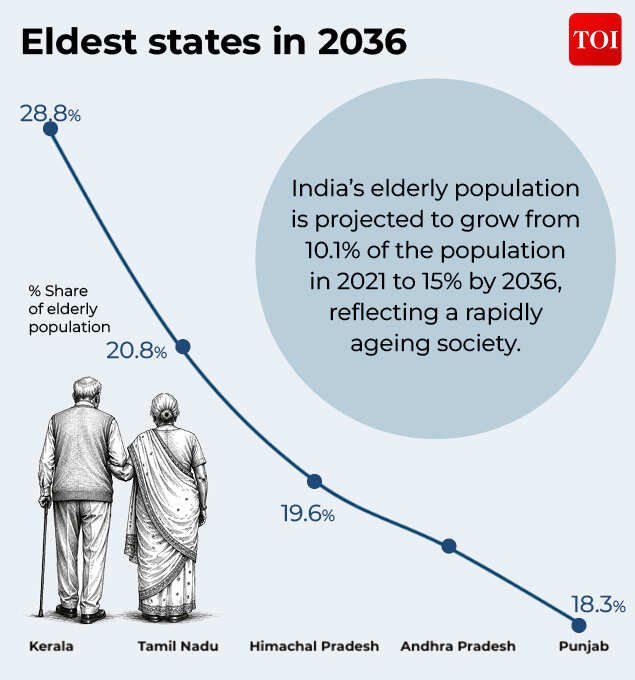
India is the second-loneliest country in the world, according to a study by JB.com. The ranking offers a stark lens through which to view a country that is also aging rapidly, urbanising quickly and watching its traditional social structures thin out.In 2011, India had about 100 million people aged 60 and above. Projections by the Technical Group on Population Projections, cited in the Ministry of Statistics and Programme Implementation’s report Elderly in India 2021, show that this figure will more than double to roughly 230 million by 2036, around 15 per cent of the population. By 2050, UNFPA’s India Ageing Report 2023 estimates, nearly one in five Indians will be 60 or older.But loneliness is not waiting for old age.It is already present in the rented flats of young migrants, in the quiet of a single-person home, in weekends spent scrolling through other people’s lives and in the small, almost invisible moments when there is no one to ask, “Are you home?”For Minal, from Bihar and living alone in Pune, loneliness is “feeling I don’t belong anywhere and nobody cares about me.” She calls herself “pretty social”, but in her current city “has only few people I know so I have phases when I go out alone.” A typical weekend is split between “one day I go out to eat somewhere nice and one day I stay in, cook something and journal or watch a movie.”At home, she spends “8–10 hours” on screens. After closing Instagram and seeing peers travelling or getting engaged, she says she feels “empty and restless and also shit about myself”.Swadha, who spent years living alone in Noida for college and work, remembers the strange contradiction of returning home.“There is a sense of relief… but then there is also a sense of silence and nobody is there to ask are you home… nobody cares whether you entered with the shoe on or have you left the shoe outside.”She placed a mirror at the entrance of her home. “Somebody has to look at me, right? I used to do that for myself.”Living alone, she says, “means you have absolutely no one to talk to about your day… that will hit you so hard that it will push you away from your loved ones whom you actually speak to on the calls.”For Neha, from West Bengal and working in Delhi, loneliness is even simpler: “no person to go back to when you feel heavy… no one to ask where you are… how have you been.”She says she has “no social life”. Her weekends are spent “grocery shopping… cooking and cleaning…”. When she returns home, her first thought is, “what should I eat now.” She estimates her screen time at 4–5 hours a day at home and says that after closing social apps, she feels, “I’m wasting my time… I should do something productive.”Their lives may seem far removed from the concerns of India’s elderly. But the emotional patterns are strikingly similar.A LASI-based study on later life reports that about 13.4 per cent of older Indians experience frequent loneliness. The odds are higher among those not in a marital union, those with more than two chronic conditions and those with small social networks or limited leisure activities. UNFPA’s 2023 report identifies social isolation and loneliness as key stressors on elderly mental health, aggravated by migration, urbanisation and weakening family support.
The country is aging into this crisis.India’s elderly population is not evenly distributed. Kerala’s elderly share is projected to rise from about 13 per cent in 2011 to nearly 23 per cent by 2036, while Uttar Pradesh moves from roughly 7 per cent to 12 per cent. Southern states, Himachal Pradesh and Punjab already have above-average elderly proportions, creating pockets where ageing, and the risk of isolation, are much more intense than the national average.The profile is also sharply gendered.Using LASI data, government summaries note a sex ratio of roughly 1,065 females per 1,000 males among India’s elderly, with women making up about 58 per cent of older persons. More than half of elderly women are widows. UNFPA’s ageing reports underline that older women are more likely to be widowed, have little personal income and live alone, increasing their vulnerability to economic insecurity and social isolation.This is the demographic stage on which India’s loneliness economy is emerging.
From joint family to flat
For generations, the family was India’s first social safety net. That safety net has not disappeared, but it has changed shape.Migration, urbanisation, nuclear families and precarious work have moved millions away from the people and communities that once filled everyday life. A home that once had several generations may now have one person, one phone and a delivery app.The coping mechanisms are increasingly mediated by markets. Food delivery replaces the shared meal. OTT platforms fill the evening. Social media offers constant contact without necessarily providing companionship.For younger Indians, these services are conveniences. For an ageing population, they are becoming part of a much larger ecosystem of care.
The silver economy
Policy has increasingly framed this demographic transition as an economic opportunity. NITI Aayog’s report Senior Care Reforms in India and the Ministry of Social Justice and Empowerment’s schemes speak of a “silver economy” built around the needs of older adults.Government estimates linked to the Senior Care Ageing Growth Engine (SAGE) initiative put the value of India’s silver economy at around Rs 73,000 crore in 2024, with scope for multi-fold expansion as the elderly population grows.
The first pillar is financial security.Atal Pension Yojana subscriptions rose from about 1.54 crore in March 2019 to 8.27 crore by October 2025, according to Pension Fund Regulatory and Development Authority data quoted in government briefs. Assets under management crossed Rs 49,000 crore.The Indira Gandhi National Old Age Pension Scheme reaches around 2.21 crore beneficiaries, offering Rs 200 a month to those aged 60–79 and Rs 500 to those 80 and above. The amounts are modest, but they establish an income floor that can help with food, healthcare and basic services.The second pillar is health protection.Ayushman Bharat-PMJAY offers Rs 5 lakh a year in hospitalisation cover to vulnerable households. In October 2024, the government announced free treatment benefits of up to Rs 5 lakh annually for about 6 crore senior citizens aged 70 and above from 4.5 crore families, irrespective of socio-economic status. More than 40 lakh seniors had enrolled by January 2025.The National Programme for Health Care of the Elderly, meanwhile, now covers all 713 health districts, with geriatric OPDs, wards and physiotherapy services, according to the Ministry of Health and Family Welfare.The third pillar is care.The SAGE portal invites start-ups to develop solutions in healthcare, housing, technology and social engagement, offering equity support of up to Rs 1 crore per project, with government equity capped at 49 per cent. The Integrated Programme for Senior Citizens grants fund 696 senior citizen homes across 29 States and UTs, with 84 more selected for 2025–26.A geriatric caregiver training scheme, run through 32 empanelled institutes, trained 36,785 caregivers in 2023–24.None of these programmes is explicitly called a loneliness programme. Yet they address many of the conditions that make loneliness more likely: widowhood, frailty, financial insecurity and living alone.
The business of being heard
Technology is becoming another layer of this support system.The government’s e-Sanjeevani telemedicine platform has delivered nearly 14 crore tele-consultations nationwide, including more than 1 crore consultations involving senior citizens, according to a 2023 Press Information Bureau update and a national telemedicine assessment.For an older person who cannot easily travel, a consultation through a screen can be a lifeline. But the broader shift is significant too: an increasing number of needs, including emotional ones, are now being addressed through digital interfaces.Elderline 14567 offers senior citizens a telephone channel for grievances, abuse and emotional support, connecting callers to local services and authorities.The legal framework, meanwhile, continues to place responsibility on families. The Maintenance and Welfare of Parents and Senior Citizens Act, 2007, and its 2019 amendment bill expand the definition of “children” and “parents”, remove the Rs 10,000 cap on maintenance, mandate that seniors should live a “life of dignity” and require dedicated police units and geriatric facilities in hospitals.The amendment widens “maintenance” to include healthcare, safety and housing. It is an acknowledgement that neglect, isolation and abuse are not merely private tragedies.But loneliness is not always about being physically alone.Anandeshwar, a civil services aspirant from Uttar Pradesh now living in Delhi, describes it as “not being understood or connected to the people around me, even when I am surrounded by others.”He has “a big enough circle of friends” but meets them rarely. Deeper conversations happen “pine ke baad” (after drinking). His ideal weekend is full: “write some good things, spend time with friends, participate in debating events”. Reality is often different. He stays home, “watch YT, Twitter, or just lay on the bed smoking,” joking that “every day is weakened for an unemployed.”The problem, then, is not simply the absence of people. It is the absence of meaningful connection.
The small economies of a lonely weekend
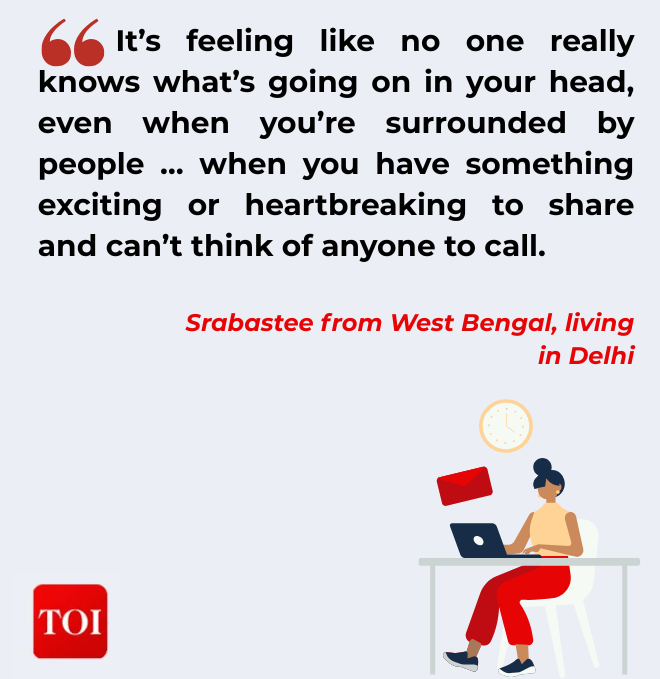
Loneliness often reveals itself through small choices.Cook or order in? Call someone or scroll? Go out or stay in bed?Minal divides her weekend between eating out and cooking at home. Neha’s ideal weekend is “reading, writing and cleaning the flat”, even if reality is often errands and rest.Yukta, a psychology student from Bengaluru living in Jaipur, describes a more connected version of the same urban life. When she is not overwhelmed by work, weekends with her roommate mean “sleep, cooking and eating good food together, watching something fun on an OTT platform, or… a movie and cafe date! And shopping or just strolling through a bazaar for fun.”“Now, it feels like ‘I am finally home’,” she says. “I can do whatever I’d like, be whatever I’d like and just exist in a space with only comfort to offer.”LASI-based studies identify regular social contact, leisure activities, yoga or meditation and even moderate television or computer use as factors associated with better wellbeing among older adults.The difference is that in cities such as Delhi, Pune, Hyderabad and Jaipur, these activities are increasingly curated through markets: OTT subscriptions, cafes, delivery services and paid experiences.At the other end is Srabastee from West Bengal, living in Delhi for work.“It’s feeling like no one really knows what’s going on in your head, even when you’re surrounded by people… when you have something exciting or heartbreaking to share and can’t think of anyone to call.”She speaks to family and “texts a few friends once in a while”, mostly sharing memes and reacting to stories. Weeks can pass before they meet.After scrolling, she often feels “drained”, comparing her routine weekends of laundry, shows and ordered food with peers who seem to be “getting promoted, buying homes, getting married, travelling the world.”The same platforms that offer entertainment and convenience also fuel comparison. The same screens that connect people can deepen the feeling of being left behind.
Who will pay for connection?
NITI Aayog argues that senior care needs to be recognised as a distinct sector, with regulations, standards, public-private partnerships and dedicated financing. Its vision combines public programmes such as pensions, NPHCE, telehealth and senior homes with private start-ups and NGOs.That is where the silver economy begins to overlap with the loneliness economy.The forces making Minal, Neha and Srabastee feel alone, migration, nuclear families, precarious jobs and digital overload, are also creating demand for therapy platforms, senior-living communities, companion-care services and digital communities.Some of these services may offer genuine support. Others may simply monetise a need that was once met by family, neighbours and community.The question becomes sharper when viewed against India’s place near the top of the global loneliness index. A country ranked number two by JB.com is also preparing for a dramatic rise in its elderly population. By 2036, roughly 230 million Indians will be 60 or older. By 2050, nearly one in five will be.The challenge is not only how to feed, house or medically care for this population. It is also how to ensure that people have someone to talk to, someone who notices when they do not come home, someone who asks how their day was.India’s loneliness economy is already taking shape, from pensions and senior homes to helplines, telehealth, therapy platforms, cafes, OTT subscriptions and delivery apps.The question is whether connection will ultimately be treated as a public responsibility or sold as another subscription.Because the people who today spend their Sundays between grocery stores and glowing screens will one day grow old. And the way India responds to their loneliness will reveal whether it sees the need to be seen, heard and remembered as a basic human need, or simply another market waiting to be tapped.