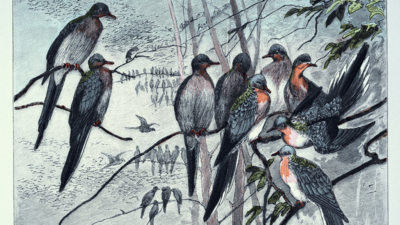
There are few stories in nature as heartbreaking as that of the passenger pigeon. It is not because the bird was rare or fragile. It was quite the opposite.The passenger pigeon was once considered the most abundant bird in North America. Scientists estimate that between 3 and 5 billion passenger pigeons lived across the continent before European settlement. Their flocks were so enormous that people described them as rivers flowing through the sky. Some reported that the birds passed overhead for hours, even days, blocking sunlight and filling forests with an endless chorus of wings.Then, in what seemed like the blink of an eye in historical terms, they were gone.On September 1, 1914, the last known passenger pigeon, named Martha, died at the Cincinnati Zoo. Her death marked the end of a species that had once seemed impossible to erase. Today, the passenger pigeon stands as one of the clearest examples of how human actions can drive even the most common animal to extinction.The passenger pigeon (Ectopistes migratorius) lived across much of eastern North America. Unlike many birds that travelled in small groups, these pigeons depended on enormous flocks. Their safety came from their numbers.Naturalists of the 19th centuries left astonishing descriptions. American ornithologist John James Audubon wrote that the birds flew in such dense masses that they “obscured the light of noon.”The forests where they nested were equally extraordinary. A single nesting colony could stretch for miles, with thousands of nests packed into one area. Oaks, beeches and chestnut trees provided the nuts and seeds that sustained these vast populations.
The mistake that proved fatal: believing there would always be more
The passenger pigeon suffered from a dangerous illusion. Because billions existed, people assumed the supply was endless. By the mid-1800s, hunting had become industrial.The expansion of railroads allowed freshly killed birds to be shipped to growing cities. The telegraph spread news of nesting colonies within hours, drawing professional hunters from far away. Nets, guns and even smoke were used to capture or kill birds in staggering numbers. Millions were sold as cheap food for both people and livestock.Young birds were taken directly from nests before they could fly. Entire breeding colonies were destroyed in a matter of days. What looked like an unlimited natural resource was actually disappearing much faster than anyone imagined.Conservationist Aldo Leopold later reflected on the tragedy in words that still resonate today, “One of the penalties of an ecological education is that one lives alone in a world of wounds.”Although Leopold wrote decades after the passenger pigeon’s extinction, his words capture the lasting lesson left behind by the species.
The forests disappeared, and the pigeons lost more than their homes
Hunting alone did not seal the passenger pigeon’s fate. During the 19th century, eastern North America underwent rapid transformation. Vast hardwood forests were cleared for farming, timber and expanding settlements.Passenger pigeons needed enormous, uninterrupted forests because they nested in gigantic colonies and relied on seasonal crops of tree seeds. When those forests became fragmented, the birds lost both food and breeding grounds.Modern research has shown that the passenger pigeon was highly social. It depended on living in very large numbers to breed successfully and to protect itself from predators. Once the population dropped below a certain level, recovery became increasingly difficult.This phenomenon is known as the Allee effect, where a species struggles to survive because too few individuals remain to support normal breeding and social behaviour.
Martha’s lonely final years became a warning for the world
By the early 1900s, finding a wild passenger pigeon had become incredibly rare. Conservation laws came too late.Martha, the last known individual, spent her final years alone at the Cincinnati Zoo. She died on September 1, 1914, at around 29 years of age. Scientists often point to her death as the moment that transformed public attitudes toward wildlife conservation in North America.
Why this century-old extinction still matters
The passenger pigeon is not just a story about the past. It continues to shape how scientists and conservationists think about protecting wildlife today.One important lesson is that abundance is not the same as security. A species can exist in huge numbers and still collapse rapidly if breeding habitats disappear and exploitation continues unchecked.The extinction also helped inspire stronger wildlife protection efforts, scientific monitoring and habitat conservation across North America.The disappearance of the passenger pigeon reminds us that every species plays a role in the larger web of life. Losing one does not simply reduce biodiversity. It changes ecosystems in ways that may take generations to fully understand.Today, when discussions focus on endangered animals, climate change and habitat protection, the story of the passenger pigeon remains one of the clearest reminders that conservation cannot begin only when a species becomes rare. By then, it may already be too late.