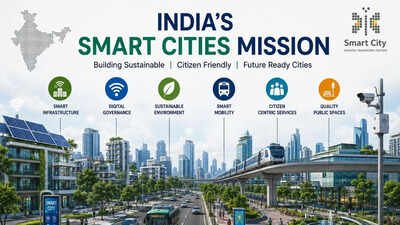
India’s urban landscape has been undergoing a technology-led transformation over the past decade, with cities adopting smarter systems for mobility, governance, public safety, water management and citizen services. The transformation was driven by the Smart Cities Mission (SCM), launched on June 25, 2015, with the objective of improving urban infrastructure, creating sustainable environments and enhancing quality of life through smart solutions. The programme brought 100 cities into a framework of technology-enabled development, with projects designed around local needs and long-term urban resilience.The development approach has focused on two broad areas — area-based development, where selected parts of cities are upgraded as models for wider urban improvement, and pan-city solutions, where technology-based interventions are introduced to improve services across the city. Over the years, the initiative has resulted in large-scale urban projects implemented through Special Purpose Vehicles (SPVs) established in each Smart City. These projects have focused on creating better-connected, efficient and citizen-focused urban spaces. According to the Ministry of Housing and Urban Affairs, the Smart Cities programme has delivered thousands of projects across sectors including transport, water supply, sanitation, public safety, digital governance, healthcare and education.By May 2025, 7,555 out of 8,067 projects under the Smart Cities Mission had been completed, accounting for 94% completion of the total project pipeline. The projects completed and under implementation represent an investment of around ₹1.64 lakh crore, according to PIB.One of the biggest changes visible across Smart Cities has been the adoption of digital platforms for urban management. All 100 Smart Cities now have operational Integrated Command and Control Centres (ICCCs), which have emerged as digital nerve centres for city administration. These centres integrate data from multiple departments and help authorities monitor and manage services such as traffic movement, emergency response, public safety, water supply and waste management. Using technologies such as Artificial Intelligence, Internet of Things and data analytics, ICCCs have enabled cities to shift towards more data-driven decision-making and faster response systems.Technology has also reshaped public safety infrastructure in Smart Cities. PIB data shows that cities have installed more than 84,000 CCTV surveillance cameras, along with 1,884 emergency call boxes and over 3,000 public address systems to strengthen safety mechanisms and improve communication with citizens.Urban mobility has also received a major push. Smart city projects have led to the development of more than 1,740 km of smart roads and 713 km of cycle tracks, supporting improved connectivity and encouraging more sustainable transport options.Several cities have used technology to improve essential services such as water supply and waste management. Under smart city initiatives, 28 cities developed drinking water treatment capacity of over 2,900 million litres per day (MLD). More than 17,026 km of water supply networks are being monitored through SCADA systems to improve operational efficiency and management.Waste management systems have also become more technology-driven. PIB noted that more than 66 Smart Cities adopted technology-enabled solid waste management systems, while around 9,194 waste management vehicles were RFID-enabled for tracking and improving efficiency.The smart city transformation has extended beyond roads and technology infrastructure into social services. According to PIB, Smart Cities have developed more than 9,433 smart classrooms and 41 digital libraries, helping expand technology-enabled education infrastructure. Healthcare services have also seen digital interventions, including 172 e-health centres and clinics and 152 health ATMs established under smart city initiatives. Public spaces have been another focus area, with cities developing parks, waterfronts, markets and heritage areas to improve urban experiences. PIB reported more than 1,320 public space projects across 84 Smart Cities aimed at creating more accessible and vibrant community spaces.