The easiest way to misread Vaibhav Sooryavanshi’s 92 against Central Zone is to look only at the scorecard. Ninety-two from 81 balls, seven fours, seven sixes and a strike rate of 113.58 reads like another extension of the destructive white-ball batter who has spent the last two years making absurd scoring rates look routine.
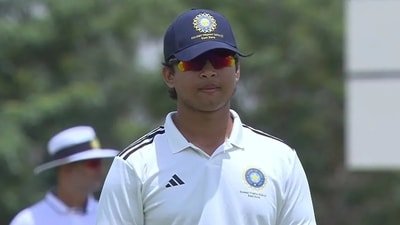
Watch the innings more closely, though, and something considerably more important emerges. This was not simply Vaibhav bringing his T20 game into the Duleep Trophy. It was perhaps the clearest evidence yet of a 15-year-old beginning to understand what red-ball cricket requires from him.
The sixes remained. The power remained. The instinct to punish anything in his hitting zone remained. What changed was what happened between those shots. Sooryavanshi was willing to defend. He was willing to allow a good delivery to remain a good delivery. More significantly, whenever the ball was not quite there to be launched, he repeatedly looked to keep his strokes along the ground rather than manufacture an aerial option simply because he possesses the ability to do so.
The 70 runs that tell only half the story
There is a fascinating split hidden inside his 92. Seven fours and seven sixes meant that 70 of his runs came in boundaries. That is 76.09 per cent of his entire innings and, viewed in isolation, appears to confirm everything already known about Sooryavanshi.
The other side of the calculation is more revealing. Those 14 boundaries occupied only 14 of the 81 balls he faced. Across the remaining 67 deliveries, Sooryavanshi scored just 22 runs. There were therefore long passages in which the teenager who has built his reputation by destroying bowling attacks was defending, rotating strike or simply waiting.
That is not a minor detail in his development. It is possibly the most important one. The challenge of first-class cricket was never going to be teaching Sooryavanshi how to hit a cricket ball. Very few teenagers in the world require less instruction on that front. The challenge was whether he could accept that there are periods in a four-day game when the bowler wins several deliveries without the batter losing the contest.
Against Central Zone, he increasingly appeared comfortable with that idea. He began rapidly, reaching 40 from 28 deliveries. There was width and there were balls in his arc, and Sooryavanshi took advantage. But after being dropped on 40, the response was instructive. There was no frantic attempt to punish the fielding side immediately for giving him another life. His next 10 runs required 14 deliveries, taking him to his record-breaking fifty from 42 balls.
Even after reaching the landmark with a six off Saransh Jain, he did not suddenly decide that every spinner had to disappear. The score eventually became 92 from 81. In other words, his first 50 took 42 balls and the next 42 came from another 39. His scoring rate actually fell after the half-century rather than accelerating wildly towards three figures. For somebody whose natural instinct is attack, that is significant.
Vaibhav is beginning to add gears rather than remove aggression
There can sometimes be a lazy assumption around attacking young batters that becoming a better red-ball player means becoming more defensive. It does not. The objective should never be to remove what makes Sooryavanshi extraordinary.
What he needs are additional gears. This innings suggested they are beginning to appear. When Central Zone offered him something to hit, there was no hesitation. Aryan Pandey was taken on. Harsh Dubey was cleared. Saransh Jain was attacked whenever Sooryavanshi felt the length allowed him to get underneath the ball. Seven sixes in a first-class innings are hardly evidence of a teenager putting his natural game into storage.
Yet those strokes increasingly appeared to be responses to deliveries rather than predetermined decisions. There were occasions when Sooryavanshi got onto the front foot and simply blocked. At other times, rather than trying to create elevation, he punched or drove along the turf. He allowed Abhimanyu Easwaran to occupy periods of the partnership without feeling compelled to compete with his senior opening partner for the scoring rate.
That is one of the fundamental adjustments between limited-overs and first-class batting. In T20 cricket, a sequence of dots creates pressure because the innings is running out of balls. In red-ball cricket, the same sequence can mean almost nothing if the batter remains at the crease.
Sooryavanshi appears to be discovering that distinction remarkably quickly. The contrast with his first-class numbers entering the semifinal makes the innings even more significant. Before Monday, he had managed 215 runs from 13 first-class innings at 16.53. His only previous fifty was a 93 for Bihar against Meghalaya. For all the extraordinary things he had already achieved elsewhere, the longest format remained the part of his game with the most unanswered questions.
The 92 does not answer all of them. It should not. He is 15. But it changes the nature of the conversation.
Also Read: Vaibhav Sooryavanshi leaves selector RP Singh shocked as he slams bat and hangs face in disbelief after missing century
The dismissal showed there is still another lesson waiting
Ironically, the innings ended with precisely the kind of decision Sooryavanshi is still learning to manage. As the hundred came into view, he attacked Jain to move rapidly through the eighties and into the nineties. Having reached 92, he tried to take Harsh Dubey over the leg side again and was caught at deep mid-wicket. Eight runs separated him from a maiden first-class hundred and from another extraordinary age record.
The frustration afterwards was obvious. But the dismissal should not obscure what preceded it. Red-ball development is rarely linear. The important question at this stage is not whether Sooryavanshi made the correct decision on every one of the 81 deliveries. It is whether the range of decisions available to him is expanding.
On Monday, it clearly was. A batter once primarily identified by what happened when the ball entered his arc spent portions of a Duleep Trophy semifinal showing that he is beginning to understand what to do when it does not.
That could eventually matter far more than whether this particular innings ended at 92 or 100. Sooryavanshi does not need red-ball cricket to tame him. India will hope it never does. What he needs is to learn when to unleash the game that makes him different and when to preserve his wicket until the opportunity arrives.
At 15, he already appears to be learning that separation. And if the attacking game remains intact while patience, defence and shot selection continue to develop around it, the frightening prospect is not the records Sooryavanshi is breaking now. It is the batter he could become once he has fully learnt how to make time work for him rather than against him.