For Vijay Subramaniam, Artificial Intelligence (AI) is not meant to replace the people who tell stories. He sees it as another tool that can help filmmakers think bigger, work faster and take on stories that may otherwise be difficult to produce. As Group CEO of Collective Artists Network, Subramaniam has built the company around talent, creators and content, while also exploring newer ways of making and distributing entertainment. He recently produced Musafir Cafe, starring Vikrant Massey, Vedika Pinto and Mahima Makwana. His latest focus is on using technology to bring Indian stories, particularly those rooted in mythology and history, to a wider audience.
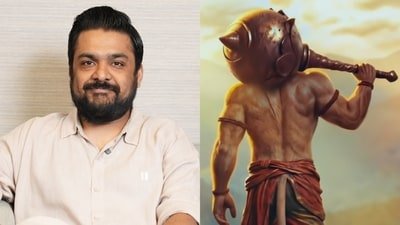
Projects such as Mahabharat and Chiranjeevi Hanuman are part of that vision. But Vijay’s argument goes beyond the technology itself. In a conversation with Hindustan Times, Vijay discusses AI, the future of creative jobs, India’s rich mythology, reaching younger audiences and his plans for Collective Artists Network.
‘AI brings down the cost of production’
Vijay looks at AI as the latest step in a long line of technological changes that have shaped filmmaking. He draws a comparison with animation, VFX and Unreal Engine, all of which have expanded what filmmakers can create while making large-scale production more achievable.
He says, “A lot is made of this word AI. What people need to understand is that when Unreal Engine came in, when VFX was invented, when animation techniques came in, it basically brought down the cost of production and helped you tell stories at a grander level. It’s as simple as that. I look at AI as a tool. If you ask me what is changing, nothing changes from the first principles of filmmaking. There are writers, directors, production designers, costume designers, DOPs and all your HODs. Those people will remain in an animated film or a live-action film. You have to be good at your job even in a film that is backed by technology.”
He adds, “Today, of course, we are working with hybrid pipelines. Are we doing everything on AI? No. We are also using a lot of 3D and VFX, and running them through AI pipelines. But from motion capture to image transfer to emotion transfer, we are able to do it at scale simply because it is affordable. Otherwise, if I have to make Mahabharat, be true to Mahabharat and make it like Game of Thrones, it’s going to cost me more than ₹1,000 crore and take me seven or eight years to make. So, for me, the pivot was very simple. I wanted to tell stories of India. I wanted to tell stories of Indian history, and I wanted to tell them at scale.”
‘In the creative field, AI is only enhancing creativity’
AI’s impact on jobs has become one of the biggest concerns around the technology, particularly in creative industries where animation, VFX, illustration and design are all increasingly using AI tools. Vijay, however, does not believe this necessarily means that creative professionals will be pushed out. He points to the people already working on his projects and says the technology is being used to support their work rather than replace them.
He asserts, “I have engineers who are doing work in creative fields. I have VFX supervisors, sketch artists, storyboard artists — they’re all part of the production. There is so much hype about this. Maybe it’s true in other jobs where AI is taking jobs, but in the creative field, it’s only enhancing creativity. I have three National Award-winning directors making films. So, for me, that is not really a problem. I think people are overhyping this idea that AI will take your job away in the creative field.”
The concern, however, is not limited to filmmaking. Across media, there is already a shift towards expecting one person to take on multiple responsibilities, with technology making it easier to write, edit, research and produce content. Vijay sees this as part of a much larger pattern of change rather than something unique to AI. He says, “But how is that different from any evolution? It is as debatable as any other industrial revolution in history. You’ve had lakhs and lakhs of postmen all around the world. Then email happened. What do you do then? Back in the day, before the internal combustion engine was invented, you had chariot riders. Then you got from Point A to Point B faster. Today, you have Pepsi being delivered to your house in 10 minutes without going to the kirana store. Technology advancement always comes at the cost of some incumbency. You can’t just look at it from field to field. You have to look at it as universal technology. The internet didn’t disrupt one sector. It disrupted all sectors. So, I don’t know why there is so much noise around this.”
He adds, “The absolute truth of the matter is that I have a National Award-winning director releasing a film, and he tells me that he could not have imagined making it if he didn’t have these tools available. I just feel that people need to wake up and smell the coffee and end this debate. It’s an armchair debate. It’s been going on for a couple of years, and a lot of people use AI behind closed doors. You can do something at ₹100, and you can do something at ₹200, but the output will be the same. Why would you not be more economical?”
‘Hanuman’s gada is greater than Thor’s hammer’
Vijay’s interest in mythology comes from a personal place too. Watching his children connect so easily with Marvel superheroes made him wonder why Indian mythology has not been given the same scale, imagination and consistency in storytelling. He says, “I have a 13-year-old and a 10-year-old, and they love the Marvel universe. I saw Spider-Man last week. I come from a defense background, so I have a very simple question: if we are the land of folklore, myth and mythology, how much of our mythology is actually being told at scale and repeatedly across generations?”
He adds, “Myth was made in Ramayan, and you still think of Ramayan only through Ramanand Sagar. I’m making Hanuman because when was the last time — I mean, Hanuman’s gada is greater than Thor’s hammer. Why are we not telling these stories? And again, I’m not saying this from a point of view of religion. I’m saying that we keep talking about Indian food, the big fat Indian wedding, but the actual thing that percolates across the world from India is its culture and history. We are a civilisation that has withstood over a thousand years of plundering. So I’m asking: when was the last time somebody put every piece together? The last time somebody did that was Ramanand Sagar, a long time ago. I’m just asking, what would Amar Chitra Katha look like in today’s day and age? And there’s a very devout and proud Indian in me that wants to tell these stories. Why? Because it makes a very material, very clear impact on the way I see India and the world.”
‘I want India’s history to have the world’s biggest stage’
Vijay believes the strength of Indian mythology lies in the fact that the stories are already deeply familiar. The challenge is to find a fresh way of presenting them so they connect with a new generation. He says, “It’s about the world you create and the treatment of the story. Christopher Nolan adapted Batman differently, but the core story — Bruce Wayne losing his parents — remains the same. Similarly, with age-old tales, whether it’s Jodha Akbar, Ramayan or Mahabharata, the essential plot points remain. What matters is interpretation.”
He adds, “For us, India’s Historyverse has to be visually at par with, if not better than, Marvel films. It should evoke the richness of our history and culture in a sensory, immersive way. The ambition isn’t simply to make content about religion or God. It is to create something so compelling that a child would choose Hanuman as a screensaver over Superman.”
About Historyverse
HistoryVerse is a slate built around some of India’s best-known figures from mythology and history. The initiative features eight titles centred on characters including Hanuman, Krishna, Shiva, Shivaji, Durga, Kali and Swami Samarth. The AI-powered Mahabharat series was the first step in this larger plan, while Chiranjeevi Hanuman – The Eternal is also in the works.