Taapsee Pannu has often spoken about how an actor can get boxed into a certain image once audiences and filmmakers associate them with a particular kind of role. After years of playing strong, intense characters, she feels that perception can sometimes be a limitation. In a recent chat with Hindustan Times, the actor spoke about Gandhari, the creative bankruptcy in Bollywood and why the industry only offers her certain kinds of roles.
What Gandhari gave her
For Taapsee, the conversation around casting is not limited to the kind of stories actors are offered. She feels that an actor’s appearance can also shape how filmmakers picture them in a role. “When it comes to certain visuals of a character, it’s a lot to do with vanity more than how that actor is born and looks,” she says.
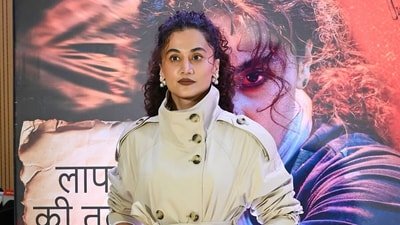
Gandhari gave Taapsee a chance to break away from that image. She plays Bani, a mother desperately searching for her kidnapped daughter, and her journey takes her into the unsettling world of Joypurra, where she uncovers a series of disturbing truths.
A big part of her transformation stemmed from how Bani was visually created. Taapsee credits her hair, makeup and costume teams for helping her look completely different from her usual self. “I would like to take the credit, not just myself, but with my look-creating people — the hair, makeup, costume — to be able to make me look like Bani in this film, because I’m nowhere close to her in real life, how I look,” she adds. “Even on my worst stress days, I will not look like that.”
That, she feels, is how an actor should approach a character. You do not necessarily have to look like the person you are playing in real life. Sometimes it is the story and world of the film that determine what the character should look like. “It’s the character and the world that demanded me to look like that,” she says.
Taapsee says Bollywood needs to take more casting risks
Taapsee also believes that Bollywood’s casting choices play a role in why so many films today end up feeling similar. She feels that filmmakers often return to the same actors for similar stories, leaving little room for a fresh combination of actor and character. If the industry wants its films to feel different, she believes the casting needs to change, too.
“All the rom-coms, glam stuff looks the same because there are only those four or five actors, actresses who are doing that. All our thrillers look and feel the same because there are only those four or five actors who are doing that,” she says. “If you really want your film to look different, something new, something different, then you need to cast people who can bring that difference on screen.”
For Taapsee, putting a familiar actor in a different outfit or changing their styling does not necessarily make the character feel new. The audience already has a certain image of an actor, and that stays with them even when the appearance changes. “If I’ve seen someone in a glamorous role, now you make that person wear a sari or a bikini or whatever, I have seen the glamour of that actor. It’s only different, right?” she adds. “So that’s not the fault of that poor actor, also.”
She admits that her own career has also been shaped by a similar perception. Taapsee has increasingly been associated with intense roles and strong female characters, and she says that is partly because those are the scripts that keep coming her way. Naturally, she will pick the best ones from what is offered, but that only strengthens the image people already have of her. She says, “If you only offer me 10 intense films, I will choose the best out of them and present that, but it will still be a strong woman, intense film because that’s the only genre that people have started imagining me.”
‘Everything runs on algorithms’
Taapsee also has concerns about how much the industry now relies on data to decide what might work. She feels that constantly looking at past successes and audience patterns can leave very little room for filmmakers to take a chance on something new. “Everything runs on algorithms, right? Like, are there past records? Whatever’s happened in the past or the algorithm says that this works or this reaches this audience, this doesn’t reach that audience,” she reveals. “They’re all relying on the past records. If you keep relying on past records and algorithms, how will you go in the future?”
She believes the things that stand out tomorrow may be the very things that today’s data cannot predict. For her, audiences are more likely to connect with something when it feels genuinely different rather than like another version of what has already worked. “Because in future, whatever’s different is going to cut through the algorithm is what will work,” she says.
That is also why Taapsee wants to keep pushing herself beyond the image created around her. She does not want her past work to decide what she gets to do next. More than anything, she wants filmmakers to take a chance on stories and actors that do not necessarily fit an established formula. “We’ll only have one Obsession coming from the West and be very happy about, ‘Oh, something different,’ and then remake it here. I hope someone approves it when it is an original here,” she concludes.
About Gandhari
Directed by Devashish Makhija and written and produced by Kanika Dhillon, Gandhari centres on Bani, played by Taapsee Pannu, whose world is upended when her daughter is abducted. Her search leads her to Joypurra, a fictional town where fear runs deep and the mysterious Behrupiyas are closely woven into its culture. As Bani digs deeper, she finds herself caught in a dangerous web of secrets.
Ishwak Singh plays Gokul, a father searching for his missing daughter, while Jatin Sarna steps in as Kabir, the police officer handling the investigation. Swastika Mukherjee, Mita Vashisht and Chhaya Kadam round out the cast. The film premiered on Netflix on September 3.