Only last week, audiences witnessed Sacha Baron Cohen’s sarcastic takedown of patriarchy in Netflix’s Ladies First. The film follows a white male executive who treats the women around him like props. But when this chauvinistic, power-hungry man finds himself in an alternate world dominated by women, he is forced to experience the same sexism that he once subjected his female colleagues to. It is only when women dictate the terms to this ‘dictator’ that he begins to recognise his mistakes and make amends.
Not sabki pasand, and proud of it
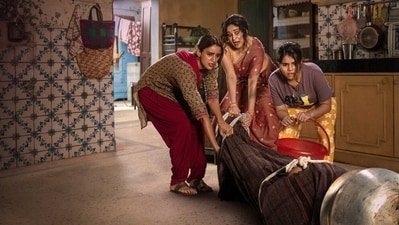
But the real world doesn’t function like that, does it? Here, women have to fight, struggle, and sometimes even deceive or lie to survive. And in extreme circumstances, they may have to become kidnappers. In Suresh Triveni’s Maa Behen, three so-called “abla naris” — Rekha (Madhuri Dixit) and her daughters Jaya (Triptii Dimri) and Sushma (Dharna Durga) — find themselves pushed to that very edge.
Rekha, Jaya and Sushma have been battling patriarchy for as long as they can remember. Even their names are borrowed from old detergent powder brand Nirma’s commercial, where women wash away stains left behind by men because, apparently, cleaning up after a husband is a woman’s job.
But things don’t become worse for the trio when Rekha’s husband dies. It becomes worse when Rekha and her daughters refuse to change themselves after the tragedy.
No man, no rules, no apologies
A widow with two daughters, dressing up, wearing lipstick, and choosing joy is simply too much for society to handle. How dare she be happy when her husband is dead? If your better half is gone, shouldn’t half of you die with him? At least that’s the script society has written for women. But Rekha refuses to play the part, even if that means being treated as an outcast.
She dresses just as she always has — in sleeveless blouses, bright red lipstick, and roses tucked into her hair. She refuses to dedicate her life to mourning or retreat into the white sarees society deems appropriate for her misfortune. She steps out, eats chowmein with her daughters and laughs loudly.
What a disaster. No husband, no father, no male guardian keeping these women in line. Surely they have gone rogue.
The Rekha angle
Rekha is openly called a witch by her neighbours, who lack the courage to confront her but have no problem painting witch graffiti on her walls. This character inevitably brings to mind veteran actor Rekha, who faced similar vilification after her husband Mukesh Aggarwal’s death in 1990. Society expected her to dim her light. She didn’t. She didn’t abandon her silk sarees, or give up her iconic red lipstick. She carried on being herself and, in doing so, remained an icon.
While society considers these women a danger to the sanctity of the ‘samajh’, men simply cannot seem to get enough of them, and other women can barely conceal their envy of their confidence and happiness. Rekha faces relentless eve-teasing because, apparently, a woman without a husband is a “khuli haveli” . Jaya is forced into marriage with the very man who harassed her, her world shrinking to a kitchen where she spins rotis as endlessly as the cycle she’s trapped in. Sushma, abandoned by her father she never knew, searches for affection in men, only to find herself betrayed and exploited by them.
You could argue that it is a little convenient that all three women from the same household end up being wronged by men. Then again, perhaps predators see them as easy prey because they have no male guardian standing over them, or perhaps it is their conditioning to keep seeking protection and love from them.
Doesn’t need ‘charitra’ certificate
What is remarkable, though, is the confidence with which the men who harass these women declare themselves paragons of virtue. The film even names its villain ‘Charitra Singh’ (Ravi Kishan), because who better to issue character certificates than a stern, self-righteous family man? Rekha is shamed for wearing a sleeveless blouse, while the men casually spend half the film bare-chested, eating, lounging, and existing with their armpit hair proudly on display. Afterall, modesty is a burden reserved exclusively for women.
Maa Behen gives it back
But when these women are filled to the brim with betrayal, humiliation, and the endless burden of proving their morality, they stop bending. They break. They break every social norm that has confined them and every relationship that has sought to control them. They pick up a slipper and slap the sexist slur that has been used to demean them for generations. And they do it while laughing. But this laughter isn’t a sign of joy. It’s a sign of resignation. They waited for society to change. It didn’t. They aren’t waiting anymore.
PS: A black cat follows these women throughout the film, a nod to the age-old superstition that when one crosses your path, something bad is about to happen. Perhaps something bad will happen. Perhaps this black cat has come to warn those who refuse to let women simply be.