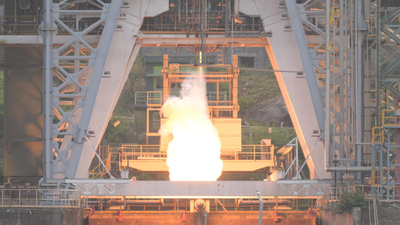
BENGALURU: Isro has taken another step towards building a more powerful version of its heaviest rocket, LVM-3, with the successful completion of a crucial test of a new semi-cryogenic engine that is expected to significantly boost the carrying capacity of future launches.The test, conducted on June 24 at the Isro Propulsion Complex in Mahendragiri involved firing the “Power Head Test Article (PHTA)” at 175 tonnes of thrust, or 88% of the engine’s planned full power. It marks the highest thrust level achieved so far during the development of the engine.Unlike a complete rocket engine, the PHTA contains almost every major component except the thrust chamber, where the actual exhaust flame is produced. Testing these systems separately allows engineers to verify that the engine’s most complex parts, including the pumps, valves and fuel delivery systems, work together safely before assembling the full engine.This was the eighth hot test in the development programme. Earlier tests had been carried out at 94 tonnes and 120 tonnes of thrust. The latest trial was designed to study how the engine settles into stable operation immediately after ignition and whether it can sustain much higher power levels.According to Isro, the test proceeded exactly as predicted. The engine’s main turbopumps, which force propellants into the combustion chamber under extremely high pressure, also operated successfully, reaching outlet pressures of 400 and 500 bar. For comparison, that is several hundred times greater than the air pressure inside a car tyre.The successful trial gives engineers confidence to move towards testing the engine at its full design thrust of 200 tonnes, an important milestone before the engine can eventually be qualified for flight.The engine is being developed for a new semi-cryogenic propulsion stage, known as “SC120”, which will replace the existing L110 liquid core stage on India’s LVM-3 launch vehicle. LVM-3 is currently Isro’s most powerful operational rocket and is used for missions such as launching heavy communication satellites and supporting India’s human spaceflight programme (in a modified avatar).The new stage is powered by the 2,000-kilonewton-class SE2000 engine and burns liquid oxygen along with purified kerosene, known as Isrosene. Engineers describe it as “semi-cryogenic” because only the liquid oxygen has to be stored at extremely low temperatures, while the kerosene remains in liquid form under normal conditions. This makes the system less complex than fully cryogenic engines while still delivering high performance.Replacing the current core stage with the new semi-cryogenic system is expected to allow LVM-3 to carry heavier satellites into space. It is also expected to improve efficiency and reduce operational complexity. Isro plans to pair the new stage with an upgraded cryogenic upper stage, a combination that could substantially increase the rocket’s payload capability.Mastering semi-cryogenic propulsion has long been one of Isro’s major technological goals, as it is seen as a key step towards launching heavier spacecraft more economically and supporting the country’s expanding ambitions in commercial launches, deep-space exploration and future human spaceflight missions.