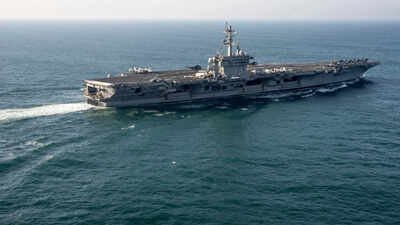
The United States is pulling its last aircraft carrier from the western Pacific as President Donald Trump’s war with Iran stretches the Navy’s ability to keep its biggest warships deployed, temporarily leaving a region where China is expanding its military presence without one of America’s most visible symbols of power.The USS George Washington is leaving the Pacific to head for the Middle East, where it is expected to replace the USS Abraham Lincoln, which has spent more than eight months at sea supporting US operations against Iran.The move will temporarily leave the western Pacific without an American aircraft carrier, a potentially short-lived gap if the Navy sends another carrier to the region in the coming months, but one that analysts say carries symbolic weight for US allies and for China.The Washington’s redeployment comes as concerns mount over the strain of prolonged deployments on the Lincoln’s roughly 5,000 sailors and Marines. The carrier has now spent more than 260 days deployed, with its return repeatedly pushed back as the Trump administration continues its military campaign against Iran.It was separately reported that the Lincoln is expected to return after a 266-day deployment, amid growing scrutiny over the welfare of its crew.
A carrier gap in the Pacific
The absence matters because an aircraft carrier’s presence is also intended to reassure US allies and demonstrate Washington’s ability to project military power across the region.China regards the US military presence in the western Pacific as a challenge to its ambitions, including its claim over Taiwan. The United States, meanwhile, has repeatedly described the Indo-Pacific as a central strategic priority.But the war with Iran is pulling American military resources in the opposite direction.“The administration says that the Pacific is supposed to be the most important behind the Western Hemisphere,” said Greg Poling, director of the Southeast Asia Program at the Center for Strategic and International Studies in an interview with news agency AP. Instead, he said, Washington is doing the opposite of its previously stated goal of reducing its Middle East commitment.For China, the temporary absence of an American carrier provides an opportunity to demonstrate its own reach, said Bryan Clark, a former Navy submariner and defense analyst at the Hudson Institute in an interview with AP.Clark said Beijing could use the gap to reinforce the message to countries including Japan, the Philippines and Indonesia that China is becoming the dominant military power in the western Pacific.No one expects China to launch an invasion of Taiwan simply because one American carrier has left the region. But the absence gives Beijing another opportunity to display its strength, Clark said.
China is already testing the waters
The carrier withdrawal comes against a backdrop of increasing Chinese military activity around contested areas of the western Pacific.China conducted naval exercises with Indonesia this week and has recently carried out military activities involving Japan and the Philippines, both US allies with territorial disputes with Beijing.Chinese forces also conducted drills near the Scarborough Shoal in the South China Sea this month. China and the Philippines both claim the feature.Last month, a Chinese guided-missile destroyer conducted a live-fire exercise near Japan’s southernmost island of Okinotori.The US has tried to reassure its partners that the movement of the George Washington does not signal an abandonment of the region.Adm. Frank Bradley, head of US Special Operations Command, visited Manila on Thursday and told Philippine officials that American special operations forces were prepared to expand joint exercises. He is also expected to travel to Japan.Still, Evan Sankey, a policy analyst at the Cato Institute who studies US policy toward China, told AP that the lack of an aircraft carrier adds to the perception that Washington is distracted by the conflict in the Middle East.
The Lincoln’s unusually long deployment
The George Washington’s move is also a consequence of what has happened to the Lincoln.The ship has spent more than 240 consecutive days at sea, setting a modern record, according to AP. The deployment has drawn increasing scrutiny from lawmakers and military families concerned about the conditions faced by its crew.
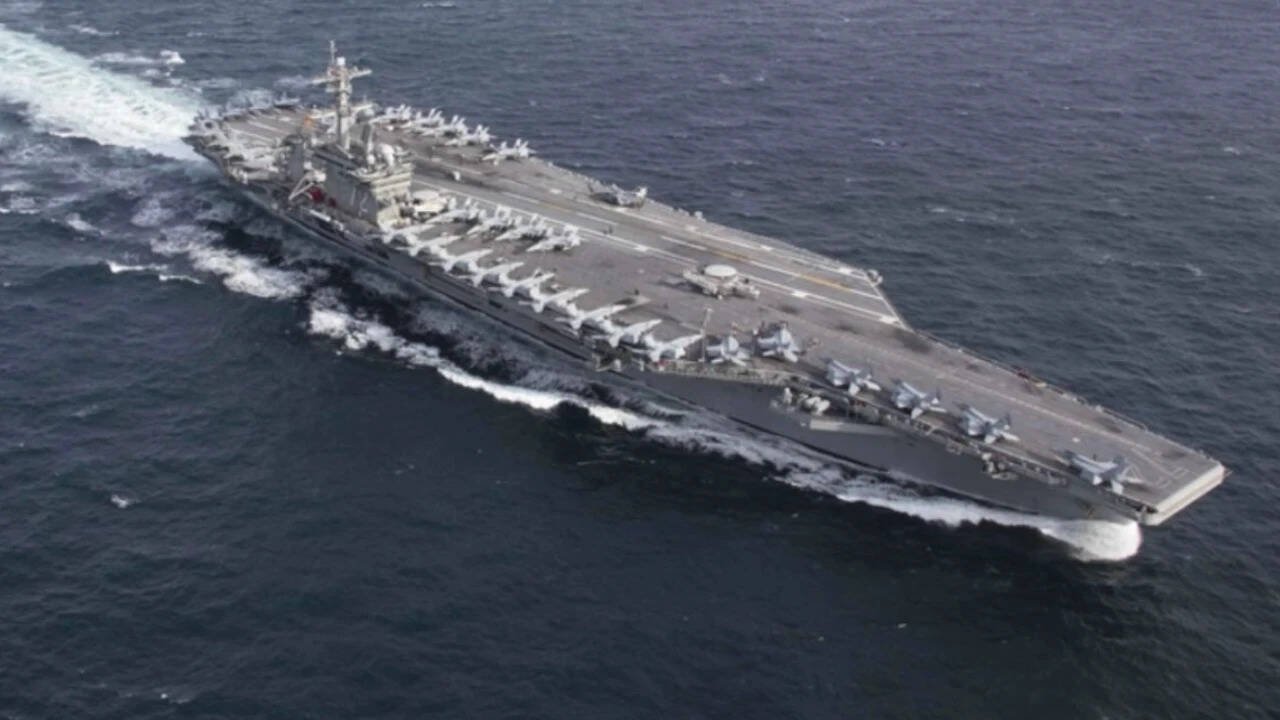
USS Abraham Lincoln has been at centre of controversy over its prolonged deployment affecting sailors’ mental health
Reports have raised concerns about food and other supplies, plumbing, water, mail and mental health aboard the ship. Democratic lawmakers have called for greater congressional oversight.There were allegations that some sailors aboard the carrier attempted to jump overboard amid the prolonged deployment and mounting mental-health concerns.The Pentagon has pushed back against some of those reports. Defense secretary Pete Hegseth said accounts of poor conditions aboard the Lincoln had been “completely misrepresented”, while Navy officials have denied that there has been a rise in suicidal ideation among the crew.Trump has also defended the prolonged mission, saying the Lincoln’s deployment was “not nearly long enough.”Also read: USS Abraham Lincoln to return home amid rising scrutiny over sailor welfareTrump has increasingly relied on aircraft carriers as the United States conducts military operations during his second term.The Navy operates 11 aircraft carriers, but only a fraction can be deployed at any one time. Others are undergoing maintenance, training or preparing for future deployments.Bryan Clark said the extended Iran war could create a longer-term maintenance problem because carriers returning from unusually long deployments will need substantial work.If the USS Theodore Roosevelt is also sent toward the Middle East, the Navy could have four carriers deployed simultaneously, potentially allowing the George Washington eventually to return to the Pacific.But that would create another problem: maintenance.The US has only two shipyards capable of carrying out major carrier maintenance, creating the possibility of a backlog as heavily used ships return from deployment.The result could be fewer carriers available for routine deployments even after the Iran war eventually winds down.
Are giant carriers still the future?
The strain is also reviving a broader debate inside US defense circles: how much should America continue to rely on giant aircraft carriers in an era of cheap drones, long-range missiles and increasingly sophisticated anti-ship weapons?Michael Swaine, a senior research fellow at the Quincy Institute’s East Asia Program, argues that carriers are becoming increasingly vulnerable to drones and missiles, particularly against a technologically capable adversary such as China.Smaller ships, submarines and other systems could potentially deliver some of the same capabilities without putting such an enormous and expensive platform at risk.For now, however, the Navy still needs the carriers, and Trump’s Iran war is forcing it to move them around the globe.As Washington pours military attention into the Middle East and the Western Hemisphere, the western Pacific — the region the administration has said should be a central strategic priority — is temporarily without an American aircraft carrier.