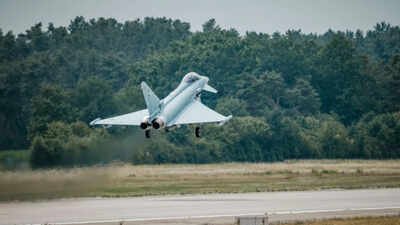
Europe is increasing defence investment to ward off the spectre of Russian aggression. The UK has unveiled its Storm Fighter loyal-wingman programme, while Germany is fielding its first Tranche-4 Eurofighter under Project Quadriga. These moves highlight a broader European push to modernise armed forces — including air power — to strengthen collective security on the continent. The shift is driven by the deteriorating security environment created by Russia’s war in Ukraine and by Washington urging allies to take greater ownership of their defence as the US pivots its strategic gaze toward the Pacific.European states are investing in military capabilities to safeguard sovereignty, deter further Russian adventurism and ensure long-term stability. Two high-profile developments illustrate this trend: the UK’s Storm Fighter programme and Germany’s induction of Tranche-4 Eurofighters. Both are emblematic of Europe’s renewed resolve to defend itself at a time when transatlantic burden-sharing is under pressure.The UK’s Storm Fighter programme represents a revival of ambitions for collaborative combat aircraft. Announced at the Global Air and Space Chiefs’ Conference in London, Storm Fighter is designed as a loyal-wingman drone to operate alongside Typhoon, F-35 and the future Tempest. It forms part of a broader £6.6 billion modernisation package over four years, with £406 million earmarked specifically for autonomous combat aircraft. Defence officials say the platform must be “good enough, cheap enough, fast enough, and available in sufficient numbers,” reflecting a focus on affordability and rapid production.The drones are envisioned as “guardian angel and attack dog” systems capable of defensive and offensive missions, including electronic warfare, strike and aerial combat. If realised, the initiative would position the Royal Air Force as the first European air arm to operate a sixth-generation fighter concept, integrating manned and unmanned assets into a cohesive warfighting structure. The programme also signals renewed seriousness after the cancellation of Project Mosquito, and industry players such as BAE Systems and Boeing have expressed interest.Meanwhile, Germany has tested its first Tranche-4 Eurofighter at Airbus’ Manching facility. The Eurofighter is jointly developed by the UK, Germany, Italy and Spain. Germany has ordered 38 Tranche-4 aircraft, which will replace older Tranche-1 jets in the Luftwaffe. Tranche 4 includes modernised avionics and will incorporate the European Common Radar System Mk1 AESA radar, enhancing detection, electronic warfare and target recognition. All 38 aircraft are scheduled for delivery by 2030. Work is also underway on a Tranche-5 standard; 20 aircraft are planned to be upgraded to that standard and will replace Tornados in the electronic-warfare role.Together, the UK’s Storm Fighter and Germany’s Tranche-4 Eurofighter illustrate Europe’s dual-track approach: investing in cutting-edge autonomous systems while modernising existing fighter fleets. These efforts are part of a wider European trend — Spain and other partners are advancing their Eurofighter programmes and countries are exploring collaborative drone projects. The underlying rationale remains clear: Russia’s aggression has upended Europe’s security order, and NATO allies are responding with proportionate measures to defend their territories and populations.