Long before T20 cricket created an industry around power-hitting, long before strike rates, boundary percentages and six-hitting range became essential parts of a batter’s profile, Garry Sobers produced an over that appeared to belong to another age.
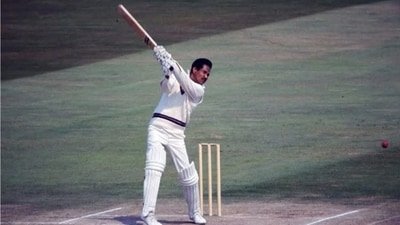
Except it happened in 1968. Sobers, widely regarded as the greatest all-round cricketer the game has known, died on Friday at the age of 89, just days before his 90th birthday. His career contained achievements that would have been sufficient for several great players: 8,032 Test runs at an average of 57.78, 26 centuries, 235 wickets and 109 catches.
Yet one of the most enduring images of Sobers requires only six balls. On August 31, 1968, playing for Nottinghamshire against Glamorgan at St Helen’s in Swansea, Sobers became the first batter in first-class cricket to strike six sixes from the six legal deliveries of an over.
Professional T20 cricket would not be introduced until 2003, another 35 years later. Sobers had already shown what its most celebrated form of destruction could look like.
This was no modern white-ball setting. There were no fielding restrictions designed to promote boundary-hitting, no shortened boundaries brought in for a television spectacle and no dugout calculating match-ups. Sobers was playing a three-day County Championship match in traditional whites.
There was, however, a clear tactical purpose. Nottinghamshire wanted quick runs before declaring, and their captain decided to supply them himself.
Six balls that travelled through cricket history
Malcolm Nash, normally a left-arm seam bowler, was experimenting with spin. He had already taken four wickets in the innings and would finish with figures of 4/100. Sobers, though, identified the opportunity immediately.
The first delivery disappeared over midwicket. The second was dispatched over the leg side again. When Nash pushed the third wider, Sobers sent it straight over the boundary. A shorter fourth delivery was pulled away with the same result.
Four balls. Four sixes.
The fifth nearly ended the sequence. Sobers lofted the ball towards long-off, where Roger Davis completed the catch but lost his balance and fell backwards over the boundary while holding the ball. A regulation introduced at the beginning of the 1968 season required a fielder completing a catch to remain inside the playing area. The umpires therefore signalled six. Had the same incident occurred one season earlier, Sobers would have been dismissed.
Instead, he remained on strike. By then, the record had entered his thoughts. Sobers later said he had not begun the over intending to hit six sixes. It was only before the final delivery that he recognised how close he was.
“I never went out with any anticipation of hitting six sixes,” Sobers recalled. “It’s only when I got to the last one, I decided, ‘I am too close now, I have to hit this last ball for six.’”
Nash delivered again. Sobers swung the ball high over midwicket and out of the ground.
“And he’s done it! He’s done it!” commentator Wilf Wooller exclaimed. “And my goodness, it’s gone … way down to Swansea!”
Six legal deliveries had produced 36 runs — a strike rate of 600 for the over.
Sobers finished unbeaten on 76 as Nottinghamshire declared at 394/5. The assault was not merely a spectacular interruption to an otherwise forgettable county match. Nottinghamshire went on to win by 166 runs, with Sobers adding 72 in the second innings and taking two wickets in Glamorgan’s first. As the achievement attracted worldwide attention, Sobers resisted treating it as a monument to individual glory.
“Six sixes are not good cricket,” he said. “It was an occasion where we were looking for quick runs. The idea was to try and get as many runs as possible.” “Records must not be the focus,” he added. “It mustn’t come at the cost of the team.”
That response may reveal as much about Sobers as the hitting itself. A modern player achieving the feat would be surrounded by instant statistics, social-media clips, sponsor graphics and debates over whether it was the greatest over ever played. Sobers acknowledged the applause, returned to his mark and prepared for the next delivery.
Even the survival of the footage owed something to chance. A BBC crew was using the match for training and had been scheduled to stop recording. The production team continued filming beyond the planned transmission and captured approximately five minutes of black-and-white footage – the precise period in which Sobers made history.
Ravi Shastri eventually equalled the first-class feat in 1985. Herschelle Gibbs became the first to do it in international cricket during the 2007 ODI World Cup, while Yuvraj Singh followed against Stuart Broad in the inaugural T20 World Cup later that year.
By then, six-hitting had become central to cricket’s newest format. Specialist power-hitters were being developed, strike rates were rising and clearing the boundary was becoming a repeatable tactical skill rather than an occasional act of rebellion.
Also Read: Garry Sobers was one of a kind: His passing marks an end to the most glorious epoch in cricket history
Sobers had been there decades earlier. He was not a limited batter swinging blindly at a favourable match-up. His Test average of 57.78 places the over in its proper context. The same man who could construct monumental innings, including his then-world-record 365 not out, could suddenly abandon accumulation and overwhelm a bowler with six consecutive strokes.
Modern statistics cannot fully capture the speed of his scoring because complete balls-faced records were not maintained throughout his era. The available numbers still explain why the Swansea over was so extraordinary: it was produced by one of cricket’s greatest classical batters, not by a player selected solely to hit sixes.
T20 cricket eventually supplied the terminology: power-hitting, range, intent, and acceleration. Garry Sobers had already supplied the demonstration. Six balls were enough.