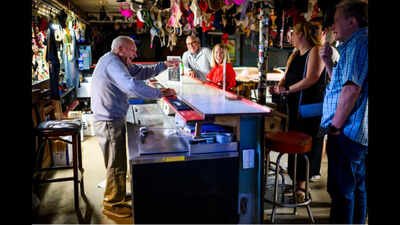
At 103, Irvin E Koch has spent more than six decades serving drinks from the basement of his own home in Pasadena, Maryland. The World War II veteran has been behind the bar since 1963, and even now, there is no fixed time for the working day to begin.“The hours are very simple,” Koch, widely known as Irv, told The Washington Post. “When the first one gets here, that’s when it opens up,” he said. Closing time is just as flexible. The bar shuts when the customers leave or when Irv gets tired.The place is officially called Club Sunset Knoll, but it is better known as Irv’s Basement Bar. Located inside the waterfront house that Irv bought in 1963, the cash-only tavern has changed little over the decades. Its lights remain dim, drinks are inexpensive, a jukebox plays music and an old Smith Corona cash register still sits behind the counter.Irv has changed little in another respect- he still enjoys talking to customers and delivering one-liners that have been polished over decades. Asked recently whether he was the oldest bartender in the world, he replied, “Don’t ask me. I haven’t been around the world yet.” By several unofficial accounts, he is indeed believed to be the world’s oldest bartender.
A bar that came with the house
Irv’s journey behind the counter was not the result of a long-held plan to enter the bar business. Born in 1923, he grew up poor in a south Baltimore neighbourhood, much of his childhood falling during the Great Depression. As a teenager, he joined the US Navy and served in the Philippines during World War II. His younger brother, Harry, later followed him into the armed forces.After the war, Irv worked as a builder for Sears and later as a plumber alongside Harry. His career changed when he bought the Pasadena property in 1963.The house had been built in 1912 as a summer home for a prominent Baltimore meatpacking family and was later converted into an inn. By the time Irv bought it, the property already had a functioning bar in its basement. “This was up for sale. We needed a house, so we bought the house – and guess what? The bar came with it,” Irv said.Instead of ignoring the unexpected addition to his new home, Irv decided to make it his livelihood. He never returned to another job. “Well, I was gifted it, so I took it. When I was born and all, everything was pennies, nickels and dimes. Now it’s twenties, fifties, hundreds. So that’s why I opened up the bar. For the money!” he said.His stepgrandson, Jason Cook, however, believes there is more to Irv’s decision to keep going. The bar makes enough money for Irv to live on, but Cook said his stepgrandfather also enjoys meeting and talking to people.“He loves the interaction, socializing with people. “He likes the attention, too. It definitely seems to keep him alive,” Cook said.

Irv, left, with his brother Harry from their younger year
Little has changed inside
Walking into Irv’s Basement Bar means entering a place that has largely resisted the changes outside it. Messages written by visitors cover walls, ceiling tiles, chairs and other surfaces. Customers have left their names and notes across the bar over the years. Its card tables are worn, the pool table still takes quarters and the old cash register remains in use.Police department patches from across the US are displayed inside, while a large banner featuring Irv’s face reads- “Drinking where the sun don’t shine.”One of the bar’s most unusual features is the collection of bras hanging from the ceiling. Many have names written on them by the women who left them there. Irv remembers the first woman to do so as Amy. “She did it, I didn’t do it,” he said.There is no website, no phone number and no fixed schedule for people planning a visit. Irv also does not use a cellphone and dislikes credit cards, so customers need cash.Yet the lack of modern conveniences has become part of the attraction. While people once visited mainly for cheap beer, many now come because the bar offers an experience that feels removed from the digital age.
A place people want to see while they can
On a recent evening, customers began arriving at around 6pm. Among them were regulars and a group of police officers. They ordered bottles of Coors Light while the jukebox offered music from performers including Buddy Holly and Dean Martin, along with country hits from 1960.Kathleen Hooper, 48, visited with her husband Robert to celebrate their 17th wedding anniversary. Although she had lived in the area for years, it was her first visit. “It’s almost like Ripley’s Believe It or Not meets ‘Coyote Ugly’ meets your neighbor,” she said.For Hooper, visiting had become something that needed to be done while Irv and his bar were still there. “This is a thing that people put on their bucket list. We just felt like we had to do it before we didn’t have the chance. Once it’s gone, it’s gone,” she said.Before leaving, she added her own message to a doorframe, joining thousands of visitors who have left their names behind over the years.Irv, meanwhile, has never seriously considered giving up the bar. Even after the deaths of his wife and his brother, he continued working. Cook, who now lives at the house with his wife and four children to help care for Irv, said his stepgrandfather never stopped.Asked whether he would make different choices if he could return to the past, Irv did not have many regrets. “If I could go backwards? There ain’t too much I would change,” he said.For now, Irv is looking forward to celebrating his 104th birthday in August. His basement bar continues to operate on the schedule it has followed for years and opens when the first customer turns up.