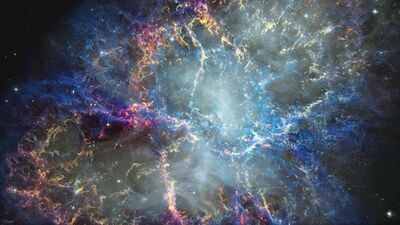
Nearly 1,000 years after people first saw a bright new star appear in the sky, scientists have measured how the remains of that explosion are still expanding today.In July 1054, court astronomers in China recorded a bright “guest star” near Tianguan, now known as Zeta Tauri. The object was so bright that it remained visible in daylight for nearly a month before continuing to shine in the night sky for several more months.That event is now known to have been a supernova, the powerful explosion of a massive star. The cloud of gas and dust left behind is called the Crab Nebula.According to a report by Space Daily, astronomers used the Hubble Space Telescope to compare new images of the Crab Nebula with pictures taken more than two decades ago.The comparison shows that the nebula’s gas filaments have continued moving outwards, allowing scientists to directly measure changes in the remnant of the ancient stellar explosion.Many objects in space change so slowly that people cannot observe the differences within a lifetime. The Crab Nebula is unusual because it is young, relatively nearby and still highly active.The findings were published in The Astrophysical Journal by William P Blair of Johns Hopkins University and his team.
Crab Nebula
The Crab Nebula lies about 6,500 light-years from Earth in the constellation Taurus. It is also known as Messier 1, or M1, and is the first object listed in Charles Messier’s famous catalogue of deep-sky objects.Although the exploding star was seen by people in 1054, the nebula itself was discovered through a telescope by John Bevis in 1731.Later, Charles Messier observed it while searching for comets and added it to his catalogue to help astronomers avoid confusing such objects with comets.
Hubble compared images
Instead of watching the nebula continuously for centuries, scientists compared Hubble images captured in 1999 and 2000 with new observations taken during Hubble’s Cycle 31 mission.Because Hubble can capture extremely detailed images, researchers were able to see that many of the nebula’s outer filaments had shifted outwards over the 24-year period. These small changes helped them measure how the remnant is still expanding.
Debris still moving
The study found that many of the Crab Nebula’s outer filaments have proper motions of 0.3 arcseconds per year or more. While that movement appears tiny because the nebula is so far away, it represents gas travelling at extremely high speeds. NASA says the gas filaments are moving outwards at around 5.5 million kilometres per hour.The Crab Nebula is not simply the remains of an old explosion. At its centre is the Crab Pulsar, a rapidly spinning neutron star left behind after the supernova.NASA says the pulsar rotates about 30 times every second. As it spins, it produces powerful magnetic fields that accelerate charged particles. These particles create the blue synchrotron glow seen inside the nebula, while older stellar material forms the network of glowing filaments around it.Because the pulsar continues to inject energy into the nebula, the remnant is still changing instead of simply drifting away from the original explosion.
New filament structures
The new Hubble observations were also compared with recent images from the James Webb Space Telescope. This helped researchers study different parts of the nebula, including gas, dust and synchrotron emission.The team also identified two previously unrecognised groups of filaments located almost opposite each other around the pulsar. The researchers reported the structures but said more work is needed to understand exactly how they formed.