For actor Adrija Roy, festivals are about preserving family traditions and staying connected to her Bengali roots. Reflecting on Kojagari Lakshmi Puja, celebrated after Durga Puja, she says, “It is very popular in Bengali culture, and almost every household celebrates it, whether on a small or large scale.” The 27-year-old, known for her work in Bengali cinema and Hindi television, recalls how the festival was a family affair, with her father and two uncles performing separate pujas. “In our house, it is a very special day. Depending on the timings and who is ready first, we begin the puja in their room. Unfortunately, I am not home this year, but I stay connected over the phone,” says the Anupamaa actor.
Having spent three days in Kolkata for Durga Puja before returning to work, Roy says she prefers observing Lakshmi Puja at her family home rather than performing the rituals independently. “I have grown up watching my family being very disciplined about the puja, from morning till night. I cannot compromise on the rituals. I have always been told that Lakshmi is Lord Narayan’s consort, and I do not want to take any risks by doing something incorrectly,” she says.
However, Roy, who got engaged to businessman Vignesh Iyer earlier this year, hopes to celebrate the festival in Mumbai with him eventually. “Perhaps after marriage, I would like to celebrate Lakshmi Puja with Vignesh in our home. Until then, as long as I am a bachelor, I will continue doing it at home,” she says.
Food is another highlight of the festivities for Roy, who particularly enjoys nolen gur rosogollar payesh. “Nolen gur is a special kind of jaggery that is particularly popular in Kolkata during winter. The dessert is made with small rosogollas in milk, and I absolutely love it. Even when I am in Mumbai, I order it if I cannot get the authentic Kolkata version,” she says. While she admits she is not particularly fond of naru, a traditional Bengali sweet, she does not believe in restricting herself when it comes to food. “Honestly, I do not diet. I think it is genetics and my metabolism, touch wood. I do try to eat fewer sweets, but when I do indulge, I do not think twice about it,” she adds.
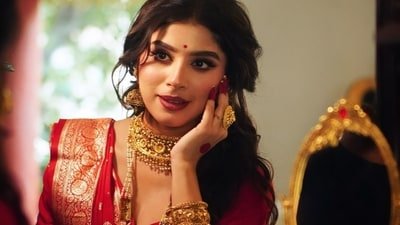
Her Bengali roots also find expression in her festive wardrobe, particularly through heirloom jewellery. “I wear a necklace that belonged to my grandmother and was part of her wedding jewellery. My mother also has old gold jewellery that has been passed down through generations. We call it ‘shabi’ in Bengali, meaning something authentic and old. These pieces carry a history, and I love wearing them,” she says.
With age, Roy says she has also come to appreciate the spiritual significance of Durga Puja. Recalling how she once struggled to understand the early-morning rituals after late nights of festivities, she says, “As a child, I did not understand why we woke up early for pushpanjali, even if we had returned home late the previous night. Now, I realise that the festival is not just about wearing new clothes, eating and having fun. There is a deeper spiritual connection. Maha Ashtami is a very special day for Bengalis who believe in the puja. If you ask Maa for something, she will fulfil it for you.”
For Roy, faith is also closely linked to respect for women. Speaking about women’s safety, she says, “People have forgotten the meaning of the word ‘mother’. If you cannot respect the women in your own family, including your mother and sisters, how will you respect women outside?”
Despite her growing recognition as an actor, Roy says returning to Kolkata allows her to reconnect with her childhood self. “Whenever I go to Kolkata, I become a child again. Every actor likes being recognised, and I do too. But when people from my neighbourhood call me ‘ma’am’, I do not like it. My nickname is Diya, and I tell them to call me that instead of Adrija. I want to remain the same person I was while growing up,” she signs off.