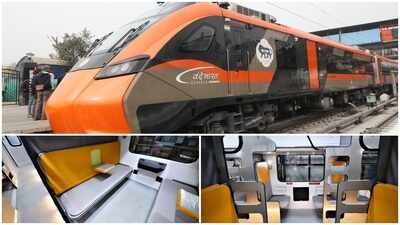
After rolling out 16-coach Vande Bharat sleeper trains, Indian Railways is now eyeing a 24-coach train set that will cater to longer distance overnight journeys. The Integral Coach Factory (ICF) Chennai has been tasked with manufacturing 50 Vande Bharat sleeper trains that will have 24 coaches.Indian Railways is expected to introduce more than 200 Vande Bharat sleeper trains over the coming years as it seeks to transform long-distance rail travel. Three major manufacturing projects are underway.BEML, with support from ICF, is producing 10 sleeper trainsets, while the Indo-Russian joint venture Kinet has been assigned the task of manufacturing another 120. A consortium of Titagarh and BHEL will produce 80 Vande Bharat sleeper trains. Separately, ICF is preparing to develop a sleeper version of its own.Also Read | Passenger trains being run with slower freight engines as Indian Railways faces locomotives shortage; records show 80-100 cases a month causing delays of several hours
24 coach Vande Bharat sleeper train soon
Sources told TOI that the designs for the new train are being finalised and are expected to be ready in a month’s time. The rollout timeline for the new Vande Bharat sleeper train set is in the first half of 2027, with June 2027 set as a target date.The 24-coach Vande Bharat sleeper trains will be a variant of the existing train design but will include a pantry car.ICF has said in the past that its 24-car Vande Bharat sleeper will be one of the longest sleeper trains being produced in India.The number of toilets on the train will also be increased in the 24-car variant. The ICF version will also include a pantry car, a feature that is absent from the other Vande Bharat sleeper design. This will allow food to be heated and served onboard. The factory is also looking at improving the interiors, although the design work is still underway.Also Read | Delhi-Varanasi in less than 4 hours, Mumbai-Pune in 48 minutes, Chennai-Bengaluru in over 1 hour: Indian Railways bets on seven new bullet train corridors in Rs 16 lakh crore high-speed push
Vande Bharat Sleeper Train Features
- Coach configuration: The prototypes running right now have 16 passenger coaches, comprising 11 AC 3-tier coaches, four AC 2-tier coaches and one AC First Class coach.
- Speed: The train is designed to operate at 160 kmph and has a testing speed of 180 kmph, placing it in the semi-high-speed category. However, most sections of the Indian Railways network cannot accommodate trains running at such speeds.
- Berth comfort: Drawing inspiration from European trains, the sleeper variant will feature cushioned berths designed to improve passenger comfort. The arrangement for accessing upper berths has also been redesigned to make climbing easier.
- Lighting and onboard facilities: The train will have dedicated night lighting, an integrated announcement system with visual displays, CCTV cameras and modular pantry units.
- Toilets and accessibility: Modern bio-vacuum toilets, similar to those used in aircraft, will be provided. A toilet for disabled passengers will also feature a baby-care station. The AC First Class coach will offer shower facilities with hot water.
- Safety and energy efficiency: The sleeper train will be fitted with the indigenous KAVACH anti-collision system. Like the chair car versions, it will also use regenerative braking technology to improve energy utilisation.
- Automatic doors and sealed gangways: The coaches will have automatic interconnecting doors, while fully sealed gangways will help maintain clean air and regulate the temperature inside the train.
- Passenger amenities: Individual reading lights, charging points, refreshment tables and interiors featuring GFRP panels will be provided in each coach. The train doors will open automatically at designated stations.
- Monitoring and emergency communication: A Centralised Coach Monitoring System will be installed. Passengers will also be able to communicate with the driver through an emergency communication system.
Also Read | Second Vande Bharat sleeper set to launch this month between Bengaluru and Mumbai; cutting travel time from 24 hours to under 16 hours, 30 year wait for faster connectivity between two cities to end