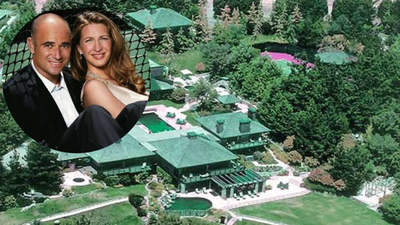
Andre Agassi and Steffi Graf’s former California home took almost four years to sell after the tennis stars put it on the market. The couple had paid about $23 million for the 3.5-acre Roundhill Estate in Tiburon, California, making it a record residential sale in Marin County at the time. They first listed the property for $24.5 million in 2003, but the asking price was cut several times before the estate finally sold for $20 million in 2006. The sale left Agassi and Graf with a $3 million difference before other ownership costs were counted.
Why did Andre Agassi and Steffi Graf pay $23 million for the Tiburon estate
Andre Agassi had already developed a strong connection with the San Francisco Bay Area before buying the property. He regularly played tournaments in Northern California and liked the idea of having a private place there.In December 2000, Agassi paid about $23 million for the Tiburon estate, which was then one of the biggest residential deals in Marin County. The property had previously belonged to John E. McCaw Jr., the former Cellular One owner.The location was a major part of its appeal. The estate sat on about 3.5 acres above the San Francisco Bay and had views of the Golden Gate Bridge and San Francisco skyline. It also came with a six-bedroom, eight-bathroom home and large outdoor areas.SFGate reported in February 2001 that Agassi described the property as a place he had come to love. “Make no bones about it – I travel 30 weeks-plus a year, and this is a place I’ve come to love, and it’s been a vacation place,” he said.At the time, the home was not only a luxury property but also a practical getaway for a tennis player who spent much of the year travelling. Agassi said it would be a part-time vacation home rather than his main base.The estate also had two swimming pools, a tennis court, a squash court and a four-bedroom staff house. Contemporary reports put the main residence at about 10,500 square feet, while other descriptions gave larger figures when additional buildings were included.
What made Andre Agassi and Steffi Graf’s California home unusual
The tennis connection was hard to miss. The estate had its own tennis court, giving Agassi and Graf a private place to play away from the public.That mattered because both were still closely linked to professional tennis when the property was purchased. Graf had retired in 1999 after winning 22 Grand Slam singles titles. Agassi continued playing for several more years and eventually retired after the 2006 US Open.The property was also built for a large family and frequent guests. Along with the main house, there were separate staff quarters and additional guest space. Reports also mentioned two pools, several spa areas, a hydrotherapy waterfall and a large private lot.The home had already undergone a major renovation before Agassi bought it. It was built in 1976, and John E. McCaw Jr. had carried out the last major renovation in the 1990s.Still, the house did not remain an easy sell later. When the property went back on the market, its older design became one of the issues affecting interest. Listing agent Bill Bullock told the San Francisco Chronicle that the house had a “dated feel,” which made the sale harder.The size and price were another challenge. A buyer needed to be willing to spend tens of millions of dollars on one property, and the pool of people looking at homes at that level was small.
Why did Andre Agassi and Steffi Graf list the $23 million estate for $24.5 million
By the time the Tiburon home was listed in 2003, the couple’s lifestyle had changed. Graf had been retired from tennis for several years, while Agassi was still competing but was spending much of his time travelling for tournaments and handling his business interests.The couple also lived primarily in Las Vegas, where Agassi had deep family and business ties. That made the California property less useful as an everyday home.Agassi explained the situation during a 2003 interview. “I’m playing the game a lot longer than I thought. We’re still traveling the world,” he said. “A lot of my business is in Las Vegas and it just doesn’t make sense for us to have a place that doesn’t get used.”They initially asked $24.5 million for the property. That was $1.5 million above what Agassi had paid when he bought it.The estate did not find a buyer quickly. It moved on and off the market, and the asking price was reduced more than once. By 2006, the price had fallen to $21 million.The decision to sell was also tied to the cost of keeping such a large property. Bill Bullock said the couple’s advisers wanted Agassi to dispose of the home because it was being used infrequently.
How did Andre Agassi and Steffi Graf’s estate finally sell for $20 million
After nearly four years on the market, the Tiburon estate finally found a buyer in 2006. The buyer was Stuart Peterson, a Marin County resident and head of the investment firm Artis Capital Management.The final price was $20 million, which was $3 million below the couple’s original purchase price. The deal was reported as one of the largest residential sales in Marin County at the time.The San Francisco Chronicle reported that the property had been difficult to sell partly because there were relatively few buyers for homes priced above $20 million. The estate had already gone through several price reductions before Peterson agreed to the $20 million deal.The sale meant Agassi and Graf did not make money from the California property itself. Based only on the purchase and sale prices, they were down $3 million. Their actual financial result would have been different after taxes, maintenance, insurance and real estate commissions were taken into account.For the couple, however, the sale also ended a chapter that no longer fitted their daily life. Graf had long since left professional tennis, and Agassi was nearing the end of his playing career when the property finally changed hands.Their Tiburon home had started as a private escape with views of the Bay Area and a tennis court of its own. By the time it sold, it had become a property the couple rarely used and one that had spent years searching for the right buyer.