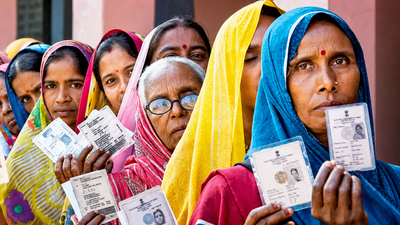
NEW DELHI: Uttar Pradesh elections have traditionally been about the caste arithmetic: counting Yadavs, non-Yadav OBCs, Dalits, Brahmins and Muslims. But ahead of the 2027 battle, there is another constituency the parties simply cannot afford to ignore: the women voters – who transcend the caste divide.Every election cycle, the same questions return: Can the BJP retain its non-Yadav OBC votes? Will Akhilesh Yadav manage to woo Brahmins and Dalits? Which side will the Jatav voters pick? Will Mayawati be able to rally all Dalits behind her BSP? And so on.This time around, while the caste questions remain, the battle will also be for the support of Uttar Pradesh’s ‘Aadhi Aabadi’ – the women voters who have proved to be game changers, election after election in many other states.When Uttar Pradesh votes in 2027 to elect a new assembly, the state’s 6,09,09,525 female voters, who constitute 45.46% of the total electorate, will hold considerable sway over the fortunes of the political contenders.That explains why Yogi Adityanath and Akhilesh Yadav, the two key challengers, are leaving no stone unturned to bring women into their fold. Congress, too, is preparing to step up its outreach as the electoral battle gathers pace.
Why women voters matter
Let’s rewind to 2007. In the 2007 UP assembly election, the female turnout in the state was under 42%, less than the male turnout of 49.35%.But this changed five years later. In 2012, Uttar Pradesh had around 5.72 crore registered women voters, of whom 3.45 crore cast their ballots. Thus, the female turnout increased to around 60.3%, surpassing that of males at about 58.7%.By the 2017 assembly election, the number of registered women voters had gone up to 6.46 crore. More than 4.09 crore women voted, and female turnout climbed to around 63.4% while the men lagged at 59%.In 2022, Uttar Pradesh had around 7.02 crore women electors, out of which more than 4.36 crore voted. Female turnout stood at around 62.2%, once again higher than that among men, which stood at around 59.6%.So, between 2012 and 2022 alone, the state added nearly 1.3 crore women to its electoral rolls. But what may be more important for political parties is the fact that 2012 elections onwards women outvoted men in all assembly elections in the state. The 2024 Lok Sabha election was no different.In Uttar Pradesh, 57.22% of women electors turned out to vote in the 2024 general elections, compared to 56.46% of men. The overall turnout was lower than in the recent assembly elections, but women still maintained their lead.And it’s not just UP. Parties cannot ignore the decisive role women voters have played in assembly elections in Bihar, Maharashtra, West Bengal, Madhya Pradesh and Jharkhand.Ahead of the assembly election in Madhya Pradesh, the Shivraj Singh Chouhan government rolled out the ‘Ladli Behna’ programme, a monthly cash assistance scheme under which money was transferred directly into women’s accounts. By the time Madhya Pradesh voted, the scheme covered more than a crore women. BJP won 163 of the 230 seats. ‘Ladli Behna’ quickly became one of the key takeaways from the election.Maharashtra also introduced its own version: the ‘Ladki Bahin’ programme. And then Bihar happened. The 2025 assembly election recorded a female turnout of 71.6%. Male turnout was 62.8%. The NDA went on to win a huge majority.
How parties are wooing women voters
Financial doles under DBT (Direct Benefit Transfer) no longer make news. If the elections are round the corner, they are a given. What makes news is the amount of dole.So, when some media reports suggested that the Yogi Adityanath government was considering a dole of Rs 50,000 for women ahead of elections – Rs 20,000 now and Rs 30,000 after its return to power – Akhilesh Yadav lost no time to dish out a pre-election offer to counter the BJP. “We will start with Rs 40,000 and increase it every year,” the SP chief wrote in a post on X while questioning the BJP’s intent and alleging that the BJP was distributing “the earnings of its sins.“Akhilesh simultaneously launched a broadside against the BJP and alleged that the party has been left with “nothing but money” to win the 2027 Uttar Pradesh Assembly elections. “The religious women of UP will never accept the ill-gotten money of the BJP,” the SP chief wrote. He also tried to discredit the BJP and claimed that the party was not keeping its promise of giving the announced doles to women in other states where it governed.“The BJP’s corrupt government has eaten up Rs 5 lakh belonging to women over the last 10 years and is now serving the jumla of giving only Rs 20,000. Rs 20,000 is only four per cent of Rs 5 lakh, which means these BJP people have swallowed 96 per cent of women’s share,” he alleged.BJP Uttar Pradesh vice-president Neeraj Singh hit back at Akhilesh, saying his party has made no such announcement and accused the SP chief of making a “deceptive” promise to give Rs 40,000 to women.“Whenever the BJP provides benefits under its schemes to eligible people, the important thing is that the money reaches those who are entitled to it. The distribution system is also very transparent, and this has been the BJP’s track record,” the BJP leader claimed.On the SP’s promise of Rs 40,000 annually to women, Singh said it was “only a deception” and alleged that the party had used a similar tactic before the 2024 Lok Sabha elections.But while the BJP questions Akhilesh Yadav’s sincerity, it perhaps realises that the SP chief has raised the bar and also the expectation of women in the state by announcing a dole of Rs 40,000, and this announcement may influence whatever dole the ruling party eventually decides.Akhilesh may have scored some brownie points here, but the fact remains that the SP chief faces a tough challenge from the BJP in UP. Chief minister Yogi Adityanath has been in a relentless pursuit of women voters, announcing a string of programmes for them at regular intervals.In March, Yogi Adityanath distributed smartphones to 69,804 Anganwadi workers and supervisors, over two lakh growth monitoring devices, and appointment letters to 18,440 Anganwadi workers and helpers. Addressing the gathering, he said, “If the newborn is well-nourished and the mother is healthy, the future of India will be strong.”In April, the Uttar Pradesh government launched a one-of-its-kind scheme titled ‘Safe Mobility Program,’ centred around employment generation for female members of Self-Help Groups (SHGs). Under the programme, an army of female e-rickshaw pilots will be trained across the state to ensure safe, accessible, and dignified transportation for girls and women travelling to schools, workplaces, and other essential destinations.From April 16 to 20, the Yogi government ran a five-day special campaign under the Nari Shakti Vandan Abhiyan to turn schools into active centres of women empowerment, focusing on building confidence, leadership qualities, and awareness among girl students.In another move to support and prop up ‘naari shakti’, the Uttar Pradesh government directed sugarcane co-operative societies in the state to allocate free spaces to women from Self Help Groups (SHGs) to set up their shops. The idea was to encourage women from SHGs to start ‘Prerna canteens’ from here, displaying and selling their products.These are some examples that showcase how Yogi Adityanath has been mindful of the power of women voters in the 2027 battle and has been working to reach out to them through his welfare measures.
Congress’s another shot at wooing women voters
BJP and Samajwadi Party are not the only parties to target this demographic. Congress had, in fact, put women at the centre of its Uttar Pradesh campaign much before the current race over cash transfers began. In 2022, Priyanka Gandhi Vadra, who was the general secretary of the All India Congress Committee (AICC) in charge of Uttar Pradesh back then, led the party’s ‘Ladki Hoon, Lad Sakti Hoon’ campaign. The party took a bold gamble by promising to give 40% of assembly tickets to women.The party eventually fielded a large number of women candidates and also made promises aimed specifically at female voters, including smartphones for girls and electric scooters for female students. However, that move did not pay off. Congress won just two of the 403 assembly seats and its vote share slipped to around 2.3%.The situation, however, is different going into 2027. Congress won six Lok Sabha seats in Uttar Pradesh in 2024 as part of its alliance with the Samajwadi Party, which won 37. The opposition therefore enters the assembly battle with more political space than it had in 2022. For Congress, the challenge will be to revive its women outreach and aim to translate schemes into electoral benefit.
Women are voting more, but are they voting as one bloc?
But amid all the attention on cash transfers and the push for women-centric schemes, the question that remains is: Can women’s votes be treated as one single bloc? A Jatav woman, a Muslim woman, a non-Yadav OBC woman may have very different expectations when she enters the polling booth to cast her vote. Caste, religion and past preferences may still continue to matter, as will factors like inflation, jobs, law and order, women’s safety, welfare benefits and the candidate on the ground.
Share your thoughts in the comments
Be respectful · TOI community guidelines
Therefore, it is hard to predict if the high turnout among women can automatically translate into an advantage for any one party.But what it does surely mean is that no party can afford to take the ‘Aadhi Aabadi’ for granted anymore. When it comes to voting, women have outperformed men in the last three Uttar Pradesh assembly elections and have maintained that lead in the 2024 Lok Sabha polls as well. So, while caste will always play a role in UP elections, the 2027 battle will also come down to who wins the trust of the over six crore women voters. The question is no longer whether women will turn up to vote. It is: who will they vote for?