Mumbai: “Rohit Sharma is playing superbly in all matches. So what more do you want?” With that rhetorical expression, BCCI secretary Devajit Saikia gave the former India captain additional time to convince the selectors that he had the required mileage for another ODI World Cup campaign.
Saikia’s media comments came minutes after attending a BCCI forward-planning gathering that also comprised ODI captain Shubman Gill and head coach Gautam Gambhir.
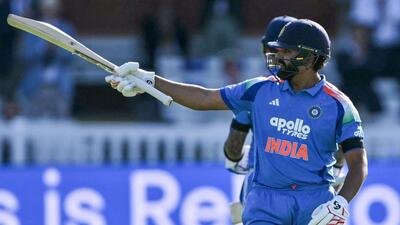
The national selection committee led by Ajit Agarkar had noticed signs of slumping benchmarks in the 39-year-old’s batting tempo and overall fitness standards. But that was before India’s last ODI at Lord’s in July where Rohit struck a powerful 110-ball 138, batting for 39 overs after spending 50 overs on the field. Although cramps troubled him toward the back-half of that innings, it was a statement knock under immense pressure in light of speculations of impending retirement.
The next World Cup is a little over a year away, which can quickly look distant at 39; but for now, Rohit has the board’s backing. “In the last match, he scored 138 runs, so why is there speculation? I don’t want to give fodder for speculators,” said Saikia.
To make it to the 2027 World Cup, which Saikia called “the ultimate goal” for the Indian cricket team, Rohit will take fresh guard against West Indies starting September 27.
Too much cricket
The two-hour “soul searching” exercise as Saikia put it, was an attempt to iron out past scheduling and planning shortcomings, which manifested as inconsistent Test cricket performances and a decline in white-ball results across bilateral series.
“There are too many matches in the year,” Saikia admitted. After winning the T20 World Cup, India has undertaken trips to Ireland and England. They are scheduled to play Afghanistan in Delhi next, followed by the Asian Games in Japan, then away matches against New Zealand, before closing the year with home matches against Sri Lanka. Few teams engage in such a spread of bilateral cricket, that too across formats.
The ODI team’s engagements are equally busy. A case in point is the upcoming West Indies ODI series clashing with the Asian Games, forcing the selectors to release some ODI regulars for the T20 medal hunt. BCCI’s fostering of boardroom friendships has also contributed to an overcrowded calendar, leaving even Indian cricket’s vast bench strength, strained.
“In the next FTP (future tours programme), we will take certain measures. We have instructed that our FTP should be such that there is proper rest for the players as well. (They have) some kind of acclimatization or friendly matches before any major series in SENA (South Africa, England, New Zealand, Australia) countries,” the board secretary said.
In the immediate future, the Test team will face the brunt of a jam-packed itinerary. A shadow tour comprising three four-day matches has been scheduled before the New Zealand Test-series in November, which will determine India’s chances for the World Test Championship final. But a bulk of that action will run parallel with India’s white-ball action in New Zealand. Gill will be among several other two-format players who will have to pick and choose. It’s precisely such ill-planned schedules that Gill has raised concerns over in the past, and he is known to have made his views known again in the meeting.
For next year’s marquee series against Australia, the team management sentiment is that the batters should get a platform to improve their play against the turning ball, allowing them to push for turning tracks. That can be achieved by preparing challenging pitches in the upcoming A series at home against Australia, but it could also be counter-productive, helping the opponents sharpen their game. The operations team led by BCCI General Manager Abey Kuruvilla is tasked with devising a strategy for India to regain Test dominance at home.
Strengthen fitness protocols
The excessive matches have also hit the players’ fitness hard, but there are other structural shortcomings at the Centre of Excellence (COE) too. The swanky new COE facility in Bengaluru has been without a sports science head for nearly eighteen months. On the record, Saikia played down the impact of a leadership vacuum in the sports science wing.
“I would like to reiterate once more that the vacant position of the head of sports science is not a deterrent to our activities in COE. That post is required (to be filled), but that is a very high-level post and a proper qualified person should be positioned,” he said.
There were discussions in the meeting, though, that return-to-play protocols would have to be strengthened. Both Gill and Gambhir are known to have given feedback on ways to avoid in-tournament player breakdowns, of which there have been many recently. Nitish Reddy, Washington Sundar, Harshit Rana and Varun Chakravarthy were unable to complete the series in which they were picked after experiencing muscle injuries.
Agarkar’s future
There have also been some concerns over instances of the selection committee’s lack of communication with the team management and the COE. Those issues could not be addressed in Agarkar’s absence. The Chief selector was out of town and in a no-network zone. Agarkar’s current tenure ends this month amid speculations over his continuation, even though he is eligible for a year’s extension. The BCCI is expected to have discussions with Agarkar soon.
The BCCI refuted reports of VVS Laxman being considered for a higher role of Director of Cricket. “We haven’t had any such discussions, nor do we have such an intention,” said Saikia.