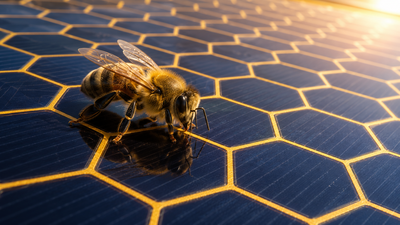
For millions of years, honeybees have relied on one of nature’s most efficient architectural designs: the honeycomb. Built from repeating hexagonal cells, a beehive is remarkably strong, lightweight and uses the least amount of material to enclose the greatest amount of space. Now, engineers are borrowing this ancient blueprint to rethink how solar panels are designed.Instead of simply copying the appearance of a honeycomb, researchers have applied its underlying engineering principles to improve the structural performance and efficiency of photovoltaic systems. The work is part of a growing field known as biomimicry, where scientists look to nature’s time-tested solutions to solve modern technological problems. By learning from bees, engineers hope to create solar panels that are lighter, stronger and better suited for the demands of large-scale renewable energy.
How honeycomb-inspired engineering is making solar panels lighter and stronger
For centuries, the honeycomb has fascinated scientists and engineers alike. Its repeating hexagonal cells allow bees to build structures that are incredibly strong while using the least possible amount of wax. This natural design distributes force efficiently, resists deformation and achieves an exceptional strength-to-weight ratio, qualities that engineers have long replicated in aircraft, spacecraft and high-performance vehicles.Now, the same principle is being applied to solar energy. In a recent study published in Solar Energy Materials and Solar Cells, researchers developed lightweight photovoltaic (PV) modules using an aluminium honeycomb sandwich structure instead of the conventional glass-and-backsheet design. The honeycomb core provides mechanical support while significantly reducing the amount of material required, resulting in solar panels that are both lighter and structurally robust.
The new design cuts panel weight by nearly half without compromising performance
The researchers manufactured lightweight modules using an aluminium honeycomb core bonded between thin composite layers. The finished panels weighed just 6.2 kg per square metre, making them around 48% lighter than conventional photovoltaic modules while maintaining the mechanical strength needed for long-term use.To evaluate their durability, the team subjected the panels to a series of internationally recognised reliability tests, including damp heat exposure, humidity freeze cycles, ultraviolet ageing, mechanical load testing and potential-induced degradation. The honeycomb-based modules successfully passed these assessments, demonstrating that reducing weight does not necessarily come at the expense of reliability or electrical performance.Beyond improving structural stability, lighter panels are easier to transport, install and mount, particularly on rooftops and buildings where weight limits are a major consideration. They also reduce the amount of raw material required during manufacturing, potentially lowering production costs and expanding opportunities for photovoltaic installations on structures that cannot support conventional heavy glass panels.
Nature continues to inspire the next generation of renewable energy technology
The honeycomb-inspired photovoltaic module is another compelling example of biomimicry, the practice of applying nature’s time-tested designs to solve modern engineering challenges. Rather than imitating the appearance of a beehive, researchers have harnessed the honeycomb’s remarkable structural efficiency. Its hexagonal cellular architecture provides exceptional strength and stiffness while using minimal material, making it an ideal model for designing lightweight yet durable solar panels.By integrating this principle into photovoltaic modules, engineers have shown that it is possible to reduce panel weight substantially without compromising mechanical integrity or long-term reliability.As countries accelerate the transition to renewable energy, innovations like these could help overcome some of the practical barriers to wider adoption of solar. Lightweight modules are easier and less expensive to transport, install and maintain, while placing lower structural loads on rooftops, commercial buildings and other supporting frameworks.They also open up new possibilities for applications where conventional glass modules are too heavy, including building-integrated photovoltaics, lightweight industrial roofs, vehicles, portable power systems and even aerospace technologies. By reducing material consumption while maintaining performance, honeycomb-inspired designs also support more sustainable manufacturing practices. The study demonstrates that solutions refined by nature over millions of years can still provide valuable inspiration for tackling some of today’s biggest engineering and clean energy challenges.