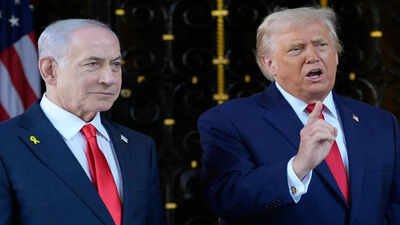
Israeli Prime Minister Benjamin Netanyahu was reportedly ‘caught off guard’ after US President Donald Trump abruptly cancelled planned strikes against Iran and announced that a diplomatic agreement with Tehran could be signed within days.According to Axios, Netanyahu was not given advance notice before Trump publicly revealed that he had called off further military action and claimed Iran’s leadership had approved a draft framework agreement.“Netanyahu was not warned in advance, and he was caught off guard when Trump released his initial statement on the deal,” the report said.The unexpected announcement marked another twist in the increasingly complicated relationship between the two leaders and highlighted growing differences over how to deal with Iran.The development comes as Washington continues to push for a negotiated settlement while Israel argues that military pressure remains necessary to prevent Iran from strengthening its regional position.Trump announced on Thursday that he had cancelled planned strikes against Iran after receiving indications that Tehran was willing to move forward with a draft agreement.“Based on the fact that discussions with the Islamic Republic of Iran have been brought to the highest level of Iranian leadership and approved, I have, as President of the United States of America, cancelled the scheduled strikes and bombings against Iran this evening,” Trump wrote on Truth Social. The proposed framework reportedly includes extending the ceasefire, reopening the Strait of Hormuz and launching a new round of negotiations over Iran’s nuclear programme.Speaking later to supporters, Trump went even further, declaring that the United States had effectively ‘ended the war with Iran’ and insisting that Tehran had agreed never to develop or purchase a nuclear weapon.The announcement appeared to catch Israeli officials by surprise.Netanyahu had no advance warning before Trump released his statement. Sources familiar with the matter said the Israeli leader learned about the development only after Trump had already made it public, Axios reported. While Israel later welcomed assurances that any final agreement would address Iran’s nuclear programme, the lack of prior consultation highlighted tensions between Washington and Tel Aviv.“President Trump spoke this evening with Prime Minister Netanyahu regarding the emerging memorandum of understanding (MOU) with Iran to enter into negotiations,” Israel’s prime minister office wrote in a post on X.“Even though Israel is not a party to the memorandum of understanding, the Prime Minister expressed his appreciation for President Trump’s commitment that the final agreement at the conclusion of negotiations will include the removal of enriched material, the dismantling of enrichment infrastructure, limits on missile production, and the cessation of Iran’s support for its terrorist proxies in the region,” the post added.For months, Netanyahu has remained deeply sceptical about diplomatic efforts with Iran.Israeli officials have repeatedly argued that Tehran uses negotiations to buy time while continuing to advance its military capabilities and support regional proxy groups.According to CNN and Axios reports, Netanyahu has urged Trump to maintain military pressure and proceed with planned strikes against Iranian targets rather than pause operations for diplomacy.During a recent phone conversation between the two leaders, Netanyahu reportedly argued that delaying military action was a mistake and warned that Iran was engaging in diplomatic ‘foot-dragging’.Israel’s position has been that only sustained pressure can force meaningful concessions from Tehran.
A relationship showing signs of strain
Despite regularly describing each other as close allies, Trump and Netanyahu have experienced a series of disagreements in recent months.The most public dispute emerged over Israel’s military operations in Lebanon.Trump became frustrated that Israeli attacks against Hezbollah were complicating wider diplomatic efforts involving Iran and Gulf states. According to reports, the US President used unusually strong language during a phone call with Netanyahu and accused him of undermining negotiations.Trump later acknowledged that the conversation had been heated, saying he was ‘perturbed’ by Israel’s continued military actions.“I was a little bit perturbed at his constantly fighting with Lebanon,” Trump said.However, the US President also stressed that his relationship with Netanyahu remained strong. “We’ve worked very well together. I like Bibi a lot. And I work very well with him,” Trump added.Netanyahu, however, sought to play down the disagreement.Speaking to CNBC, he described the tensions as tactical differences rather than fundamental disagreements.“Sometimes we have tactical disagreements. But we always find a way to work them out,” Netanyahu said.He stressed that both leaders remained committed to preventing Iran from obtaining a nuclear weapon.
Trump increasingly asserts control
The recent Iran negotiations have also revealed a growing imbalance in the relationship.Trump has repeatedly made clear that Washington, not Tel Aviv, will determine the course of negotiations with Tehran.In an interview with the Financial Times earlier this week, Trump dismissed suggestions that Netanyahu could block a US-Iran agreement.“He won’t have any choice. I call the shots. He doesn’t call the shots,” Trump said.Also Read | ‘I call the shots’: Trump insists Iran deal on track amid fresh strikes, says Netanyahu has ‘no choice’The comment was one of the clearest indications yet that the White House intends to pursue its diplomatic strategy regardless of Israeli objections.While previous US administrations often coordinated closely with Israel on Iran policy, Trump has increasingly portrayed himself as the final decision-maker.
Iran remains cautious
Adding further uncertainty, Iran has not fully embraced Trump’s optimistic assessment.Iranian foreign ministry spokesperson Esmail Baghaei said reports of a final agreement were ‘mere speculation’ and stressed that Tehran had not yet reached a final decision, state news agency IRNA reported. He added that Qatar and Pakistan were “active as mediators”, but noted that “US actions are affecting the diplomatic process”. “From the beginning, the status of the negotiations was clear to us, and a large portion of the text had already been finalised. However, the Americans kept changing their positions,” Baghaei said, as reported by IRNA and cited by CNN.He stressed that Iran had “proven that it does not compromise on what it has defined as its red lines” and confirmed, “So far, Iran has not reached a final decision regarding any agreement.”
What happens next?
Trump has said a memorandum of understanding could be signed in Europe as early as this weekend, with Vice President JD Vance expected to lead the American delegation.Speaking in the Oval Office, Trump said, “We just made a great settlement of the war with Iran, and we’re going to be subject to finalisation of documents. We should get done over the next few days. We’ll probably have a signing, maybe in Europe. When oil comes down, everything else comes down.”Trump also asserted that Iran had agreed to permanently forgo the development or acquisition of nuclear weapons under the proposed arrangement.“They will not have a nuclear weapon. They’ve agreed to that. There will be no, which is the whole reason, which is a big part of the reason. They will not only not have, they will not purchase, develop in any way, any shape, in any way, shape, or form a nuclear weapon. They will not have a nuclear weapon,” he further added.He described the proposed arrangement as beneficial for both Washington and the wider region, while insisting that preventing Iran from obtaining nuclear weapons remained a central objective.“Because they (Iran) have taken a pounding like very few people could take, and they want to make the deal a lot more than I do. We could have done the other way, but it would have taken longer. They got hit very hard recently, as you know. And I don’t like to have to do things that way, but I felt it was necessary. It’s a great deal for the US and for the Middle East, and I think ultimately great for Iran because they’ll be able to build up their country,” Trump said.