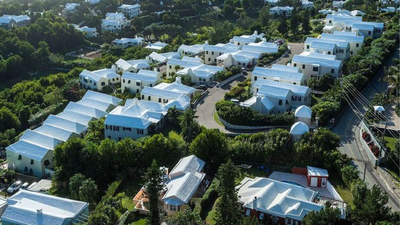
Bermuda has no rivers, no freshwater lakes and no natural springs, yet it has supplied drinking water to its residents for more than four centuries. The British Overseas Territory in the North Atlantic relies on an ingenious rainwater harvesting system built into the roofs of nearly every home. Around 65,000 people depend on these distinctive white, stepped limestone roofs, which capture rainfall and channel it into underground storage tanks. Together, they form one of the world’s oldest and most successful examples of decentralised water management, proving that centuries-old architecture can still solve one of humanity’s most fundamental challenges.Unlike many islands, Bermuda has no permanent rivers, freshwater lakes or natural springs. It is formed largely from porous limestone resting on top of an ancient volcanic seamount. When rain falls, it quickly seeps through the rock instead of remaining on the surface.The freshwater eventually mixes with surrounding seawater beneath the island, making it unsuitable as a dependable source of drinking water. This unique geology forced Bermuda’s earliest settlers to find an alternative way to secure fresh water, ultimately leading to one of the island’s most remarkable engineering innovations.
The 400-year-old roof design behind Bermuda’s water supply
The story began in the early 17th century after the Sea Venture was shipwrecked on Bermuda’s reefs in 1609. Permanent English settlement followed in 1612, and settlers soon realised that traditional English houses were poorly suited to the island’s climate and limited freshwater resources.Using locally quarried limestone, they developed distinctive stepped roofs made from overlapping limestone slates. These roofs served two purposes: protecting homes from Bermuda’s harsh Atlantic weather and collecting rainwater for daily use. Over time, the design became a defining feature of Bermudian architecture and one of the world’s best-known examples of rainwater harvesting.
How the roofs collect drinking water
Every part of Bermuda’s iconic roof is designed with water collection in mind.Rainwater flows down the stepped limestone slates into gutters before passing through pipes and into large underground cisterns beneath each home, where it is stored for household use. The stepped profile also helps control the movement of water during heavy rainfall while contributing to the roof’s durability in Bermuda’s hurricane-prone climate.Traditionally, the roofs were coated with lime-based whitewash, which helped waterproof the limestone and maintain clean roof surfaces. Today, approved white roof coatings perform the same function while also reflecting sunlight, helping keep homes cooler in the island’s subtropical climate.
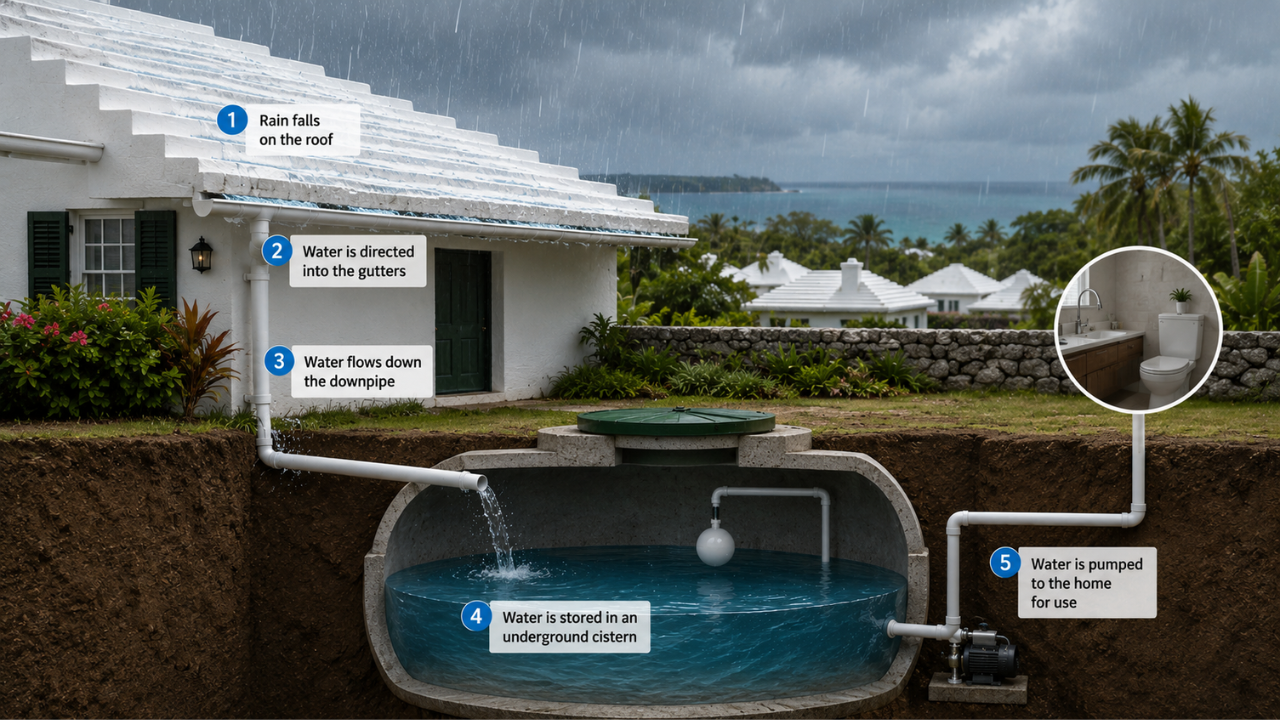
Every home is part of the island’s water system
One of Bermuda’s most distinctive features is that individual homes function as their own water suppliers.Building regulations require new houses to include rainwater harvesting systems and underground storage tanks sized according to the roof area. As a result, thousands of homes collect and store their own water, creating a distributed system that has sustained Bermuda for generations.
Does Bermuda still rely on these roofs today?
Yes, although modern infrastructure now supplements the traditional system.Rainwater harvested from rooftops remains the primary water source for many households. During droughts or periods of high demand, desalination plants, groundwater wells and water delivered by tanker trucks provide additional supplies. Large hotels and commercial buildings often depend on these supplementary sources because rooftop collection alone cannot meet their water requirements.
Lessons for a world facing water shortages
As climate change places increasing pressure on conventional water supplies, Bermuda’s centuries-old approach has attracted growing interest from engineers, architects and urban planners.Rather than relying solely on reservoirs and extensive pipeline networks, the island demonstrates how decentralised rainwater harvesting can strengthen water security at the household level. Although Bermuda’s model cannot be copied everywhere, it shows how architecture, local geography and long-term planning can work together to create resilient communities.More than 400 years after it first emerged, Bermuda’s iconic white roof remains far more than an architectural symbol. On an island without rivers or lakes, it continues to provide one of life’s most essential resources while offering valuable lessons for a world confronting growing water scarcity.