
NEW DELHI: Taking a stern view of allegations that the Bihar govt is filling parts of three historic ponds in Darbhanga to create public amenities such as recreation spaces and stalls, Supreme Court on Tuesday warned the state govt “not to touch the water bodies under the garb of beautification” without its approval.A bench of Justices Vikram Nath and Sandeep Mehta directed the state to immediately stall ongoing work related to ‘Beautification and Rejuvenation of Gangasagar, Digghi and Harahi Lake’ project. Although the state refuted allegations of encroachment and urged Supreme Court to allow the work to continue, describing it as an ambitious project worth more than Rs 100 crore, the bench refused to budge and ordered that no further work be carried out.“You can’t fill up water bodies under the garb of beautification. Do not touch the water ponds, keep your hands off and tell your officers not to touch the ponds,” it told advocate Manish Kumar, who was appearing for the state.
‘Immediately halt work on 3 centuries-old lakes’
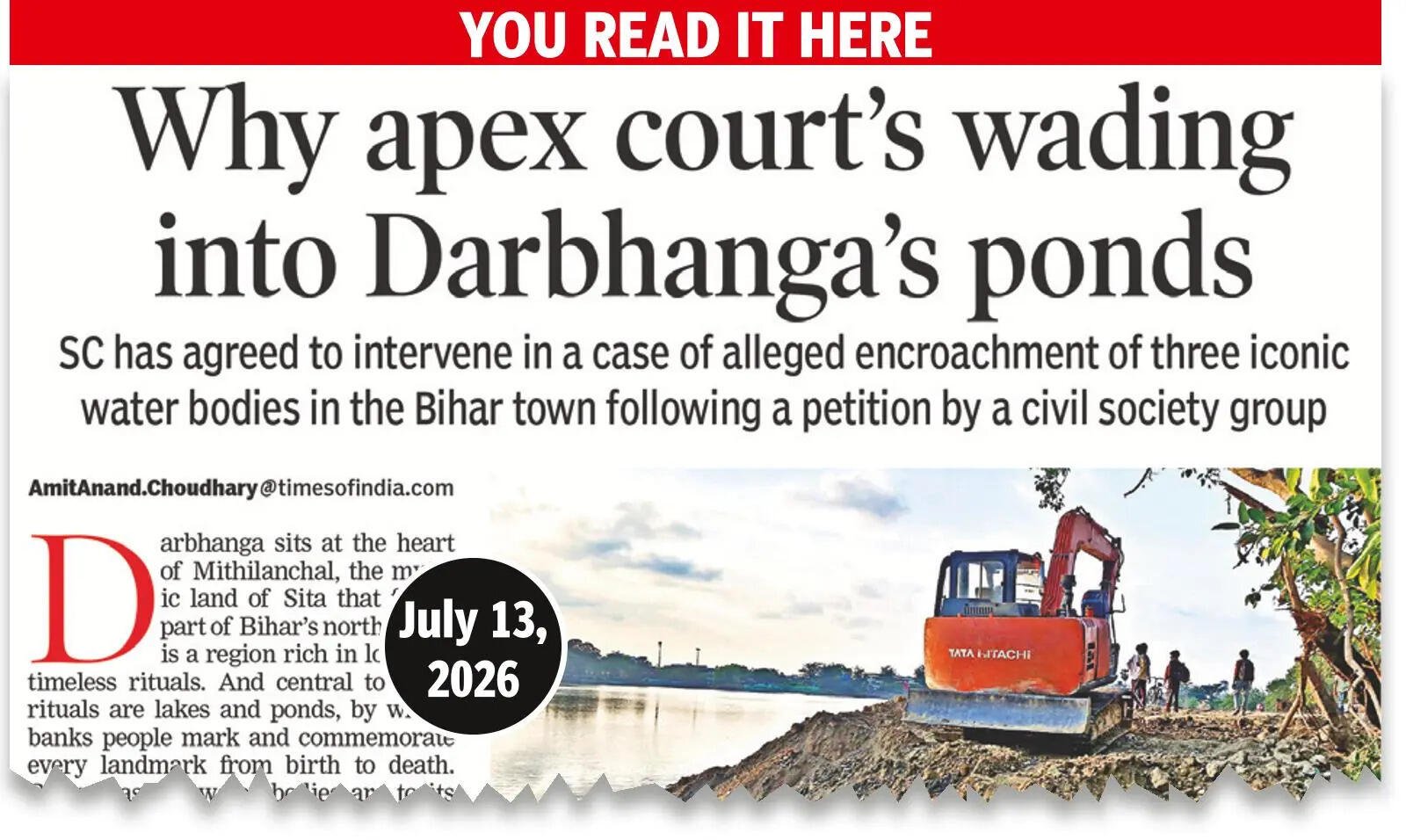
TOI had reported on July 13, with photographs, that three ponds in Darbhanga were being filled with soil and boulders to make way for stalls and footpaths, despite opposition from local residents and environmentalists.Advocate Renu Prajapati, appearing for Darbhanga-based voluntary group Talab Bachao Abhiyan, informed the bench that the three ponds form part of a list of protected wetlands and that any construction on their banks would violate rules and earlier rulings of Supreme Court. She also pointed out that the state, in its own affidavit, had admitted that around four acres of the ponds would be filled under the project.The state claimed that no arbitrary filling of the water bodies was taking place and that the activity was highly restricted and meticulously planned “earth filling & stone pitching” work. “This process is a necessity to stabilise and strengthen the severely eroded embankments, directly executing the mandate of NGT’s order. Furthermore, soil-filling footprint is strictly limited – for instance, constituting exactly 1 acre out of the 37.7-acre Harahi site, 1.42 acres out of the 50.9 acres at Digghi Lake, and 1.69 acres out of 44.2 acres at Gangasagar Lake,” the state’s affidavit stated.After a brief hearing, Supreme Court directed the govt to stop the work and ensure that the area of the ponds remain intact and is not reduced by filling.Justifying the project, the state said the integration of public amenities is aimed at managing footfall, ensuring public hygiene, and preventing future degradation.Supreme Court was hearing a plea filed by retired academicians, environmentalists and concerned citizens, seeking urgent intervention to halt filling of three historic ponds in Darbhanga – all 800-900 years old and integral to the city’s identity.Since the state is acting in contravention of these orders and no remedy remains, petitioner is constrained to approach the court seeking urgent direction to stop further filling of ponds, remove encroachments in and around the three Darbhanga ponds, and restore them to their original position as depicted in maps of 1868 & 1960,” the petition stated.In response, the state submitted: “To tackle unregulated access that historically turned the lakes into garbage dumps, the project provides structured public utility interfaces, including 11 designated bathing ghats, five changing rooms, and seven toilet blocks to eliminate open defecation and water contamination.”