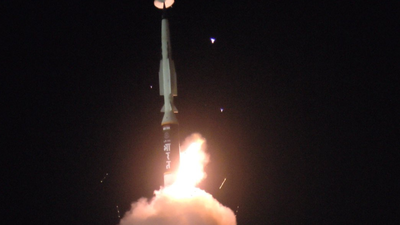
Operation Sindoor offered a masterclass in why high-speed weapons can help win conflicts. BrahMos missiles, travelling at nearly three times the speed of sound, sliced through Pakistan’s Chinese-origin air defences, dismantling command infrastructure and rendering key runways unusable in the process. It was a demonstration of a simple lesson: the faster a weapon reaches its target, the harder it is to stop.As air defence systems around the world grow more sophisticated, that lesson is pushing militaries towards an even faster frontier: hypersonic weapons.Hypersonic weapons broadly fall into two categories. The first is hypersonic glide vehicles, which are boosted atop rockets before gliding unpredictably towards their targets. Their erratic flight paths make interception extraordinarily difficult. Russia’s Avangard, China’s DF-ZF and DF-27, and the US Navy’s Conventional Prompt Strike system belong to this category.The second is hypersonic cruise missiles, which remain powered throughout their flight, retaining both speed and manoeuvrability from launch to impact. India’s under-development BrahMos-II and scramjet-powered Extended Trajectory-Long Duration Hypersonic Cruise Missile fall into this bracket, alongside France’s ASN4G, Russia’s 3M22 Zircon and America’s Hypersonic Air-breathing Weapon Concept.Yet the wars of the past few years have surfaced a different, equally urgent lesson, that speed alone is not enough if it comes at a prohibitive cost. The conflicts in Ukraine and Iran have both underlined the need for weapons that can be produced and expended at scale, rather than exquisite systems too expensive to use freely in a prolonged fight.This lesson has been made very clear in the ongoing conflict against Iran, in which the America’s missile stockpile has dropped significantly. This drop in weapon stocks has reduced the US’ staying power in a conflict against China in the broader Indo-Pacific.The cost factor also needs weighing, as shortages and smaller inventories of expensive weapons forced both the US (in Iran) and Russia (in Ukraine) to rely on riskier methods, such as using aircraft over well-defended areas, to destroy targets.This is precisely the gap the US Army now hopes to close with Blackbeard, a ground-launched hypersonic missile being developed by Castelion Corporation, a startup founded just three years ago by former SpaceX engineers. Designed to strike targets hundreds of miles away at hypersonic speeds, Blackbeard is being built alongside new uncrewed launcher vehicles. It is also expected to be compatible with the widely used M142 HIMARS launcher, already in service across multiple armies.If the design proves viable, the Army could gain a genuinely affordable way to strike time-sensitive, moving targets at hypersonic speed, without the eye-watering costs typically associated with such systems.With cost emerging as almost as decisive a factor as speed itself, more militaries are likely to follow the same playbook: building hypersonic weapons that are not just fast, but affordable and scalable enough to be fielded in the numbers that modern, protracted conflicts increasingly demand.As armed forces around the world experiment with hypersonic weapons, the next challenge will be developing systems that can deliver speed, precision and survivability, without becoming too expensive to use at scale.