The economy or a recession may be the last thing on your mind when you buy lipstick but that little swipe of colour could have a bigger economic story to tell.Introduced nearly 25 years ago, the Lipstick Index suggests that our beauty buys may reveal more about the ongoing financial circumstances than we realise. The theory is simple: when money gets tight, consumers may put big-ticket purchases such as holidays and designer handbags on hold, but still make room for smaller indulgences such as lipstick, perfume and cosmetics. After all, a little luxury may feel more affordable when the bigger splurges have to wait.After all, a little retail therapy can lift the mood without leaving a luxury-sized hole in the wallet. But does this feel-good fix still hold up when money gets tight?India’s beauty market certainly adds colour to the debate. In 2025, consumers bought a whopping 1,750 lipsticks every hour, through beauty retail website Nykaa. That’s a lot of pouts, but does it mean shoppers are reaching for a fresh shade when their budgets are under pressure?A small survey suggests otherwise. More than half the respondents said they had never bought lipstick as a little treat during financially difficult times.So, does the Lipstick Index still have a place in India, or is the theory beginning to smudge?
Decoding the Lipstick Index
Why lipstick became an economic indicator
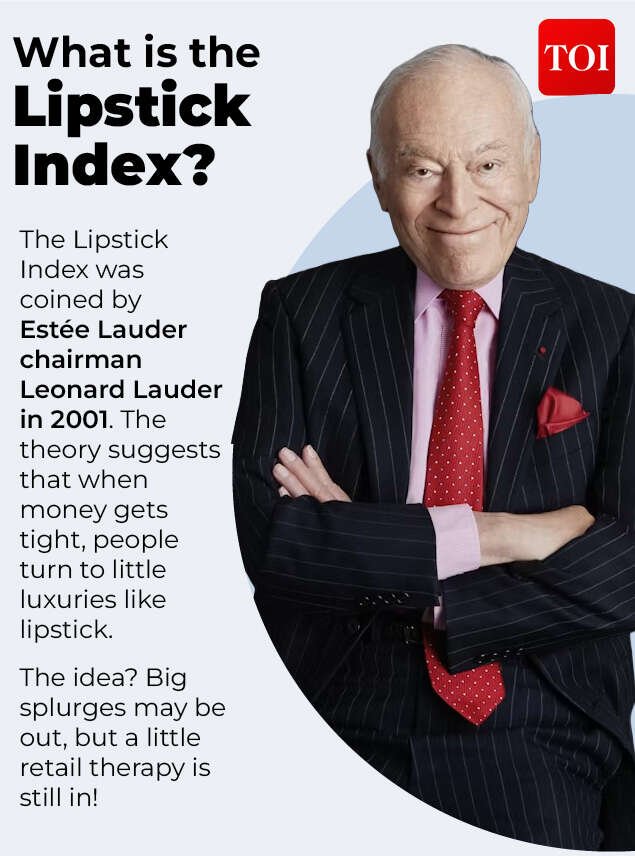
The Lipstick Index or the lipstick effect, in general, is built on the idea that when budgets get squeezed, consumers may put expensive purchases on pause but keep smaller luxuries in play.Leonard Lauder, then chairman of Estée Lauder, popularised the term in 2001 after observing a rise in lipstick sales during a US economic slowdown. The logic was that a holiday or designer handbag may feel like a stretch for buyers, but a new lipstick can still offer a little indulgence without a luxury-sized bill.The idea of affordable luxury, however, is older than the term itself. After World War II, fashion houses such as Chanel, Dior, Yves Saint Laurent and Balenciaga offered consumers a more accessible taste of luxury through perfumes and cosmetics, rather than expensive designer clothing.Explaining the consumer psychology behind the index, Jeff Kreisler, head of behavioural science at JP Morgan Private Bank, said that consumers may find it easier to absorb a price increase on an inexpensive item than on something as costly as a house.When bigger financial goals feel out of reach, smaller treats can offer a little comfort without putting the same pressure on the pocket.But before we declare lipstick the economy’s mood ring, there is a catch: a rise in sales does not automatically signal financial stress.Jyoti Prakash Gadia, managing director of Resurgent India, cautioned against applying the theory universally. “Just because there is an observation in one company or even broader category, it doesn’t mean that this economic hypothesis is universally applicable,” he told TOI.
India’s Lipstick effect put to test
India’s beauty boom tells a different story
Lipstick Index offers a useful lens on consumer behaviour, but is no crystal ball for predicting a recession in India.According to Gadia, “The Lipstick Index is a plausible and valuable hypothesis regarding consumer behaviour but cannot be regarded as an accurate predictor of recession in India.”He explained that smaller luxuries can offer a sense of satisfaction and normality during financially uncertain times without requiring a large outlay.“If one is in a relative financial distress, the individual may opt to make the gratifying indulgence smaller instead of altogether cutting out the indulgences. Lipsticks, perfume miniatures, and luxury snacks offer satisfaction, self-assurance and a feeling of normal stability, while requiring only small initial expenditure or investment,” he said.In short, consumers may choose smaller treats instead of giving up luxuries altogether. But whether lipstick makes the cut depends on individual budgets, priorities and spending habits. And when it comes to India’s growing beauty market, there is more than one shade to the story.
From an economic perspective, this involves a cautious substitution; that is, buying something less costly, like a lipstick or a luxurious gourmet snack in place of a vacation, designer clothes or a more luxurious purchase. The consumer may be trying to hold onto some of the choices available to him or her amid uncertainty and financial tightening. Nonetheless, it all ultimately boils down to how much money the individual has.
Jyoti Prakash Gadia, managing director of Resurgent India
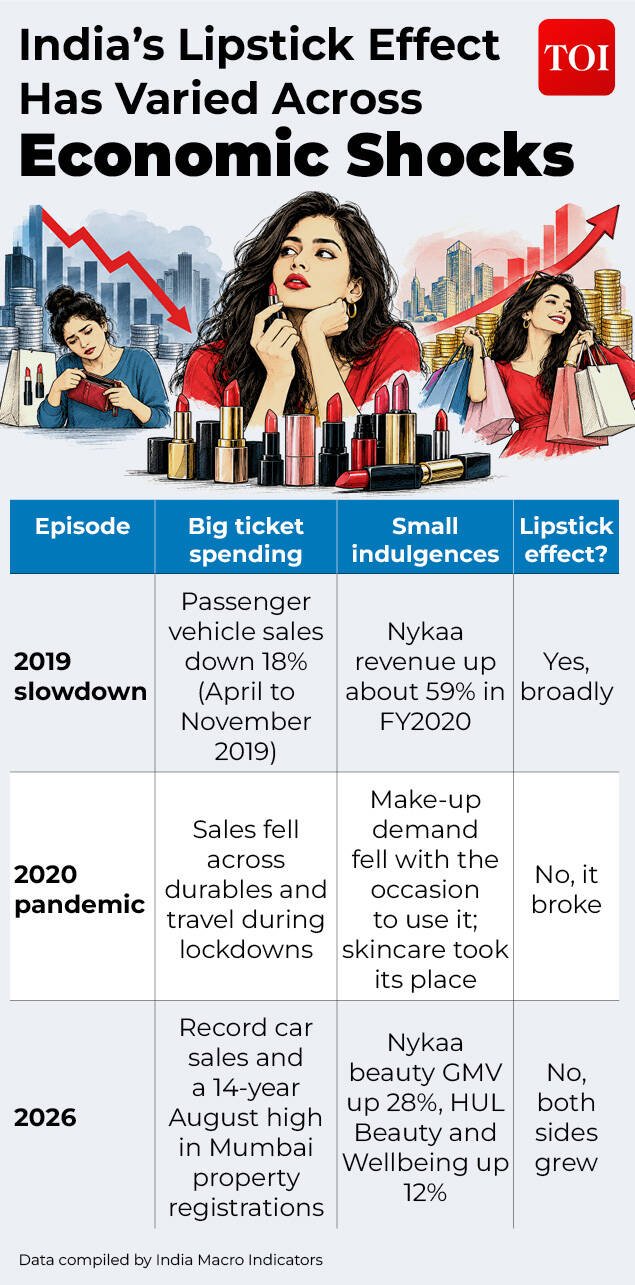
Rising lipstick sales may appear to support the theory, but the beauty boom has other possible drivers, too. Online shopping, wider product choices and premiumisation, when consumers move towards more expensive products within a category, can all influence spending.Furthermore, a growing beauty market, therefore, does not automatically mean shoppers are feeling financially squeezed.Online beauty seller Nykaa’s performance offers a glimpse of the sector’s growth. Its gross merchandise value (GMV) rose 28% year on year to Rs 4,105 crore in the first quarter of FY2027. Its House of Nykaa portfolio of owned brands recorded annualised GMV of around Rs 3,760 crore, up 39%.HUL’s Beauty and Wellbeing business reported a segment margin of 27.6% in the same quarter. However, its Home Care business grew faster, showing that the company’s growth was not confined to beauty products.Prices add another layer to the picture.In July 2026, personal care inflation stood at 2.24%, below headline inflation of 4.45%. By comparison, inflation in other personal effects, mainly jewellery and watches, reached 43.54%.With jewellery and watches becoming more expensive, beauty products might seem like a more affordable indulgence for some consumers.But buying lipstick because it fits the budget is not necessarily the same as buying it for comfort during financial stress. Nor do industry sales figures reveal whether shoppers are choosing lipstick instead of costlier purchases or simply spending more across categories.
Does the lipstick index hold up? Here’s what TOI found
We asked 61 people. Here’s what they said
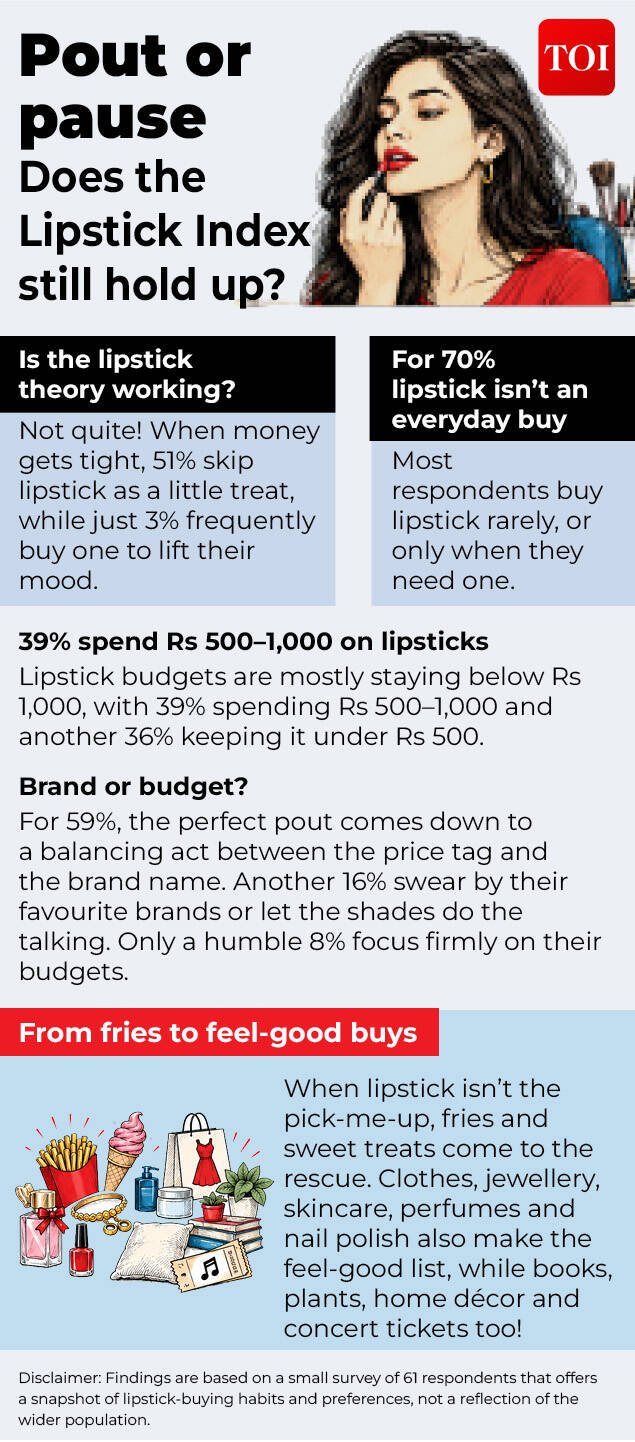
A small TOI survey of 61 respondents explored lipstick-buying habits, spending preferences and go-to treats. While the findings offer a glimpse into consumer behaviour, the sample is too small to represent India’s wider population.
When budgets tighten, is lipstick still a treat?
For most respondents, lipstick does not appear to be the first pick-me-up when budgets are stretched. More than half (51%) said they never bought lipstick as a treat during financially difficult periods, while another 25% said they rarely did so.Only 21% said they sometimes turned to a new lipstick for a little indulgence, and just 3% said they did so often. With around 76% rarely or never reaching for lipstick when money gets tight, the classic Lipstick Index does not quite hold up in this small survey.Lipstick also appears to be more of an occasional purchase than a regular mood-lifter. Around 55% of respondents said they bought it rarely or only when needed, while 22% purchased it every two to three months. Another 13% described their purchases as impulsive, while 5% bought lipstick whenever it was on sale and another 5% bought it every month. The findings suggest that for many, lipstick is more of a planned beauty purchase than an impulse buy or a go-to treat.Spending patterns point to a preference for the lower price brackets. Around 37% of respondents usually spent under Rs 500 on a lipstick, while an equal share spent Rs 500–1,000. Another 18% spent between Rs 1,000 and Rs 2,000, and 8% spent more than Rs 2,000. In all, nearly three-fourths spent up to Rs 1,000 per lipstick, suggesting that most respondents kept their purchases within this range.
India has multiple income levels and segments and diverse tastes and hence, one product alone cannot be an indicator of the macro status of the economy. Financial planning requires us to consider affordable luxury expenses taking into account the overall consumer sentiments , inflationary trends, employment, and discretionary spending.
Jyoti Prakash Gadia, managing director of Resurgent India
Price or brand: What drives lipstick purchases?
When it comes to spending, affordability appears to matter. Around 40% of respondents usually spent Rs 500–1,000 on lipstick, while 36% kept their spending below Rs 500.By comparison, 17% spent Rs 1,000–2,000, and 8% spent more than Rs 2,000. While spending habits varied, most purchases fell within the lower price brackets.Price, however, is not the only thing shaping buying decisions.Around 60% said both their budget and preferred brands influenced their choices. Another 17% prioritised the brand, while an equal share focused on the product and shade. Just 8% said budget was their main consideration.This suggests that even when shoppers are mindful of costs, the appeal of a particular brand, formula or shade can still influence what ends up in their beauty bags. The findings also show why affordability alone may not explain lipstick-buying habits: consumers can weigh price alongside their preferred products and brands.
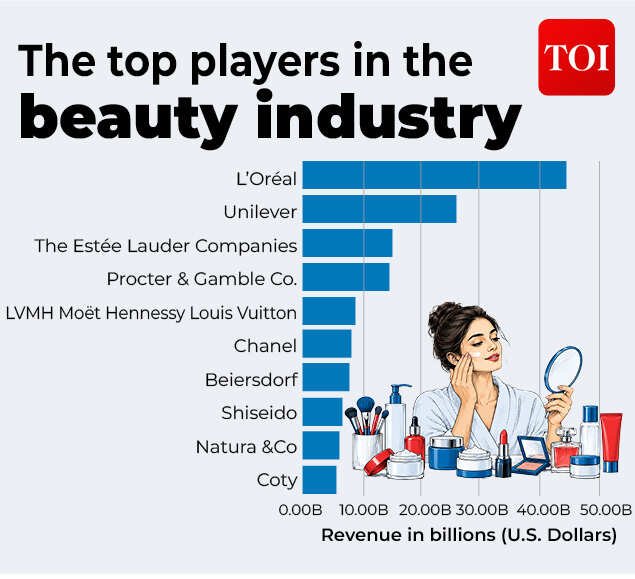
Who dominates the beauty world (Info credit: Statista)
If not lipsticks, then what?
If lipstick is not everyone’s go-to pick-me-up, what else makes the list? Survey responses pointed to a range of alternatives, including food, clothes, skincare, other cosmetics, earrings, jewellery, face masks, trekking gear and plants. For some, even buying a favourite food item was enough to feel good.The choices underline how personal affordable indulgences can be. While one person might reach for a new lipstick, another might prefer a favourite meal, a skincare product or a pair of earrings. There is no single purchase that works as a mood-lifter for everyone.Gadia said the psychology behind the Lipstick Index could extend beyond cosmetics. Small purchases may offer gratification, self-assurance and a sense of normality when bigger financial goals seem distant. However, what counts as an affordable luxury can differ widely across income groups, regions and cultures in India.“There does not seem to be a common equivalent in India, since what constitutes an affordable indulgence differs by income group, geography and cultural traits,” Gadia said.He suggested that alternatives could include high-end tea or coffee, mithai, affordable artificial fashion jewellery, skincare samples and salon services.“For some consumers in urban areas, a visit to a cafe could be an alternative to an expensive night out. For others, a low-cost grooming expense could serve as a substitute for an expensive clothing line. The above are illustrative examples and do not constitute actual indicators of a possible or impending recession.”The survey, too, does not establish that consumers are replacing expensive purchases with smaller treats. Instead, it offers a glimpse into how varied their choices can be, and why lipstick alone may not be enough to tell us how consumers are feeling about their finances.
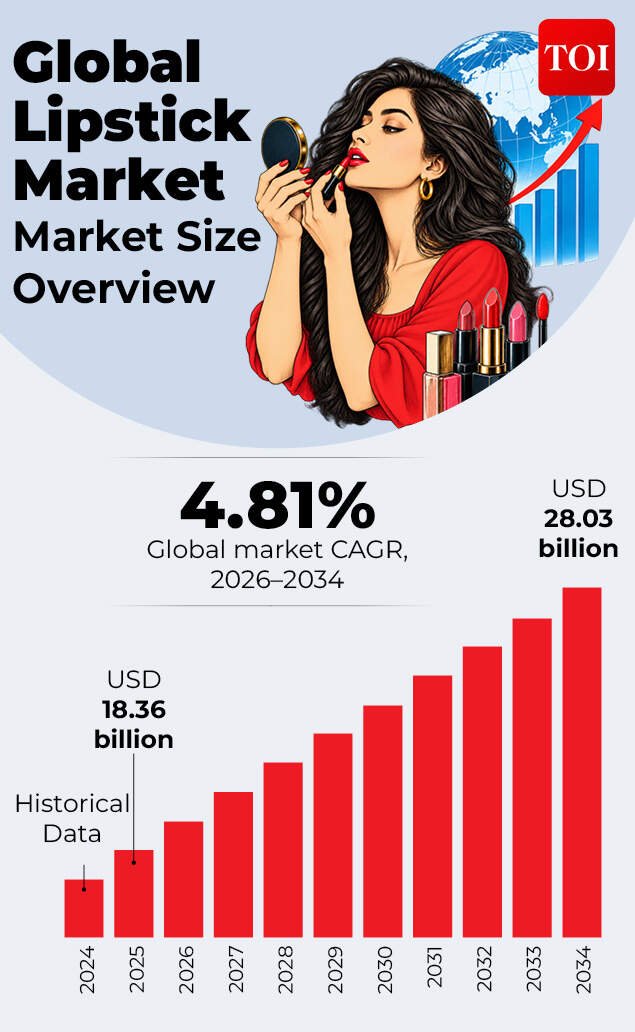
Lipstick market around the world (Credit: market data forecast analysis)
So, does the Lipstick Index work in India?
Ultimately, the Lipstick Index may say as much about personal choices as it does about the economy. For some, a new lipstick is a little treat; for others, it could be their favourite food, a skincare product or even a new plant for the balcony.This makes the theory difficult to apply to India, where spending habits and budgets vary widely. Rising lipstick sales do not necessarily mean consumers are worried about money, just as falling sales do not automatically point to financial stress. Beauty trends, brand preferences and changing spending power can also influence purchases.So, while the Lipstick Index offers an interesting way to look at consumer behaviour, lipstick sales alone cannot tell us whether the economy is under pressure.Finding the right shade may be tricky, but reading the economy takes more than a lipstick tally!