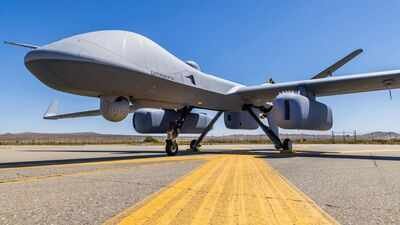
Swedish defence company Saab and US drone manufacturer General Atomics have successfully flown an MQ-9B unmanned aircraft equipped with an airborne early warning radar, marking what could be the world’s first operational step towards a drone-based AWACS capability.The demonstration combines the long endurance of the MQ-9B remotely piloted aircraft with airborne surveillance capabilities traditionally performed by large crewed Airborne Warning and Control System (AWACS) aircraft.The test flight used Saab’s new podded radar system, known as LoyalEye, designed to provide persistent airborne surveillance and early warning against a range of aerial threats. By mounting the radar on a long-endurance drone, militaries could potentially maintain radar coverage for far longer periods and at significantly lower operating costs than conventional AWACS platforms.A new approach to airborne early warningAirborne early warning aircraft are among the most valuable assets in modern warfare. Operating at high altitude, they can detect aircraft, missiles and drones hundreds of kilometres away, extending the reach of ground-based radar networks.However, these aircraft are expensive to acquire and operate, require large crews and are often available in limited numbers.The MQ-9B AEW concept seeks to address those limitations by using an unmanned platform capable of remaining airborne for more than 30 hours while carrying an advanced radar payload.Talking about the MQ-9B AEW capability, General Atomics Aeronautical Systems, Inc. President David R Alexandar said, “AEW for MQ-9B will offer critical aloft sensing to defend against tactical air munitions, guided missiles, drones, fighter and bomber aircraft, and other threats.”He further stated that, “Operational availability for a medium-altitude, long-endurance UAS is the highest of any military aircraft, and as an unmanned platform, its aircrews are not put into harm’s way.”The concept comes at a time when militaries worldwide are facing growing threats from low-flying cruise missiles, swarming drones and precision-guided weapons that can be difficult for conventional ground-based radar systems to detect in time.Why militaries are interestedModern conflicts have demonstrated the growing importance of persistent surveillance.Traditional AWACS aircraft typically operate in limited numbers because of their high cost and maintenance requirements. Losing even one such aircraft can significantly affect battlefield awareness.A drone-based airborne early warning platform could remain on station for much longer periods while reducing operational costs. It would also allow militaries to deploy multiple surveillance nodes simultaneously, creating broader radar coverage over large geographic areas.The MQ-9B AEW concept is designed to provide continuous monitoring of airspace, enabling operators to detect and track aerial threats at greater distances. This could be particularly valuable in detecting low-observable targets, drone swarms and cruise missiles before they reach defended areas.Equally important is the platform’s ability to share information in real time across wider command-and-control networks, helping military commanders build a comprehensive air picture.What it means for IndiaThe development is likely to attract significant interest in India, which is in the process of acquiring 31 MQ-9B High Altitude Long Endurance drones for the Army, Navy and Air Force.Also read: India to kick off acquisition process for 31 armed drones from US in early JulyIndia currently relies on a relatively small fleet of airborne early warning platforms consisting of three Israeli-origin Phalcon AWACS aircraft and three indigenous Netra AEW&C systems.These aircraft play a critical role in monitoring airspace, tracking aircraft and missiles, coordinating fighter operations and extending radar coverage beyond the reach of ground-based systems.However, India’s airborne surveillance fleet remains limited compared to the scale of its operational requirements.New Delhi is already working to expand these capabilities. The Indian Air Force plans to induct six additional Netra Mk-1A aircraft, while the AWACS India programme will equip Airbus A321 aircraft with indigenous radar and mission systems.Even with these programmes, India’s requirement for airborne surveillance remains substantial.The country faces the challenge of monitoring two active land borders with China and Pakistan while simultaneously maintaining awareness across the Indian Ocean Region, where maritime competition and security concerns continue to increase.A drone-based airborne early warning capability could complement existing AWACS fleets by providing additional surveillance coverage at lower operating costs.