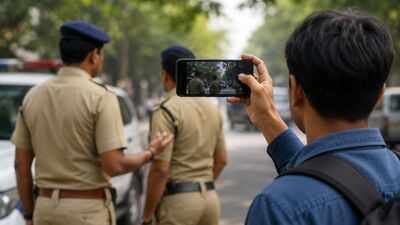
NEW DELHI: A viral video of a police officer interacting with a citizen often raises the same question: can you legally record the police? No law expressly bans filming police on duty in public, but the right isn’t absolute — courts have stressed that recording must not get in the way of police work or break any other law.Is recording the police legal?There’s no specific law banning citizens from recording police performing their duties in public. The right flows from Article 19(1)(a) of the Constitution — freedom of speech and expression — which courts have interpreted to include gathering and sharing information, including filming public officials at work.If you’re in a public place and not interfering with police work, recording is generally not illegal. Courts have recognised that transparency matters in a democracy, and citizen videos have helped establish facts in several police-conduct cases.Can police stop you from recording?Police may ask you to stop if recording genuinely interferes with an investigation, search, arrest, or other official function.The relevant law is obstruction of a public servant — earlier Section 186 IPC, now Section 221 of the Bharatiya Nyaya Sanhita (BNS). It punishes “voluntarily obstructing” a public servant on duty with up to three months’ jail, a fine up to Rs 2,500, or both.But merely recording an officer on duty in public, from a distance, doesn’t automatically amount to an offence.Can police seize your phone?Police cannot arbitrarily seize your phone just because you recorded them. Under Section 106 of the Bharatiya Nagarik Suraksha Sanhita (BNSS), police can seize an electronic device only if it’s relevant to an investigation. The officer must also record the reasons for the seizure and inform a magistrate about it.Can police force you to delete a video?There’s no general legal power allowing police to force the deletion of a lawfully recorded video.Courts have pushed back on police misusing other laws to intimidate citizens who record them. In September 2024, the Bombay High Court’s Aurangabad bench ruled that recording inside a police station isn’t an offence under the Official Secrets Act, 1923, since a police station isn’t a “prohibited place” under the Act.A 2022 Bombay High Court order went further, fining the state Rs 25,000 for booking a man under the same Act for merely photographing a police station from outside, calling it a misuse of law “to harass or torment persons.”If a recording is part of an investigation, it may be dealt with through due legal process — but forcing someone to erase evidence without following the law has no legal ground.Can you upload the video on social media?Uploading a video is different from recording one. If a video is defamatory, invades someone’s privacy, reveals the identity of protected persons such as certain victims under the law, or affects an ongoing investigation, the person posting it may face legal consequences. Sharing misleading or edited videos can also attract action under criminal law.What do courts say?The Supreme Court’s 2020 ruling in Paramvir Singh Saini v. Baljit Singh made CCTV cameras with audio recording mandatory in every police station, to prevent custodial torture — a mandate the court has repeatedly had to remind states to comply with, as recently as November 2025.Citizen and CCTV footage have similarly been relied upon in cases of alleged excessive force, illegal detention and custodial violence. But courts have also said individual rights must be balanced against public order, privacy and effective policing.Section 33(2) of the Kerala Police Act, 2011, explicitly bars officers from stopping a person from recording police action in public or private, so long as it doesn’t obstruct their duty. No other state has a similar law.Citizens can generally record police on duty in public places, provided they don’t obstruct police work or break any other law. There’s no complete ban on filming police, but how the recording is used — and whether it interferes with duty — determines whether legal issues arise. Recording peacefully from a safe distance is generally fine, but outcomes depend on the specifics, especially where national security, ongoing investigations, or privacy are involved.