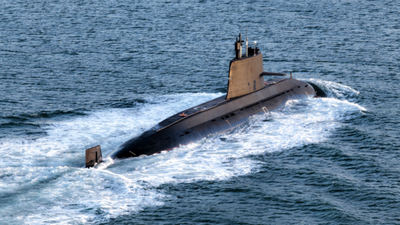
Fresh satellite imagery of a submarine under construction at China’s Bohai Shipyard in Huludao has provided new indications of Beijing’s efforts to develop a more advanced generation of nuclear-powered attack submarines. Analysts are focusing on the vessel’s pumpjet propulsion system, X-shaped stern and possible weapons configuration.The imagery, captured by Vantor on September 18, shows the submarine undergoing construction at the northeastern Chinese shipyard. The vessel is widely assessed to be a possible Type 095 nuclear-powered attack submarine, although its exact designation remains unconfirmed. The latest images offer a clearer view of the stern and provide further clues about the design of what could become one of the Chinese navy’s most advanced attack submarines, The War Zone (TWZ) reported.Pumpjet propulsionThe most significant feature is the apparent use of a pumpjet propulsion system. Unlike a conventional exposed propeller, a pumpjet encloses the propulsor within a shroud and is generally associated with improved efficiency at higher underwater speeds and reduced noise, Janes reported.For a nuclear-powered submarine, which can remain submerged for long periods, acoustic stealth is critical to avoiding detection by enemy submarines, surface ships and maritime patrol aircraft.The vessel also features an X-shaped stern control arrangement, replacing the more conventional cruciform configuration seen on several earlier Chinese submarine designs. Such a configuration can provide improved control and manoeuvrability, while potentially reducing the submarine’s acoustic and hydrodynamic signatures.Similar features have been observed on newer Chinese submarine designs, suggesting that Beijing is experimenting with common technologies across different classes.Implications for PakistanThe development has implications for the wider regional undersea balance, including Pakistan’s expanding conventional submarine fleet.Pakistan is inducting eight Hangor-class submarines based on China’s Type-39A design, with four being constructed in China and four in Karachi. The first, PNS Hangor, is part of a programme scheduled for completion by 2028.The Hangor-class boats will use air-independent propulsion, allowing them to remain submerged for longer periods without surfacing or frequently using a snorkel to recharge batteries. This reduces exposure to detection by maritime patrol aircraft, unmanned aerial vehicles and surface vessels.Once all eight are inducted, Pakistan’s submarine fleet is expected to grow to 11 boats, nine of them equipped with AIP.India’s submarine numbers remain unchangedThe Indian Navy operates 16 attack submarines and three strategic submarines, with its conventional fleet comprising Kalvari, Sindhughosh and Shishumar-class boats. Six Kalvari-class submarines are planned to receive a domestically developed DRDO air-independent propulsion system, allowing them to remain submerged for longer periods.However, delays in submarine acquisition have slowed fleet expansion. The Navy’s 1998 plan to induct 24 conventional submarines by 2030 remains far from being achieved, with only six new boats inducted while four have been retired.The P-75I programme for six to nine submarines, estimated at around Rs 70,000 crore, has moved ahead after Mazagon Dock Shipbuilders and Germany’s TKMS cleared technical evaluation. However, deliveries will take years.Project-76 is expected to run alongside P-75I, while Project-77 envisages indigenous nuclear-powered attack submarines. India is also pursuing a leased Russian nuclear-powered submarine.These programmes, however, remain years away, leaving the Navy dependent on its existing fleet even as Pakistan expands its submarine capability.