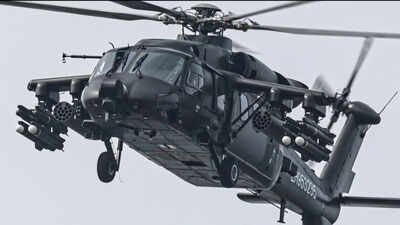
The next shift in the military balance along the India-China frontier may not come from fighter jets or missiles alone.China is increasingly turning its attention to the skies over the Himalayas, expanding the People’s Liberation Army’s (PLA) helicopter fleet with new attack gunships, heavy-lift platforms and multi-role aircraft designed to move troops, weapons and supplies across some of the world’s most difficult terrain.From the Z-10 attack helicopter to the versatile Z-20 family, Beijing is building a more diverse rotorcraft force that could give its troops greater mobility and operational flexibility along the border with India.The expansion is not limited to adding more helicopters to its existing inventory. China is also changing the composition of its helicopter force, moving from a fleet that has relied on foreign-sourced platforms towards a wider range of domestically developed aircraft designed for specialised military roles.Russian-built helicopters, including the Mi-17/171 transport family and Ka-28 and Ka-31 naval variants, continue to serve alongside China’s expanding indigenous fleet.According to a report by The War Zone (TWZ), the PLA now operates an increasingly diverse helicopter fleet covering battlefield transportation, pilot training, dedicated attack missions, airborne early warning and anti-submarine warfare. The report noted that indigenous designs are increasingly supplementing foreign-origin helicopters that continue to serve important roles in troop transportation and naval operations.This transition has been particularly visible in the development of China’s Z-series helicopters. The Z-10 and Z-19 provide dedicated attack and reconnaissance capabilities, while the Z-8 family offers heavy transport and specialised support variants. The Z-20 has emerged as a central platform in China’s modernisation drive, with variants developed for ground forces, airborne assault and naval operations.China is also developing a larger attack helicopter, tentatively identified as the Z-21, which could add another dimension to its combat aviation capabilities.China’s helicopter edge worries IndiaFor India, the growing helicopter capabilities of the People’s Liberation Army (PLA) have particular significance along the Himalayan frontier, where difficult terrain, extreme weather and limited road connectivity make aerial mobility critical to military operations.Helicopters allow armed forces to transport troops, ammunition, fuel and other supplies to remote forward positions, evacuate injured personnel and provide fire support to ground troops. They can also operate from forward landing sites that are inaccessible to larger transport aircraft, making them an important component of high-altitude warfare.The importance of helicopter operations in the region has been demonstrated repeatedly by the Indian armed forces. During Operation Meghdoot in 1984, the Indian Army and Air Force used helicopters to airlift troops to strategic heights on the Siachen Glacier. The Indian Air Force had also been operating helicopters in the region since 1978, when a Chetak helicopter made its first landing on the glacier.India’s helicopter fleet and plans to counter ChinaIndia is relying on a combination of attack, transport, heavy-lift and utility helicopters to strengthen its military capabilities along the northern borders. Its existing fleet includes Russian-origin Mi-17 helicopters, indigenous Dhruv and Rudra platforms, American Apache attack helicopters and Chinook heavy-lift helicopters.New additions, particularly the indigenously developed Prachand light combat helicopter, are expected to strengthen India’s ability to conduct combat and logistical operations in mountainous terrain.India also operates the indigenously developed Rudra, the armed version of Hindustan Aeronautics Limited’s (HAL) Advanced Light Helicopter (ALH) Dhruv. It is designed for armed reconnaissance, close air support and other combat-support missions. The Dhruv family also performs troop transportation, reconnaissance and search-and-rescue operations.India operates 15 American CH-47F Chinook heavy-lift helicopters. The tandem-rotor aircraft can transport artillery, vehicles, engineering equipment and other heavy military supplies to remote locations. The IAF also relies on Russian-origin Mi-17 variants, including the Mi-17 V5, for troop transportation, logistics, casualty evacuation and air maintenance missions.