The fire in commercial kitchens just got significantly more expensive. Effective May 1, 2026, the cost of a 19-kg commercial LPG cylinder has surged by approximately ₹993, landing at a staggering ₹3,071.50, from its earlier ₹2,078, making it a nearly 50% hike. For many, this isn’t just a price hike; it’s a systemic shock.
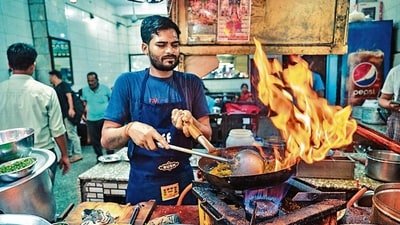
While the government pushes for a gas-neutral future, the architectural reality of Delhi also stands in the way. Pranav Girish Patel, Store Manager of Hengbok restaurant in Andheri West says the impact of the price hike doesn’t fall on their place as they have been working on a gas pipeline connection. “Our prices won’t see any change, as thankfully due to the pipeline connection, we don’t have to spend any extra amount from our side,” he says.
Future-proofing the menu
For larger chains, the blow has been softened by foresight. Prashant Pallath, owner of the Tanjore Tiffin Room which has branches across Mumbai, says the price hike will be dealt with internally without any impact on the consumers. “The gas cost is hardly as denting when it comes in comparison to the total cost we have to bear. There is enough margin for us to play around without increasing any prices on our menu. The electricity and gas costs comprises only five percent of the total cost for us, so while the increase in LPG price is big, in comparison to the whole scenario, it isn’t worth compromising on the comfort of the customers by increasing the prices. The customers should get the benefit as it is a crisis that the world is facing and I am in no hurry to increase our prices.”
Pankaj Shukla, the manager of Persian Darbar, says, “Bahaut mushkil ho gayee hai, sab kharche bhad gaye hai, bahaut dikkat ho raha hai. Cylinder toh mil bhi nahi raha hai.” He adds, “Agar zarorat padhi toh khane ki cost bhi badhani padh sakti hai.”
Sunil Yadav, who sells momo on a cart in Versova, insists while the rising prices of LPG cylinders have put a strain, they are helpless in the situation. “Agar hum price bada dein to customers kam ho jayenge, isliye hum wo nahin kar sakte. Hum bas ye soch rahe hain ki do ya teen mahine ki aur baat hai, fir sab theek ho jayega,” he says.
What’s next?
As of May 2026, the industry is split. While some are protected by electric transitions, smaller standalone eateries may have no choice but to adjust. For now, the main course for Delhi’s restaurateurs is a complex mix of logistical gymnastics and financial endurance, all while hoping the global oil tide turns before the pilot lights go out.