
NEW DELHI: As India moves towards introducing a dengue vaccine by next year, the country’s first nationwide mapping of dengue virus strains has found all four serotypes circulating simultaneously in eight states and UTs, a development researchers say could influence vaccine strategy as infections with multiple strains are associated with more severe disease.The pan-India molecular surveillance study, led by ICMR-National Institute of Virology, Pune, analysed 6,889 lab-confirmed dengue samples collected through 45 virus research and diagnostic laboratories (VRDLs) across 25 states and UTs between 2023 and 2025. It found that dengue serotypes – at least two – were co-circulating in each state and UT included in the surveillance, indicating increasing hyperendemicity of the disease in India.
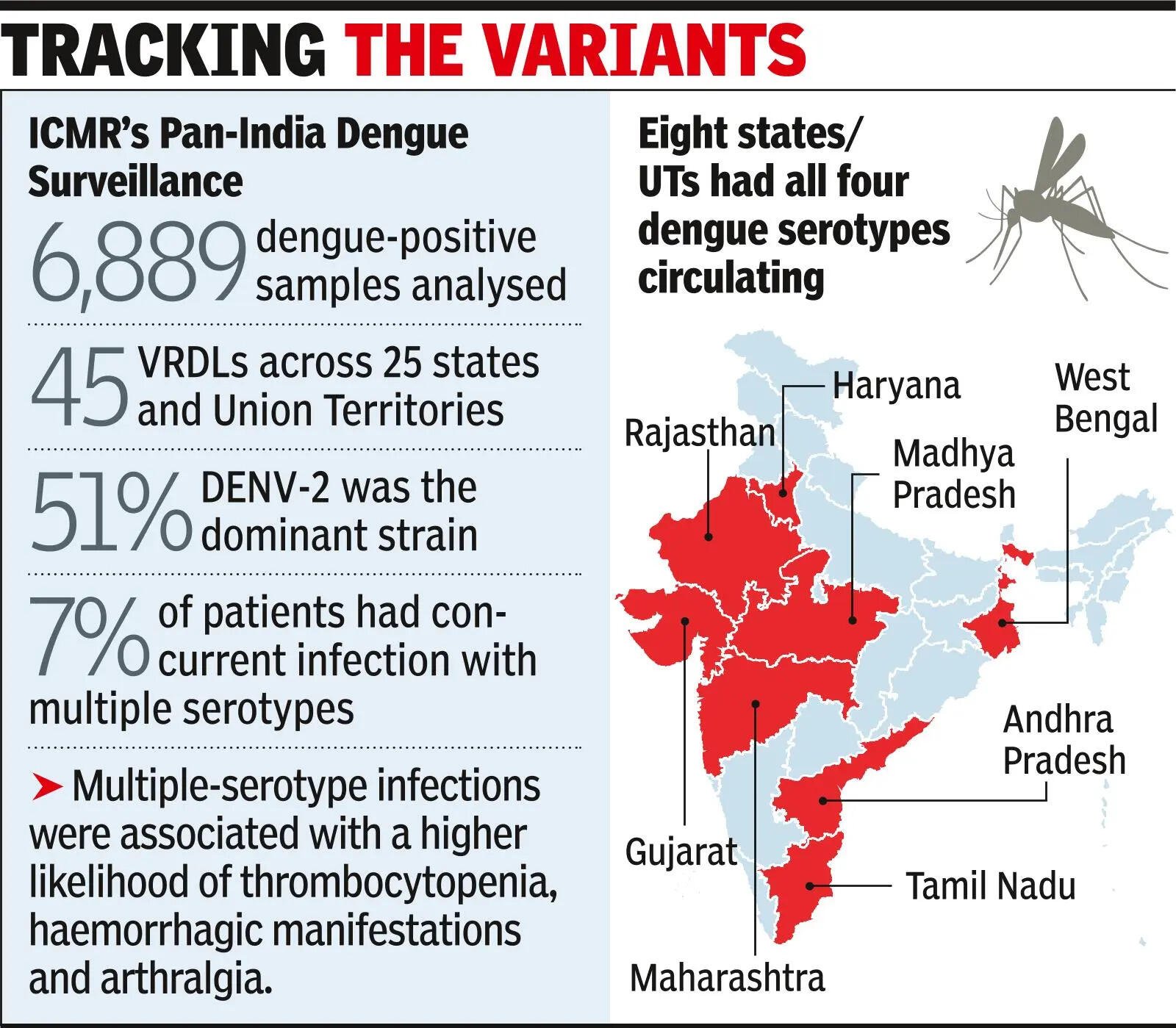
According to the study, all four dengue serotypes (DENV-1, DENV-2, DENV-3 and DENV-4) were detected simultaneously in Andhra, Gujarat, Haryana, MP, Maharashtra, Rajasthan, Tamil Nadu and West Bengal. Fifteen other states and UTs had three serotypes in circulation, while two reported circulation of two serotypes.Researchers found DENV-2 to be the dominant circulating strain, accounting for 51% of infections, followed by DENV-3 (13%), DENV-1 (7%) and DENV-4 (1%). About 7% of patients were infected with two or more dengue serotypes simultaneously.The study found patients with concurrent infections were more likely to develop thrombocytopenia, haemorrhagic manifestations and arthralgia than those infected with a single serotype, suggesting that circulation of multiple strains could increase the burden of severe dengue.
Share your thoughts in the comments
Be respectful · TOI community guidelines
The researchers said continuous molecular surveillance is essential to monitor changing dengue virus circulation, improve outbreak prediction and guide vaccine introduction strategies. They noted that several dengue vaccine candidates are in advanced stages of development and that vaccine efficacy varies against different serotypes, making surveillance critical for immunisation policy.The study also highlighted regional differences in virus circulation. While DENV-2 predominated across India, DENV-1 accounted for a relatively larger share of infections in Tamil Nadu (29%), Haryana (38%) and Rajasthan (25%). DENV-3 was more frequently detected in Gujarat (30%), TN(29%), UP (29%) and WB (20%).