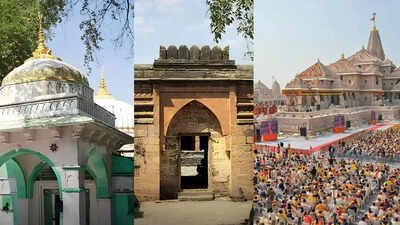
Devotees offer prayers at Bhojshala complex; how principles from Ayodhya verdict paved way for temple
DHAR: People have begun entering the Bhojshala complex in Dhar to offer prayers after the Madhya Pradesh high court ruled that the disputed site is a Hindu temple dedicated to goddess Vagdevi/Saraswati and a centre of Sanskrit learning. A devotee said, “After years, we got the chance to have darshan without any obstacle. The court gave a great verdict. I will come here every day to offer prayers.” Bhoj Utsav Samiti Sanrakshak Ashok Kumar Jain said, “We have never been more happier than we were yesterday. Hindu community was struggling for a long time and three of our brothers were martyred in this struggle. It is because of them and the efforts of countless others that the locks of Maa Saraswati Mandir in the Bhojshala have opened. This morning, I was the first one to reach here and along with others agitating for the cause, performed morning prayers at the temple.“ Bhojshala Mukti Yagna coordinator Gopal Sharma said, “This was not my fight, but the fight of the entire Hindu community. It was not for one place alone, but a victory of Hindu and Sanatana culture. For 720 years, the Hindu community here felt humiliated and made every kind of sacrifice, but the court’s decision that came yesterday, is only a pause in the larger struggle. Until the glory of Bhojshala is fully restored and the site regains the form it had during Raja Bhoj’s time, the Hindu community of Dhar will continue its efforts. “I remember all those who led this movement over the years and those who guided it to the masses. Because of their efforts, this movement reached far and wide. Bhojshala will now be known as Maa Sarasvati-Kanthabharana. I appeal to the Hindu community to come here, offer prayers and treat it as a temple, so its full restoration can be achieved,” he added further.
Drawing on principles from the Ayodhya case
The Indore bench of the Madhya Pradesh high court said the religious character of the Bhojshala-Kamal Maula Mosque complex in Dhar is that of a “centre of Sanskrit learning and Hindu temple dedicated to goddess Vagdevi/Saraswati”. Drawing on principles from the Ayodhya case, the court held that archaeology involves multidisciplinary interpretation and said it relied on the Archaeological Survey of India’s findings along with historical and literary material. Historical records, the court noted, indicated the site was associated with Raja Bhoj of the Parmar dynasty and contained references to a temple dedicated to goddess Saraswati. The court declared the site a protected monument under the Ancient Monuments and Archaeological Sites and Remains Act with effect from 18 March 1904. It directed that the ASI will continue to have supervisory control over preservation, conservation, and regulation of access at the site. In its operative directions, the court also struck down a 2003 ASI order that had restricted Hindu worship to Tuesdays while allowing Muslim prayers on Fridays. The Union government and ASI have been asked to take over the administration and management of the site as a Bhojshala temple and centre of Sanskrit learning, while suggesting alternative land in Dhar district for construction of a mosque.