Dhruv Jurel’s second Test century, scored on Day 2 of the ongoing second Test against Sri Lanka in Colombo on Monday, came with a celebration that carried far more meaning than the milestone itself. After reaching three figures, the India wicketkeeper-batter raised his bat before subtly pulling up his sleeve, revealing a Hindi tattoo on his forearm: “Jai Jawan, Jai Kisan.”
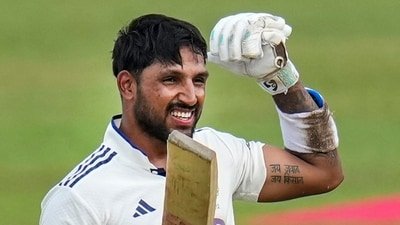
The iconic slogan, coined by former Prime Minister Lal Bahadur Shastri in 1965, salutes India’s soldiers and farmers. For Jurel, though, the words carry a deeply personal meaning, they are a tribute to his father, Nem Chand Jurel, a former Indian Army Havildar who fought in the 1999 Kargil War, and his grandfather, who was a farmer.
“That is my story. My grandfather was a farmer and my father was a soldier. Those are my roots, where I came from, and I do not want to forget them. So that celebration was for my father and grandfather,” Jurel said in the post-day press conference, dedicating his second Test century to his parents.
Jurel’s unbeaten knock of 117 helped India post 503/9 before captain Shubman Gill declared the innings. Along the way, he stitched together a gritty 112-run partnership with Rishabh Pant, who battled through an injury concern to score 63.
IND vs SL Live Score, 2nd Test
The right-hander also explained his batting approach and why he chose to stick to his strength as a run accumulator while partnering Pant, who was playing in his archetypal attacking style.
“We all know Pant is such a terrific player and what he has done for India in Australia and England. So, whenever he is in, I only seek his advice, because he has so much experience. So, I always ask him for advice as to what I should do in a particular situation,” he said.
But does playing alongside Pant ever tempt him to adopt the same attacking approach?
“As you can see, Test cricket has different ways of playing, and it makes the game beautiful. When you play with Pant, it’s a very terrific experience. I can’t play like him, the way he has been playing since childhood.
“My game plan is to see which bowler I should take down, which spell I should play, and I always ask Pant because he is a wicketkeeper, I am a wicketkeeper, and we play in the middle order, so it’s a very good experience.”
The century had also been a long time coming for Jurel, whose place in India’s playing XI had been debated in recent months, with some arguing that Sarfaraz Khan was better suited to the No. 6 role.
But more than his own contribution, Jurel was quick to acknowledge Mohammed Siraj, who blocked 29 deliveries on the second evening to give him the chance to complete his century.
“Siraj, whenever I speak to him, I think he celebrates more. It’s a good thing about him. His defending was solid. It was good,” Jurel said.