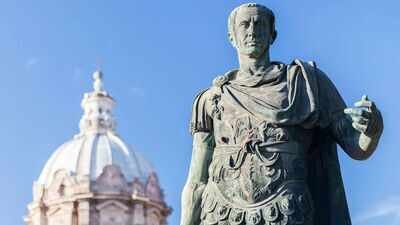
“Veni, Vidi, Vici” — “I came, I saw, I conquered.”Just three words. Yet they have echoed across history for more than two millennia.They were written by Gaius Julius Caesar, the Roman general and statesman whose military brilliance, political ambition and sweeping reforms transformed the ancient world. More than 2,000 years after his death, Caesar’s influence can still be found in everyday life—including on the calendar.On Julius Caesar’s birth anniversary, here’s a look at the extraordinary legacy of one of history’s most influential leaders.Did you know July is named after Julius Caesar?Every time you write the date in July, you’re using a name that honours Julius Caesar. The month was originally called Quintilis, meaning “fifth month” in the early Roman calendar, which began in March. After Caesar’s assassination in 44 BC, the Roman Senate renamed the month Julius in recognition of his achievements. Over time, the name evolved into the modern July.Caesar’s impact on timekeeping extended far beyond the name of a month. In 46 BC, he introduced the Julian calendar, a major reform that replaced Rome’s outdated calendar with a more accurate solar system. It later became the foundation for the Gregorian calendar, which is used across most of the world today.Born into nobility—but not powerBorn in 100 BC, Caesar belonged to the gens Julia, one of Rome’s oldest and most prestigious noble families, which claimed descent from the mythical Trojan prince Aeneas.Despite its illustrious lineage, the family had lost much of its political influence and wealth by the time Caesar was born. Through political skill, determination and military success, he rose from relative obscurity to become the most powerful man in the Roman Republic.The conqueror who changed RomeCaesar’s greatest military achievement came during the Gallic Wars (58–50 BC), when he conquered territories spanning much of modern-day France, Belgium and parts of Switzerland.The victories dramatically expanded Rome’s borders, brought enormous wealth to the Republic and earned Caesar the unwavering loyalty of his soldiers. His firsthand account, Commentaries on the Gallic War, remains one of the most important military texts from antiquity.‘Veni, Vidi, Vici’One of history’s most famous quotations was born after a remarkably swift military campaign. In 47 BC, after defeating Pharnaces II, King of Pontus, at the Battle of Zela in present-day Türkiye, Caesar sent the Roman Senate a report containing just three Latin words:“Veni, Vidi, Vici” — “I came, I saw, I conquered.”The phrase perfectly captured the speed and decisiveness of the victory. More than two thousand years later, it remains a universal expression of overwhelming success.Crossing the RubiconCaesar’s ambitions eventually brought him into conflict with the Roman Senate. In 49 BC, senators ordered him to disband his army before returning to Rome. Instead, Caesar marched across the Rubicon River with his troops—an act considered a declaration of civil war.His decision changed Roman history forever. Even today, the phrase “crossing the Rubicon” refers to making an irreversible decision from which there is no turning back.The leader who reshaped the calendar—and Rome. After defeating his rivals, Caesar became dictator of Rome and launched a series of reforms that reshaped the Republic.He reorganised government administration, tackled corruption, reformed taxation, expanded Roman citizenship and settled military veterans on land. Most significantly, he introduced the Julian calendar, one of history’s most enduring administrative reforms.Many historians regard his rule as the bridge between the Roman Republic and the Roman Empire.The assassination that changed historyCaesar’s growing authority alarmed many Roman senators, who feared he intended to make himself king.On 15 March 44 BC—the famous Ides of March—a group of conspirators assassinated him inside the Theatre of Pompey, stabbing him 23 times. Ironically, the assassination failed to preserve the Republic. Instead, it plunged Rome into another civil war, paving the way for Caesar’s adopted heir, Augustus, to become Rome’s first emperor and establish the Roman Empire.A legacy that enduresFew historical figures have left a mark as enduring as Julius Caesar. His military campaigns continue to be studied in defence academies around the world. His name inspired royal titles such as Kaiser in Germany and Tsar in Russia. His life has been immortalised in literature, most famously in William Shakespeare’s Julius Caesar.And every year, when July arrives, the world unknowingly pays tribute to the Roman leader whose influence reached far beyond the battlefield.More than two thousand years after he wrote “Veni, Vidi, Vici,” Julius Caesar’s legacy continues to shape history, politics, language—and even the calendar itself.