Ebenezer
Director: Ti West
Writer: Nathaniel Halpern
Cast: Johnny Depp, Rupert Grint, Andrea Riseborough, Sam Claflin, Daisy Ridley, Arthur Conti, Ellie Bamber, Henry Lloyd-Hughes, Charlie Murphy, Tramell Tillman and Ian McKellen
Rating: ★★★
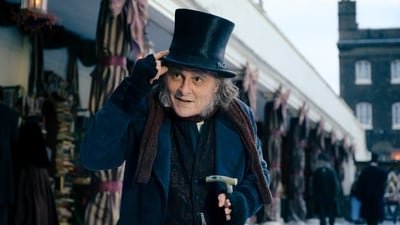
You’d think you have seen it all when it comes to Johnny Depp. From Edward Scissorhands to Sweeney Todd via Jack Sparrow, he has portrayed every shade of eccentricity imaginable. The last few years have been barren, largely due to the actor’s personal travails. But Ebenezer is his comeback, in more ways than one. And yet, despite having done it all, Depp finds a new shade, a new gear, and a new energy as Ebenezer Scrooge, literature’s most infamous miser. His performance elevates this feel-good Christmas flick beyond ‘watchable’, adding emotional weight and gravitas in a way only an artiste of his calibre can.
The premise
Based on Charles Dickens’ classic A Christmas Carol, the film is about Ebenezer Scrooge (Johnny Depp), the most miserable man in London. He runs a loan firm with his partner Marley (Ian McKellen) in a rather miserly fashion. Scrooge hates Christmas and dismisses do-gooders as charlatans. On one Christmas night, he is haunted by the ghost of his dead partner, then by the three spirits of Christmas past, present, and future, who show him various Christmases from his life and how he lost his way in the world. It is now up to Scrooge to learn from these ‘hauntings’ and mend his ways before he is condemned to a miserable afterlife.
A faithful adaptation seamlessly made for 2026
A Christmas Carol is the coming-of-age story. Granted, Scrooge comes of age rather late in life, but the original text is one of the best examples of character transformation. The film, thankfully, largely stays true to Dickens’ text. That means it retains the book’s pace, depth, and emotional weight, along with its signature humour. And whenever director Ti West and writer Nathaniel Halpert deviate, it is almost always for the better. Some deviations from the book are much needed to make the film palatable to a modern audience, while others are creative liberties. But none of them sticks out or derails the narrative. The tracks with Scrooge’s former fiancée Belle and his clerk Bob Cratchit (Rupert Grint) see the biggest changes, while a subplot involving Scrooge’s ignorance of working camps is also introduced. Credit to the makers, these feel very organic and only add to the story, never taking anything away from it.
The sequence in which Scrooge discovers what debtors’ prisons are like is particularly interesting. I don’t know if the makers intended it as a parallel to internment camps around the world, but it does seem apparent. It is the most unsubtle way the film highlights the contrast between the haves and have-nots, while also mocking the sheer ignorance of those sitting in society’s ivory towers. It may be set in Victorian England but is very much contemporary.
Johnny Depp, the master
There has never been any doubt about Johnny Depp’s acting skills. Ebenezer just proves that time away from the silver screen has not dulled his senses or diluted those skills. He still remains the master of misfits, playing difficult characters with unfathomable ease. He brings his own unique humour and dry delivery to Scrooge, and a good dose of physical comedy, making the character endearing right from the first frame. But where Depp truly shines is in the emotional scenes, one where he takes off the mask of Scrooge’s disdain and appears as a human being, letting his eyes and pitch-perfect voice do the trick. Ebenezer allows Johnny Depp to stretch those wings once again, and he shows he can still soar.
Ian McKellen, in a cameo, is his perfect partner-in-crime in the early scenes and then masterful when he haunts Scrooge. Rupert Grint is the other highlight as Bob Cratchit, bringing earnestness to a role that deserves it. Daisy Ridley springs a nice surprise with a delightful performance as well. But the scene-stealer is Tramell Tillman as Ghost of Christmas Present, almost outdoing Depp with his unpredictability and eccentricity.
Not a perfect film, but still engaging
There are faults in Ebenezer. For one, it makes this increasingly common mistake of hammering every point. If a character thinks something, they must say it out loud. If they see something, they must describe it. Whatever happened to letting the audience feel for themselves and deduce all this. This habit of filmmakers spoon-feeding the audience is a sign of the attention-deficit times we live in. But I live in the hope that fewer filmmakers will fall prey to it every year. For now, it remains a hope.
But despite that, Ebenezer remains a heartwarming story, one that touches you, tickles you, and teaches you without sermonising. And in the end, isn’t that engagement all that matters?