
Amazon CEO Andy Jassy has been with the company since 1997 and moved into his current role five years ago. On his first visit to India as chief executive, Jassy announced a further scale up in its investment and a ramp up of the quick commerce business to 300 cities. He also took time out for an interview with TOI. Excerpts:How have things moved in India for you since you took charge five years ago? What is the strategy going forward?It’s very exciting what’s been happening in India over the last five years as a country in general and then for us as a company investing in India. We’ve invested over $40 billion in India since 2010 and we’ll invest an additional $48 billion by 2030, including $13 billion we’re announcing now. We’re making a very substantial investment in India because we see our marketplace business continuing to grow at a very rapid rate. One of the things we’ve been excited about is the growth of quick commerce here, which has doubled every quarter. Prime members who use quick commerce are shopping three times as frequently as before they started using it. We’re also very encouraged by what we’re seeing in our AWS (Amazon Web Services) business. We have two regions, Mumbai and Hyderabad, and hundreds of thousands of customers in India. AI is growing very quickly, which is one of the reasons we just announced incremental investment. We’re increasing the amount of infrastructure and AI capabilities we have in India because it’s growing so quickly.
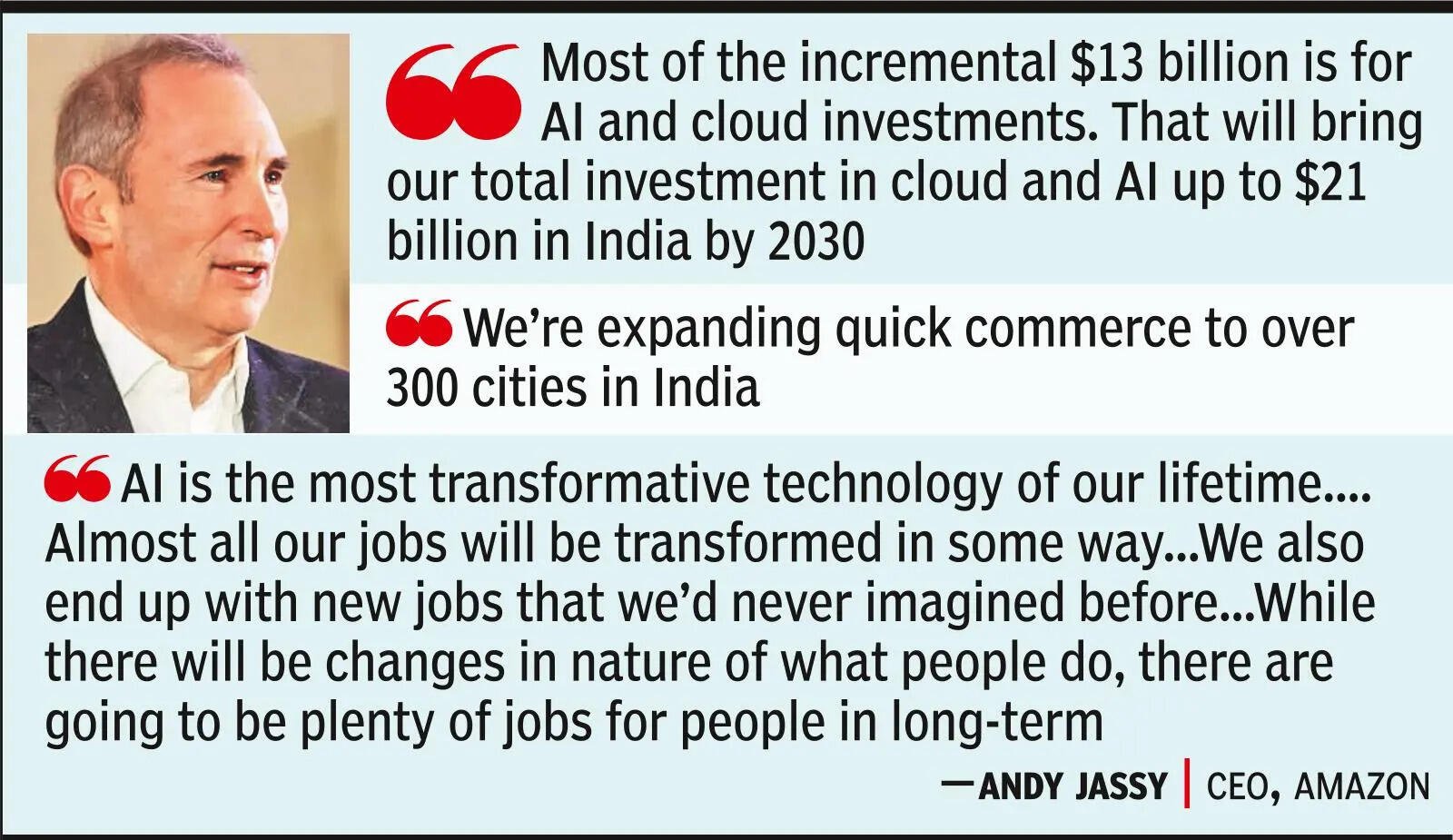
Increasingly Investing Substantial Amounts In AWS, Cloud & AI Biz: Amazon CEO Jassy
Can you help us understand how this $48 billion is going to be allocated across business segments?If you look at the combination of the $40 billion since 2010 and the incremental $48 billion through 2030, the largest absolute amount is still in our marketplace business. But, increasingly we’re investing very substantial amounts in AWS, cloud and AI businesses. Most of the incremental $13 billion is for our AI and cloud investments. That will bring our total investment in cloud and AI up to $21 billion in India by 2030.You are a late entrant to quick commerce. Did you miss the consumer pulse and will the quick ramp-up involve a lot of cash burn?If you look across our marketplace business, we have an unusual offering. We have focused really hard on having the broadest selection of items that get to people in the fastest amount of time. We also have a membership programme in Prime. If you look at the set of benefits, it’s a very differentiated offering. We started experimenting a few years ago with different forms of quick commerce. But a year ago, we found a format that really had resonance with customers. We have expanded it very quickly and just announced that we’re expanding quick commerce to over 300 cities in India.There’s this question of AI impacting jobs, especially in a country like India. How do you see that playing out, along with its impact on productivity?AI is the most transformative technology of our lifetime, which is saying a lot, given we’ve lived through the internet, mobile and cloud. Every customer experience we know will be changed by AI. Almost all our jobs will be transformed in some way and it can’t help but improve the productivity of virtually every job in virtually every country. What happens when you have these big transformative technology shifts is that the nature of what people spend their time on changes. We also end up with new jobs that we’d never imagined before. Fifteen to 20 years ago there was no such thing as a cloud architect and now you have tens of thousands of cloud architects. While there will be changes in the nature of what people do, there are going to be plenty of jobs for people in the long-term.In your letter to shareholders, you spoke about exploring plans to sell chips to third parties. What is the status? Also, given govt’s push towards semiconductors, does Amazon see a role in that space in India?For about 12 years, we’ve been designing our own chips. We did that because our customers are always demanding better prices and performance. Several years ago, we started designing our own custom silicon for AI, which we call Trainium, and it has about 30% better price performance than comparable AI accelerators. It’s now a $20-billion-plus annual revenue run-rate business. Most of the way we monetise our chips is by selling them as part of our compute offerings. If we sold all the chips to Amazon or third parties, it would be a $50-billion annual revenue run-rate business. The largest AI labs in the world, Anthropic and OpenAI, have made multi-year, multi-gigawatt commitments to our chips. We expect a lot of customers in India that consume those chips.There are reports about Amazon’s or your discomfort with the Anthropic models and your discussions with authorities in the US. Are they true?We’re at a stage in AI right now where the models are improving by such leaps and bounds and becoming so powerful that it’s natural that at different stages you may have some starts and stops. Model creators, infrastructure providers, cloud providers and all the companies want to have great models that allow them to change customer experiences and do so in a way that’s secure and cost-effective. Along the way, there are going to be different times where you keep adjusting what the guidelines are and how you operate with these models. But I’m very optimistic about it moving forward.