Angkrish Raghuvanshi slammed his bat on the ground, let out a roar in anger and then flung his helmet inside the Kolkata Knight Riders dugout at the Ekana Stadium on Sunday. In 19 years of IPL history, he became only the fourth batter to be dismissed for obstructing the field. The KKR youngster was far from convinced with the decision, and neither was the dugout, with players and support staff left shell-shocked as the incident unfolded.
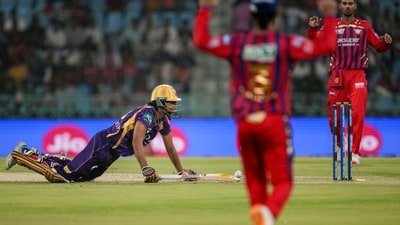
Raghuvanshi was seen having an animated exchange with the on-field umpire before walking off. Near the boundary rope, KKR head coach Abhishek Nayar was also spotted confronting the fourth umpire.
Unfortunately for KKR and Raghuvanshi, the third umpire was indeed correct.
What actually happened?
The incident took place on the final ball of the fifth over of KKR’s innings against the Lucknow Super Giants. Raghuvanshi pushed for a single after hitting a length delivery from Prince Yadav towards mid-on. Cameron Green, at the non-striker’s end, immediately turned it down.
ALSO READ: Ruturaj Gaikwad fronts up after CSK loss, makes honest call on his batting as commentators hold nothing back
Raghuvanshi halted, turned back and rushed to regain his ground, eventually diving towards the crease. Meanwhile, the fielder collected the ball and threw at the striker’s end , a throw that was blocked by Raghuvanshi during his dive.
Mohammed Shami appealed, and the on-field umpires referred it upstairs. After reviewing the replays, Raghuvanshi was adjudged out.
Why was Raghuvanshi given out?
According to Clause 37.1.4 of the IPL 2026 Playing Conditions:
“If a batter, in running between the wickets, significantly changes direction without probable cause and thereby obstructs a fielder’s attempt to effect a run out, the batter should, on appeal, be given out. It is irrelevant whether a run out would have occurred.”
The law hinges on two aspects , change of direction and probable cause. Third umpire Rohan Pandit focused strictly on these, avoiding any debate around “intent.”
Did he change direction? Yes. After playing the shot, Raghuvanshi moved across the pitch line. Once Green turned him back, he altered his path again while returning, ending up outside the natural running line before diving.
Was there probable cause? This is where it becomes clearer. Raghuvanshi had his eyes fixed on the fielder and the incoming throw before his dive, indicating awareness of the trajectory.
With both conditions satisfied, Pandit had little option but to rule him out.
What about intent? This is where the debate exploded , on social media and in the commentary box, with Daren Ganga among those questioning the call. Raghuvanshi and the KKR camp, including Nayar, were also seen arguing along similar lines.
But crucially, intent does not feature in the law.
In the end, whether Raghuvanshi intended to obstruct or not , or whether the throw would have hit the stumps , became irrelevant. The moment he changed his direction and came in line with the throw, the decision was effectively sealed.