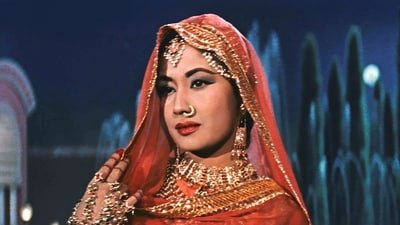
A 4K restored version of Meena Kumari-starrer 1972 classic Pakeezah is set to have its world premiere at Festival Lumiere in Lyon, France, and the BFI London Film Festival. The restoration on the movie, directed by Kamal Amrohi, was spearheaded by not-for-profit organisation Film Heritage Foundation, which spent two years to bring the film to its original glory.
About the premiere of Pakeezah
The world premiere in Lyon will be led by Cannes and Lumiere chief Thierry Frémaux.
From France, the film will travel to London for a gala screening at the BFI IMAX, that will be presented by FHF director Shivendra Singh Dungarpur alongside Amrohi’s children, Tajdar and Rukhsaar and grandson Bilal Amrohi.
Hailed by the late film critic Derek Malcolm as one of the most extraordinary musical melodramas ever made, Pakeezah boasts a legendary, production-plagued history that mirrors the high drama and heartbreak of its onscreen narrative.
More details
Dungarpur said restoring Pakeezah has been a long-held dream for him ever since he saw the movie as a child with his grandmother in a cinema hall in Dumraon, Bihar. He thanked Bilal for being the “moving spirit” behind the restoration work.
“The restoration of ‘Pakeezah’ took two years. It has been one of the most exciting yet one of the most challenging restorations I have worked on. When I went to inspect the original camera negative and saw that it had almost melted, my heart sank.
“And the other film elements we had to work with were not in good condition with faded colours, scratches and mould… I wondered how I would be able to restore Kamal Amrohi’s original vision with what I had to work with,” Dungerpur said in a statement.
During their research, the FHF team discovered original film stills which helped in restoration. Dungerpur also consulted Kamal Amrohi’s children — son Tajdar and daughter Rukhsaar — who had visited the sets and had vivid memories from the making of the film. “I couldn’t have asked for a better showcase for the restored ‘Pakeezah’ than the Festival Lumiere in Lyon, the birthplace of cinema followed by a gala screening at the London Film Festival,” Dungerpur said.
The restoration, spearheaded by FHF in association with the Amrohi family, caps a historic year for the foundation on the international festival circuit. FHF has achieved the rare feat of placing a restored classic at every major global film festival over the past 12 months, including Berlin (In Which Annie Gives It Those Ones), Cannes (Amma Ariyan) and Venice (English, August).
Tajdar Amrohi recalled memories of attending the grand premiere of the movie in 1972 with his father and “Choti Ammi” (Kumari) when the film cans arrived at Maratha Mandir in a palanquin.
“I never imagined that I would be presenting the restored film with my family at the gala premiere in London fifty-four years later. I would like to thank Shivendra Singh Dungarpur and Film Heritage Foundation for restoring the film with so much passion and meticulous care and for bringing my father and his greatest work back to life so that new generations will see the unforgettable Meena Kumari and enjoy the beauty of the film.
“I remember when I was a child, my father was deep into the making of ‘Pakeezah’. Everything in our lives revolved around ‘Pakeezah’. My father had put in everything he had in the film and whenever we asked him for anything as children, his response would always be, “After Pakeezah.” Pakeezah was his life’s mission,” Tajdar said in a statement, recalling his set visits on Floor No. 3 at Filmistan where most of the film was shot.
Rukhsaar Amrohi said Pakeezah was her father’s “obsession, dream, oxygen” that gave meaning to his life. “No one else could have played the role of Pakeezah, but Choti Ammi (Meena Kumari). She was ‘Pakeezah’. My father nurtured the film for over fifteen years like a child…”
Conceptualised in the mid-1950s as a tribute to the beauty of Amrohi’s wife and muse, Meena Kumari, the project spent a gruelling 15 years production hell. Filming began in black-and-white in 1956 before shifting to Eastmancolor in 1958, shot by acclaimed German cinematographer Josef Wirsching.
About the film
The story of Pakeezah is set during the twilight era of nawabs in Lucknow. Meena Kumari played the dual roles of courtesan Nargis and her daughter Sahibjaan.
Production on the movie went through several hurdles due to casting shifts, script revisions, and Amrohi’s obsessive perfectionism. A studio fire also destroyed a portion of the original black-and-white negatives, the release by FHF stated.
The work on the film stalled completely by 1964, when Amrohi and Kumari separated due to personal differences. Kumari subsequently descended into severe alcoholism and was diagnosed with liver cirrhosis in 1968.
It was revived when Sunil Dutt and Nargis saw the footage of the movie in 1969 and convinced Kumari, who was ill at the time, to complete her life’s work. Pakeezah finally released in theatres on February 4, 1972. Kumari, who had been diagnosed with liver cirrhosis in 1968, passed away on March 31, 1972.
Propelled by Kumari tragic death at the age of 38 and overwhelming critical acclaim, the film became a box office sensation.