
Many times, human actions surpass their simplicity of tradition to evolve into a climate hazard. This is what happened in Northern Ireland’s Giant’s Causeway, where people have been placing coins in the cracks between the basalt columns in order to invite good luck.Recently, the National Trust had to remove more than 20 kilos of coins from the cracks of the 60 million year old formation, some 10,000 pieces that visitors had been wedging in between the rocks, which were breaking the rock from within. The World Heritage Site is maintained by the conservation organisation. “It’s a relief; the coins were causing considerable damage,” said Cliff Henry, their nature outreach officer, according to a report by Vozpopuli15.The problem with the coin was not the aesthetics but the climate. “These coins were oxidising and expanding and they were able to press against the entire column of rock above them, pushing it upwards,” explained Henry. The basalt was fracturing and disintegrating right next to these joints.According to a report by the Geological Survey of Northern Ireland, this is due to the “expansive delamination of the coins as they oxidise.” Henry explained it like this: “They oxidize and expand to three times their original thickness, putting enormous pressure on the surrounding rock and causing it to crumble.”The expert also blamed the formation of the coins for this. They “have a core of one metal with a thin coating of another,” which led the entire sections of dark stones to be coated in orange rust. “UK ‘copper’ coins, since 1992, have a steel core with only a thin layer of copper on the outside, while 5, 10 and 20 pence pieces are nickel-plated steel. When coins start to corrode, the steel often corrodes faster and separates from the different metal of the outer layer. This delamination causes the basalt to flake. The coins here also have accelerated corrosion because they are often soaked in saltwater spray and the mixture of metals means they break down faster,” he added.
The extraction process
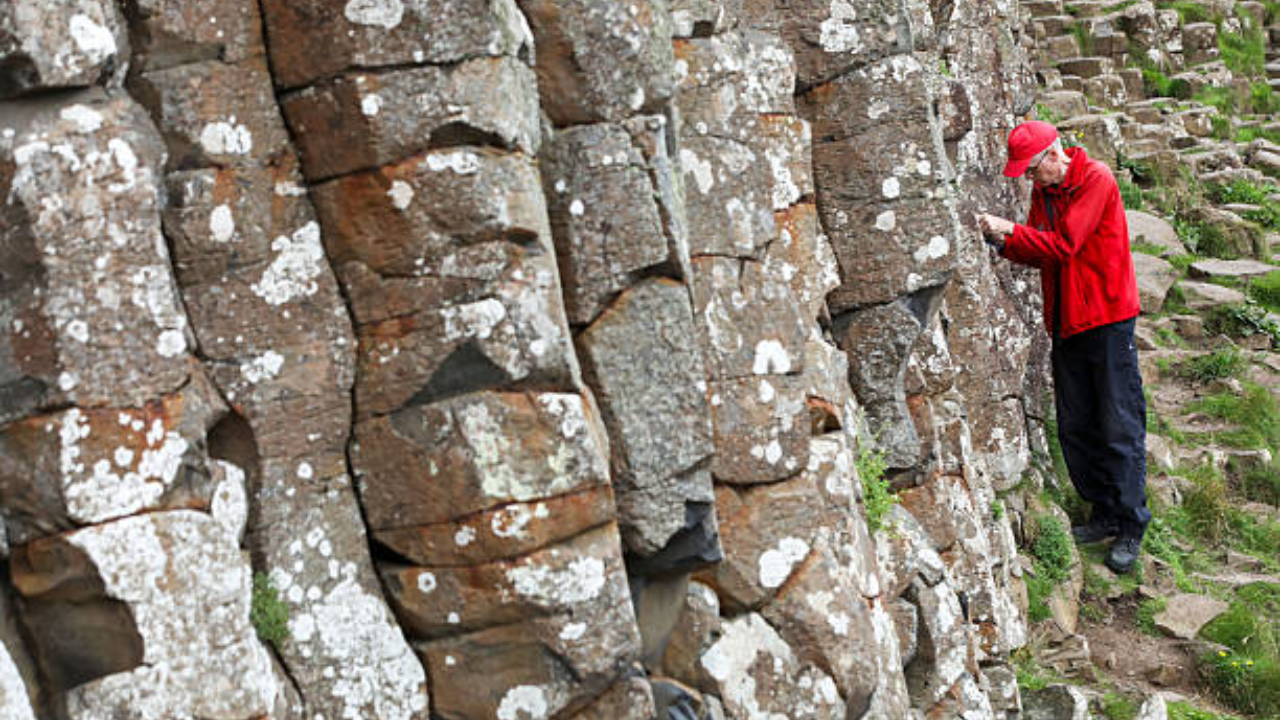
Visitors are advised to put their money in a donation box
The entire removal process took nearly 200 hours and was carried out by Nathan Morrow, a stonemason specialising in stone conservation. While pliers were sufficient for the stones along the edge, in areas where visitors had hammered in the coins, a repointing tool had to be used, extremely carefully so as to not damage the edge of the column they were trying to save in the first place.But no one method always worked. Some coins came loose in seconds, while others resisted for more than twenty minutes. “Some were quite firmly embedded,” Henry recounted: “He discovered that if he could move them a little, by working them back and forth he would eventually get them out.”
What should visitors do now when they visit Giant’s Causeway?
In 2024, some 684,000 visitors passed over those same 40,000 basalt columns, formed about 60 million years ago when the lava cooled and contracted. The causeway is said by legend to have been created by the giant Finn McCool and is one of Antrim’s most loved landmarks. The dramatic rock exposures and columnar jointing have helped scientists study and understand ancient volcanic activity and earth sciences for over 300 years. Due to its universal value for exceptional geological phenomena and striking natural beauty, the site was declared a UNESCO World Heritage Site in 1986, the first in Northern Ireland.A three-second gesture, repeated thousands of times a year, ends up leaving its mark on the stone. Most coins are from the UK or the Euro-zone, but others are from the far east, USA or elsewhere. “We know that some people want to leave a mark of their visit, but the coins are causing harm and we ask people to stop this practice,” said Henry. Along the most damaged sections, new signs have been posted, and the message is repeated on the organization’s social media. Those who wish to leave something behind are offered another option: to put their money in a donation box, where it will actually be used for something.The coins are still embedded in the stone and completing the cleanup will cost over £30,000. Still, the task will only be complete if people finally stop putting the coins between the joints. Of those already extracted, barely 5% are usable again: the rest are too bent or corroded to even be exchanged.